Acupuncture for Back Pain in Santa Clara: What Patients Often Ask
Research-supported, patient-centered information about acupuncture for low-back pain, what treatment may involve, and how progress can be measured.
Back pain can make simple things feel harder than they should—getting out of bed, sitting at work, driving, exercising, sleeping comfortably, or simply enjoying your normal routine.
If you are looking for a non-drug option for back pain, acupuncture is one treatment worth considering.
The encouraging news is that research supports acupuncture as a useful option for many people with back pain, particularly chronic low-back pain. The goal is not simply to lower a pain number. Good treatment should also help you move more comfortably, function better, sleep better, return to work or activity, and feel more confident about your recovery.
At ACE California Health Clinic in Santa Clara, patients commonly ask:
- Can acupuncture really help back pain?
- How does acupuncture work?
- What does the research say?
- Is acupuncture safe?
- Does it hurt?
- How many treatments will I need?
- Can acupuncture be combined with chiropractic care or rehabilitation?
- What happens at the first visit?
This article answers those questions from a patient point of view.
The short answer
1-page visual summary
Key patient questions, evidence, safety, and progress tracking at a glance.
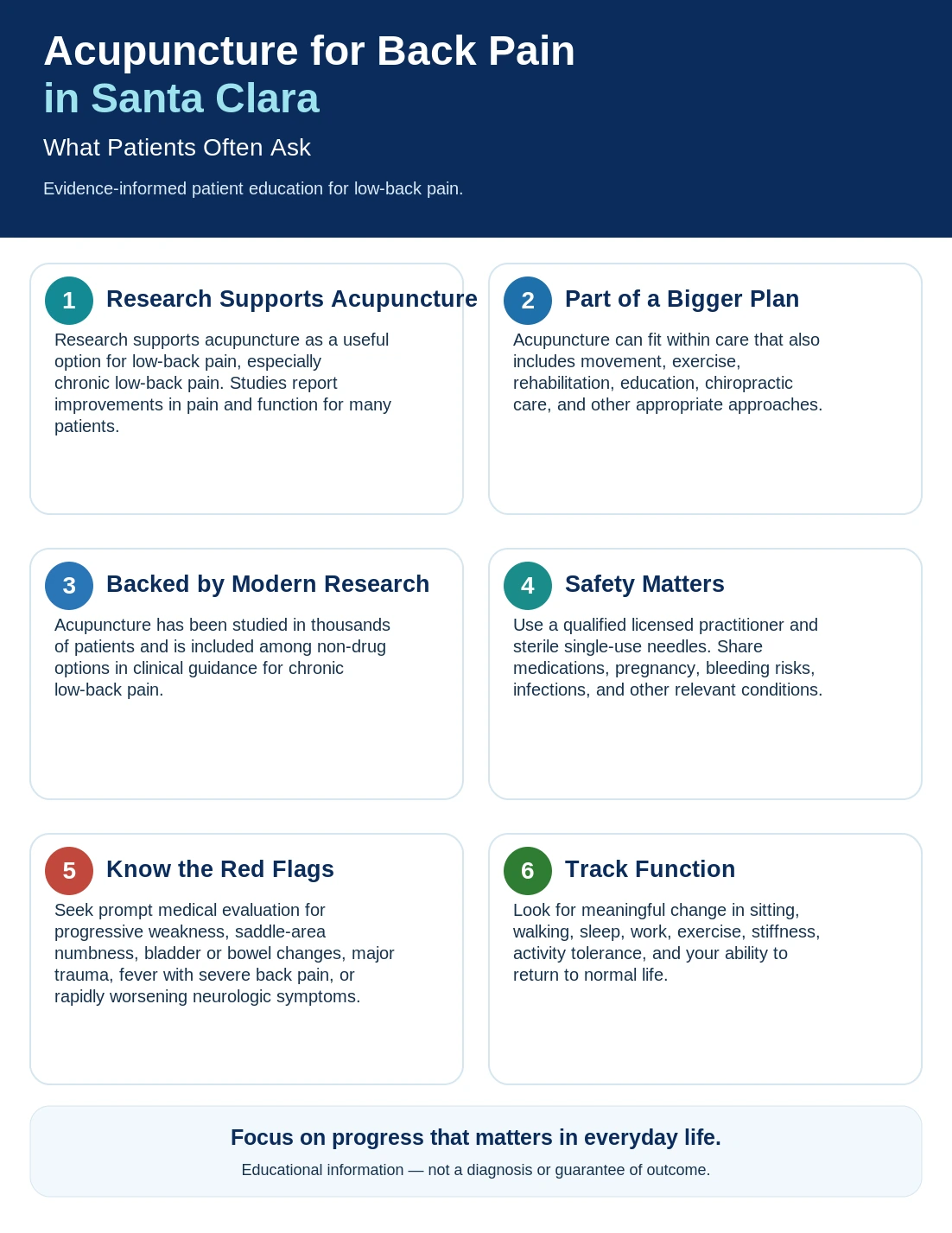
Yes—acupuncture can be a helpful treatment option for back pain, particularly chronic low-back pain.
Acupuncture has been studied extensively as a non-drug approach to pain. Research has found benefits in pain and function for many patients, and acupuncture is included among the non-drug treatment options recommended in clinical guidance for chronic low-back pain.
That does not mean every patient will respond the same way or that acupuncture should be the only treatment used.
Instead, acupuncture can be one part of an individualized treatment plan designed around an important question:
What will help you function better in everyday life?
That might mean:
- getting out of bed with less discomfort
- sitting longer at work
- walking more comfortably
- driving without constantly shifting positions
- sleeping better
- returning to exercise
- feeling less stiffness
- getting through the workday more comfortably
For many patients, improvements like these matter just as much as a change in the pain scale.
Why so many people with back pain consider acupuncture
Most people do not investigate acupuncture simply because they are curious.
They are looking for relief.
Some have experienced recurring back pain for months or years. Others want to avoid relying only on medication. Some have tried one form of treatment and are looking for another approach that can complement what they are already doing.
Patients commonly consider acupuncture when they want:
- a non-drug approach to pain management
- help with chronic or recurring back pain
- less muscle tension or stiffness
- support alongside exercise or rehabilitation
- another conservative treatment option
- care tailored to their individual symptoms and goals
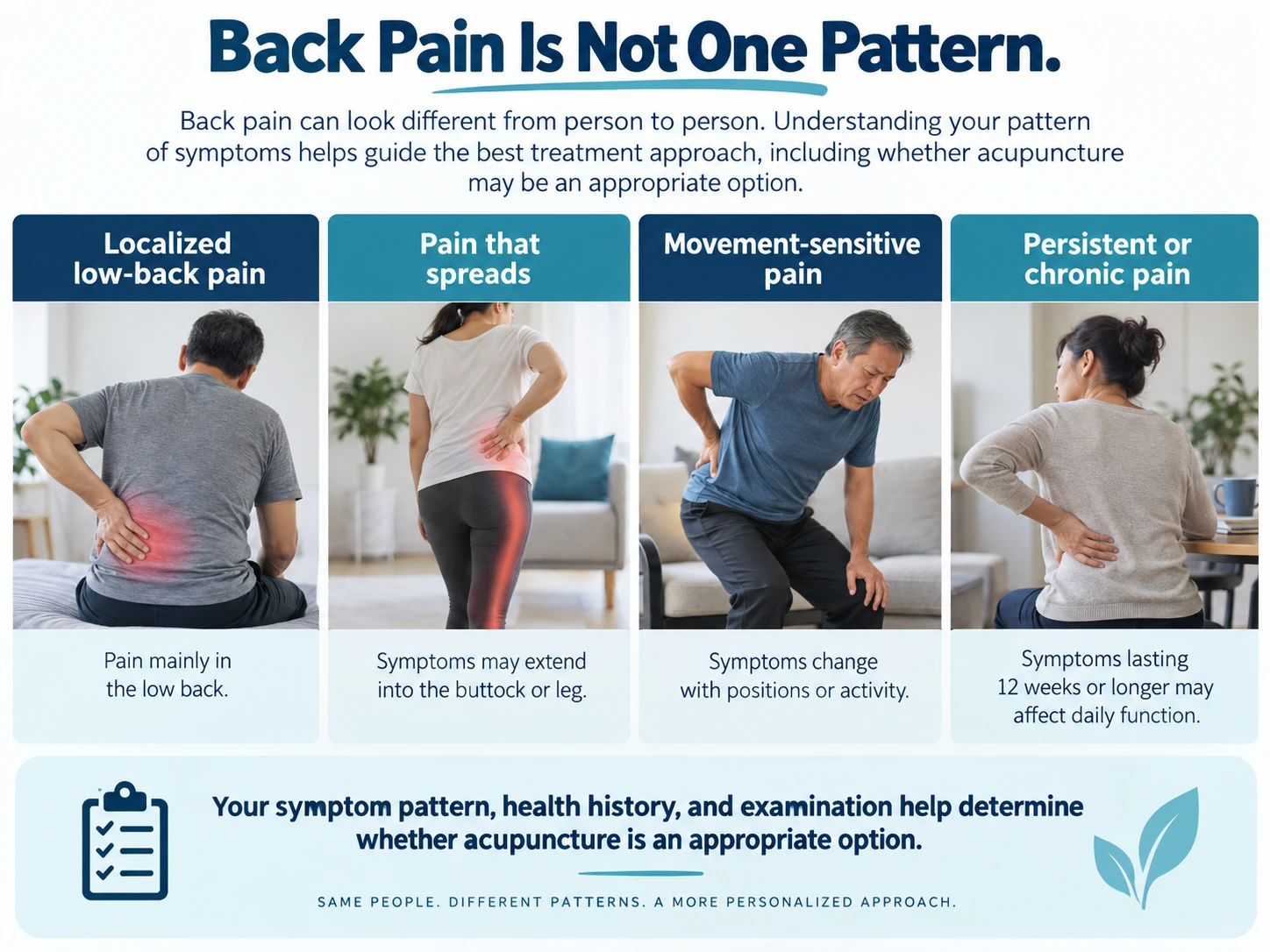
Back pain is also not always caused by one simple issue.
Pain may involve a combination of muscle tension, joint irritation, movement restriction, nervous-system sensitivity, weakness, poor movement patterns, prolonged sitting, repetitive activity, sleep disruption, or other contributing factors.
That is why an individualized evaluation can be more useful than treating every person with back pain exactly the same way.
Acupuncture has a long history—but modern evidence matters too
Acupuncture has a long history within East Asian medicine and has evolved over many centuries.
Its continued use across different cultures and generations tells us that patients and practitioners have continued to find value in the treatment.
But history by itself does not prove that a medical treatment works.
That is why modern research is important.
Today, acupuncture is no longer evaluated only as a traditional practice. It has been examined in controlled clinical studies, systematic reviews, pain-management research, and clinical guidelines.
The National Center for Complementary and Integrative Health (NCCIH) reports that research supports acupuncture as helpful for low-back pain, with stronger evidence for chronic low-back pain.
A large evaluation cited by NCCIH reviewed 49 acupuncture studies involving more than 7,900 participants and found evidence of benefit for both acute and chronic low-back pain, with greater support for chronic low-back pain.
The American College of Physicians has also included acupuncture among the non-drug treatment options for chronic low-back pain.
So there are two different parts of acupuncture's story:
Its history shows its long-standing place in healthcare. Modern clinical research helps us understand where and how it may benefit patients today.
What does the evidence say about acupuncture for back pain?
From a patient's perspective, the question is usually straightforward:
Does acupuncture work well enough to be worth considering?
For many people with low-back pain, especially chronic low-back pain, the evidence says it can be.
Research reviewed by NCCIH has found that acupuncture can provide improvements in pain and function compared with no acupuncture treatment, and some research has also found benefits when acupuncture is compared with simulated acupuncture or usual care.
The evidence is particularly relevant for chronic low-back pain, generally meaning pain that has continued for 12 weeks or longer.
The American College of Physicians clinical guideline recommends initially considering non-drug therapies for chronic low-back pain. Those options include treatments such as:
- exercise
- multidisciplinary rehabilitation
- acupuncture
- mindfulness-based stress reduction
- motor-control exercise
- yoga
- tai chi
- spinal manipulation
- other appropriate non-drug approaches
That is important because it places acupuncture within a much larger modern movement toward helping patients manage back pain through effective conservative and non-drug options whenever appropriate.
How acupuncture may help with back pain
Patients often ask:
“What is acupuncture actually doing?”
Scientists are still studying all of the biological mechanisms involved, but research suggests acupuncture may influence several systems related to pain.
1. It may influence pain signaling
Acupuncture can stimulate nerves and influence the way pain signals are processed by the nervous system.
This may be particularly useful when pain has persisted for a long time and the nervous system has become more sensitive to painful input.
2. It may help reduce muscle tension and guarding
Back pain often causes muscles to tighten protectively.
Unfortunately, persistent guarding can make movement more uncomfortable and contribute to stiffness.
For some patients, acupuncture may help reduce this feeling of tension and make movement easier.
3. It may stimulate local physiological responses
Needle stimulation produces local responses in the tissues being treated and interacts with the body's nervous system.
These responses are among the mechanisms researchers continue to study in relation to pain modulation and recovery.
4. It may make movement more comfortable
For many patients, the most important result is not simply reporting “less pain.”
It is being able to:
- bend more comfortably
- sit longer
- stand longer
- walk farther
- sleep better
- return to work
- participate in exercise or rehabilitation
Reducing discomfort can sometimes make it easier for a patient to become active again and participate in the other parts of recovery.
5. It may help interrupt the pain-tension-stress cycle
Pain, muscle tension, stress, poor sleep, and reduced activity can reinforce one another.
Some patients find acupuncture sessions relaxing and report feeling less guarded or tense afterward.
That can be particularly valuable when persistent pain has started affecting sleep, activity, work, or quality of life.
The goal is more than pain relief
At ACE California Health Clinic, an important question is not only:
“How much does it hurt?”
We also want to know:
“What is the pain preventing you from doing?”
Back pain becomes a significant problem when it begins interfering with normal life.
Patients may notice:
- difficulty sitting through a workday
- discomfort while driving
- trouble bending or lifting
- interrupted sleep
- difficulty exercising
- reduced walking tolerance
- stiffness after prolonged sitting
- difficulty getting up in the morning
- fear of aggravating the back again
For that reason, progress should be evaluated not only by pain intensity but also by improvements in movement and function.
If you can sit longer, walk more comfortably, sleep better, return to exercise, or work with less irritation, those are meaningful signs of progress.
An integrated approach to back pain at ACE California Health Clinic
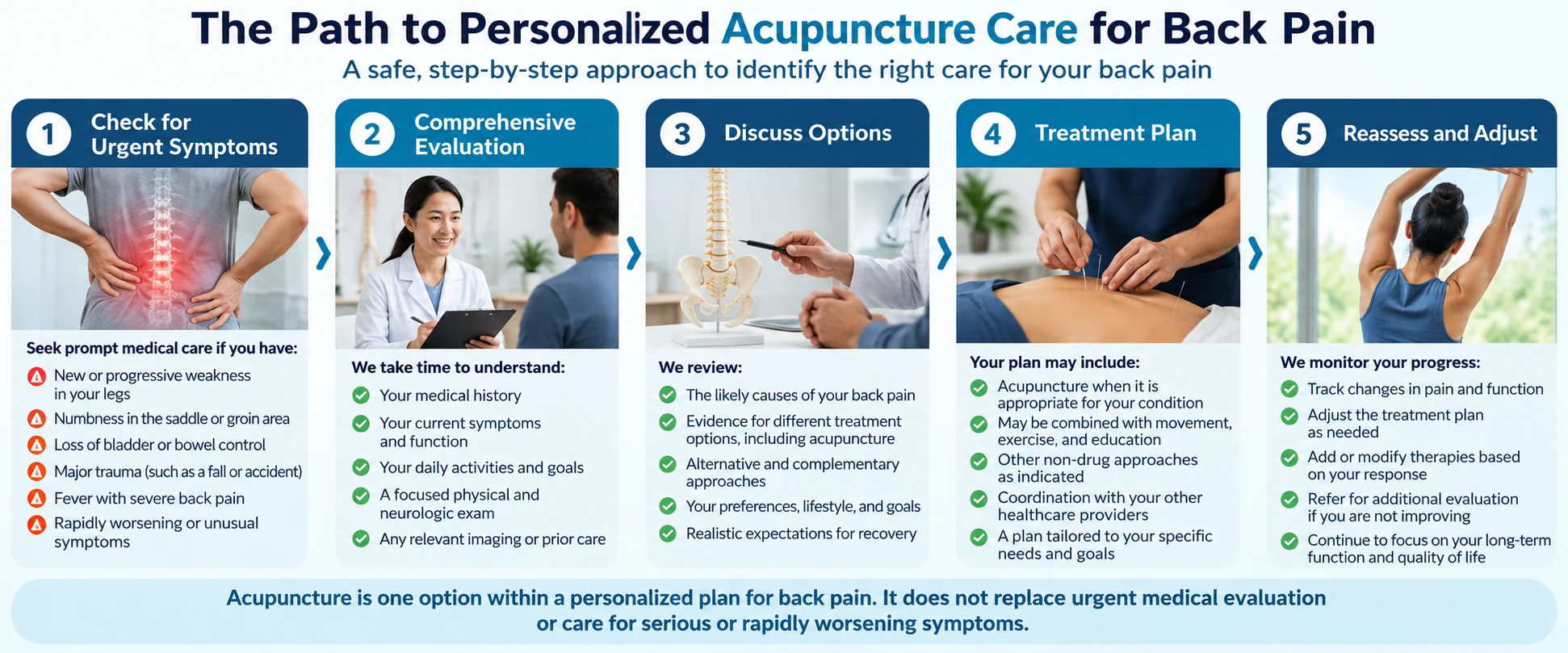
One advantage of receiving care at ACE California Health Clinic is that acupuncture does not have to exist by itself.
Depending on the patient's condition and examination findings, care may incorporate different conservative approaches.
These may include:
- acupuncture
- chiropractic care
- corrective exercise and rehabilitation
- soft-tissue treatment
- mobility work
- stretching or strengthening
- posture and ergonomic recommendations
- activity modification and home-care strategies
This does not mean every patient needs every treatment.
The purpose of having multiple treatment options is exactly the opposite.
It allows care to be individualized.
One patient may primarily benefit from acupuncture. Another may need acupuncture combined with rehabilitation. Another may require more emphasis on mobility, strengthening, chiropractic care, ergonomic changes, or self-management.
The treatment plan should follow the patient—not force every patient into the same treatment plan.
Why acupuncture and rehabilitation can complement each other
Acupuncture and exercise can serve different purposes within a recovery plan.
For example, a patient may initially have enough pain or muscle guarding that certain movements are difficult.
If treatment helps make movement more comfortable, the patient may then be better able to participate in:
- mobility exercises
- strengthening
- corrective exercise
- walking
- home exercise
- gradual return to normal activities
Over time, rehabilitation can address strength, movement tolerance, conditioning, and other factors important for longer-term function.
This is why we often think about back pain as a recovery process, rather than simply a painful spot that needs to be treated.
Who may want to consider acupuncture?
Acupuncture may be worth discussing if:
- your low-back pain keeps returning
- your back frequently feels tight or stiff
- pain has persisted for several weeks or months
- sitting or driving aggravates your symptoms
- back pain interferes with work or sleep
- you want a non-drug treatment option
- you are already exercising or undergoing rehabilitation but want additional support
- you want to explore conservative treatment before considering more invasive options
- you prefer an individualized treatment plan
Some people begin acupuncture relatively early.
Others come in after dealing with recurring symptoms for a long time.
There is no single correct point at which everyone must begin treatment.
The important question is whether acupuncture is appropriate for your condition, symptoms, health history, and goals.
What happens at your first acupuncture visit?
Many people become much more comfortable with acupuncture once they know what to expect.
A first visit at ACE California Health Clinic typically begins with an evaluation rather than simply starting treatment immediately.
We discuss your symptoms
You may be asked:
- Where is your pain?
- When did it begin?
- Was there an injury?
- What makes the pain better?
- What makes it worse?
- Does the pain travel into the buttock or leg?
- Do you have numbness or tingling?
- How does the problem affect work?
- Does it disturb your sleep?
- What activities have become difficult?
- What treatments have you already tried?
We review your health history
Your medical history helps determine whether acupuncture is appropriate and whether any precautions are necessary.
We perform an appropriate examination
Depending on the problem, this may include evaluating:
- posture
- movement
- range of motion
- areas of tenderness
- functional limitations
- related orthopedic or neurological findings when appropriate
We discuss a treatment plan
Treatment should have a purpose.
We may discuss:
- what we think is contributing to your symptoms
- whether acupuncture is appropriate
- what improvement we are looking for
- whether exercise or rehabilitation may help
- what you can do at home
- how progress will be monitored
Then treatment begins when appropriate
Acupuncture uses very fine, sterile, single-use needles placed at selected treatment points.
Many first-time patients are surprised by how gentle acupuncture feels.
Some people feel almost nothing when a needle is inserted.
Others may notice:
- a mild ache
- heaviness
- warmth
- tingling
- pressure
- relaxation
Patients then typically rest with the needles in place for a period of time.
Many patients describe the treatment itself as relaxing.
Does acupuncture hurt?
This is one of the most common questions we hear.
For most patients, acupuncture is considerably more comfortable than they expected.
Acupuncture needles are extremely thin and are very different from the larger hollow needles used for injections or blood draws.
You may notice a brief sensation when a needle is placed, followed by sensations such as mild heaviness, warmth, tingling, or a dull ache.
Some patients barely feel the needles at all.
The treatment should always be performed with attention to your comfort.
If something feels uncomfortable, tell your practitioner.
Is acupuncture safe?
When performed appropriately by a qualified licensed practitioner, acupuncture has a good safety record.
The U.S. Food and Drug Administration regulates acupuncture needles as medical devices and requires them to be sterile and labeled for single use.
As with any medical treatment, acupuncture is not completely risk-free.
That is why your health history matters.
Before treatment, tell your provider about important health considerations, including:
- pregnancy
- bleeding disorders
- medications, particularly blood-thinning medications
- implanted medical devices
- infections or skin problems
- recent surgery
- other significant medical conditions
Good care begins with determining whether the treatment is appropriate for the individual patient.
How many acupuncture treatments will I need?
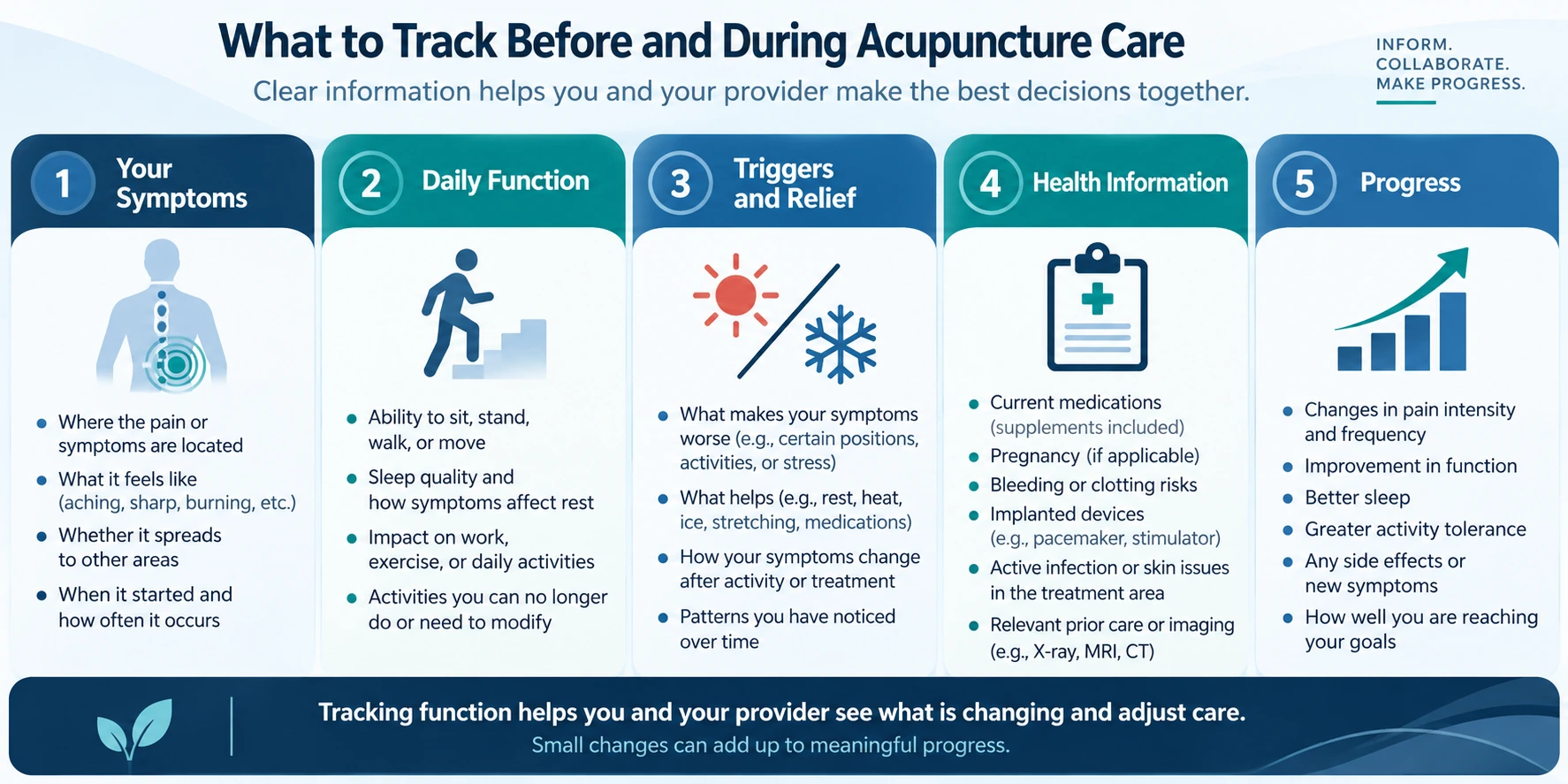
There is no universal number.
Back pain varies considerably from one person to another.
A person who developed discomfort recently after prolonged sitting may have a very different situation from someone who has experienced recurring low-back pain for several years.
Factors that can affect treatment planning include:
- how long the problem has been present
- severity of symptoms
- how frequently symptoms occur
- physical examination findings
- daily activities and work demands
- general health
- previous injuries
- response to treatment
- rehabilitation needs
Some patients notice changes relatively quickly.
Others improve more gradually.
Instead of focusing only on an exact number of visits, we believe it is useful to repeatedly ask:
- Is the pain changing?
- Is movement becoming easier?
- Am I sitting longer?
- Am I walking better?
- Am I sleeping more comfortably?
- Can I do more than I could before?
- Is treatment moving me toward my goals?
If the patient is not progressing as expected, the treatment plan should be reconsidered.
Acupuncture does not have to stand alone
One of acupuncture's strengths is that it can fit into a broader conservative treatment program.
Depending on the individual patient, that program may include:
- exercise
- rehabilitation
- mobility training
- chiropractic care
- strengthening
- ergonomic changes
- activity modification
- education
- home care
- gradual return to activity
For many people, the goal is not simply to feel better temporarily.
The larger goal is to move better, function better, become more active, and reduce the disruption that back pain causes in everyday life.
When back pain needs prompt medical evaluation
Most back pain does not represent a medical emergency.
However, certain symptoms should not simply be treated as routine back pain.
Seek prompt medical evaluation if you experience symptoms such as:
- new or progressive leg weakness
- numbness involving the groin or saddle area
- loss of bladder or bowel control
- significant trauma
- fever associated with severe back pain
- rapidly worsening symptoms
- other severe or unusual neurological symptoms
These situations deserve timely medical evaluation.
Acupuncture can be an excellent part of conservative care when appropriate, but it should never replace necessary evaluation of warning signs.
Questions to ask when choosing an acupuncturist in Santa Clara
If you are considering acupuncture for back pain, it is reasonable to ask:
- Is the practitioner licensed?
- Does the clinic regularly treat patients with back pain?
- Will my condition be evaluated before treatment begins?
- How will the treatment plan be individualized?
- How will progress be measured?
- Can acupuncture be combined with rehabilitation or other conservative care if appropriate?
- What should I expect after treatment?
- What happens if I am not improving?
Good healthcare should make you feel informed—not pressured.
You should understand what is being recommended and why.
A practical way to think about acupuncture
Acupuncture does not need to be viewed as a choice between ancient medicine and modern medicine.
Its history and modern evidence tell us different things.
Its long history shows that acupuncture has remained an important therapeutic practice across generations and cultures.
Modern research allows us to evaluate its effectiveness using contemporary scientific methods.
For back pain—particularly chronic low-back pain—the research is encouraging enough that acupuncture is now included among recognized non-drug treatment options.
That does not make acupuncture a miracle treatment.
It makes it a reasonable, evidence-supported option worth considering for appropriate patients.
For someone living with persistent back discomfort, stiffness, or reduced function, that can be an important option to have.
Acupuncture for back pain at ACE California Health Clinic
At ACE California Health Clinic in Santa Clara, our goal is not simply to treat a painful location.
We want to understand:
- what you are experiencing
- how the problem affects your daily life
- what movements or activities are difficult
- what you have already tried
- what your treatment goals are
- which conservative treatment options may be appropriate
Because ACE California Health Clinic offers acupuncture as well as chiropractic care, physiotherapy/corrective exercise and rehabilitation, and supportive soft-tissue treatment, care can be adapted to the needs of the individual patient.
Some patients may primarily need acupuncture.
Others may benefit from a combination of treatment and rehabilitation.
The goal is always the same:
Help you reduce pain, improve function, move more comfortably, and get back to the activities that matter to you.
Final thoughts
Back pain can gradually interfere with almost every part of life.
It can affect how you work, sleep, drive, exercise, travel, and spend time with your family.
Fortunately, medication is not the only option.
Acupuncture has a long history of clinical use, and modern research supports its role as a non-drug treatment option for many people with back pain, particularly chronic low-back pain.
When acupuncture is combined appropriately with movement, rehabilitation, education, and other conservative care, it can become part of a broader strategy for helping patients recover function and return to normal activity.
If you are looking for acupuncture for back pain in Santa Clara, an evaluation can help determine whether acupuncture—or a combination of conservative treatments—may be appropriate for you.
ACE California Health Clinic
345 Saratoga Ave.
Santa Clara, CA 95050
Phone: 408-984-6000
Call ACE California Health Clinic to schedule an evaluation and discuss whether acupuncture may be appropriate for your back pain.
Frequently Asked Questions
Can acupuncture really help back pain?
Yes. Research indicates that acupuncture can help some people with low-back pain, particularly chronic low-back pain. Studies have found improvements in pain and function, and acupuncture is included in clinical guidance among non-drug treatment options for chronic low-back pain.
Is acupuncture a proven treatment for back pain?
Acupuncture has been studied in thousands of patients with low-back pain. Research summarized by the National Center for Complementary and Integrative Health supports its benefit, particularly for chronic low-back pain. The American College of Physicians has also included acupuncture among recommended non-drug options for chronic low-back pain.
Does the long history of acupuncture prove that it works?
No treatment should be considered effective simply because it has existed for a long time. Acupuncture's long history demonstrates its enduring role in healthcare. Its effectiveness for modern patients should be evaluated using modern clinical research—and research on low-back pain provides evidence supporting its use in appropriate patients.
How does acupuncture work for back pain?
Acupuncture may influence nervous-system pain processing, stimulate local physiological responses, and help reduce muscle tension or guarding. Researchers continue to study the exact mechanisms involved.
Is acupuncture safe?
Acupuncture has a good safety record when performed appropriately by a qualified licensed practitioner. Sterile, single-use needles should be used for treatment.
Does acupuncture hurt?
Most patients find acupuncture much more comfortable than they expected. The needles are extremely thin. Some patients feel almost nothing, while others notice a mild ache, pressure, warmth, heaviness, or tingling.
How many acupuncture sessions will I need?
There is no single number that applies to everyone. Treatment depends on your condition, how long symptoms have been present, examination findings, treatment goals, and how you respond. Progress should be reassessed based on pain, movement, function, and activity tolerance.
Can acupuncture be combined with chiropractic care?
Yes, when clinically appropriate. At ACE California Health Clinic, acupuncture may be used alone or as part of a broader conservative treatment plan that can include chiropractic care, corrective exercise, rehabilitation, mobility work, and other supportive care.
Can acupuncture be combined with exercise or rehabilitation?
Yes. In many cases, reducing pain and muscle guarding can make it easier for a patient to participate in movement, exercise, and rehabilitation. The combination should be individualized to the patient's condition and goals.
When should I see someone about my back pain?
Consider an evaluation when back pain persists, repeatedly returns, limits your activities, affects sleep or work, or causes concern. Seek prompt medical attention for symptoms such as progressive weakness, saddle-area numbness, loss of bladder or bowel control, significant trauma, fever with severe back pain, or rapidly worsening neurological symptoms.
References
- NCCIH — Low-Back Pain and Complementary Health Approaches
- NCCIH — Acupuncture: Effectiveness and Safety
- American College of Physicians — Nonradicular Low Back Pain Guideline
- 2025 systematic review/meta-analysis — acupuncture vs usual care for chronic low back pain
- California Acupuncture Board — Consumer FAQs
- CMS — Acupuncture for Chronic Low Back Pain NCD
- ACR Appropriateness Criteria — Low Back Pain
- NICE — Suspected neurological conditions, cauda equina referral
- ACE California Health Clinic — Acupuncture
Medical disclaimer: This article is provided for general educational purposes and does not replace an individual examination, medical diagnosis, or personalized treatment plan. Treatment recommendations depend on each patient's history, symptoms, examination findings, and individual circumstances.
Considering acupuncture for back pain?
ACE California Health Clinic provides acupuncture, chiropractic care, and rehabilitation services in Santa Clara. Call 408-984-6000 to discuss an evaluation.