
What is De Quervain’s tenosynovitis?
De Quervain’s tenosynovitis (also called De Quervain’s tendinopathy) affects the abductor pollicis longus (APL) and extensor pollicis brevis (EPB) tendons. These tendons help move the thumb and travel together through a narrow passage called the first dorsal compartment near the radial styloid, the bony bump on the thumb side of your wrist. When tissues around the tendons thicken and become irritated, everyday thumb and wrist movement can hurt. [1] [2]
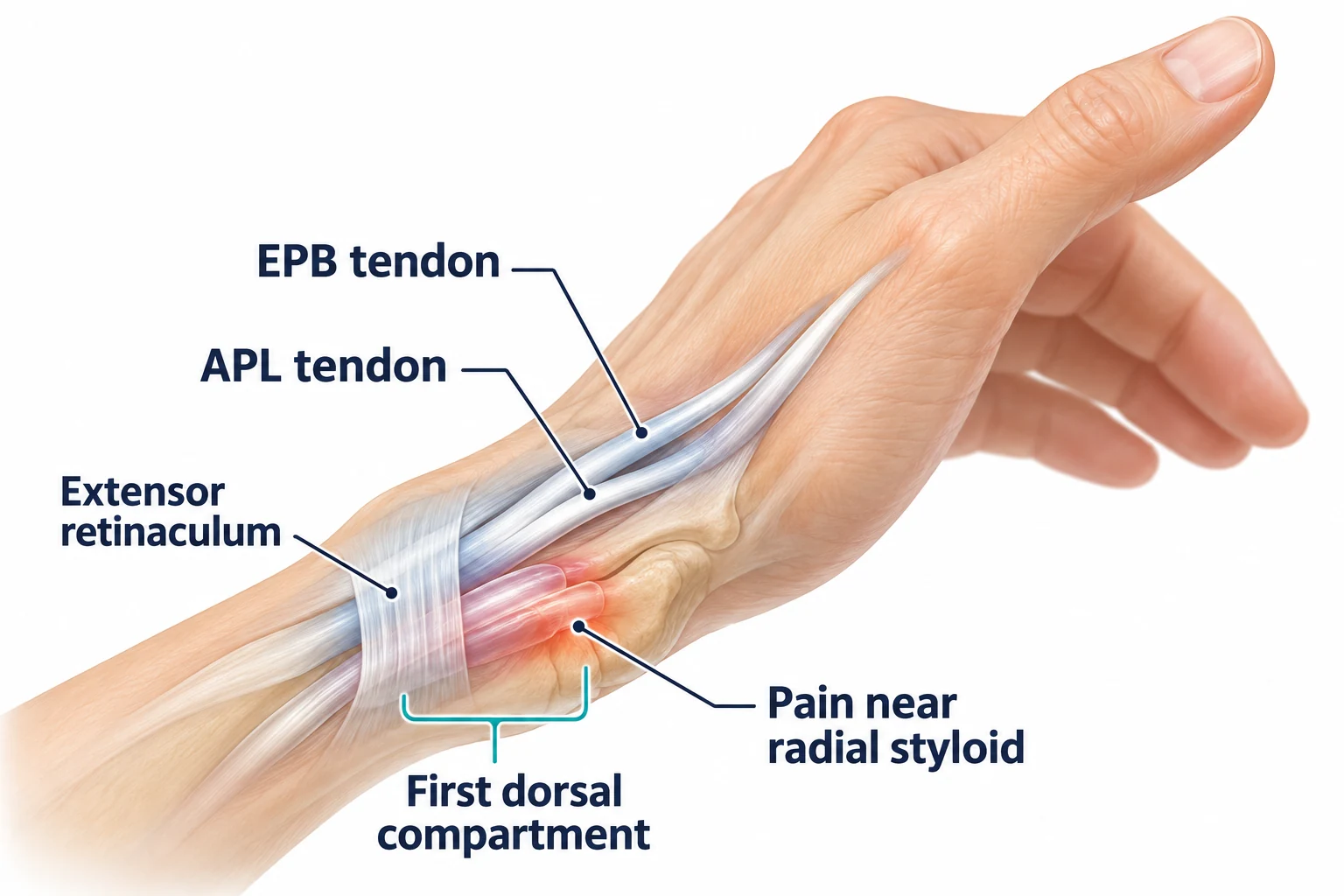
Why does it happen?
De Quervain’s is often linked with a change in thumb or wrist loading, although it does not always have one identifiable cause. Examples include repetitive grasping, lifting, pinching, twisting or sustained wrist positions. Symptoms also occur during pregnancy or after childbirth, particularly when repeatedly lifting or holding a baby. Individual anatomy and underlying inflammatory conditions can also contribute. [2] [3]
Common aggravating activities include lifting a child with the thumbs spread, carrying heavy bags, using tools, playing racquet sports, knitting, gardening and extended phone use. These activities do not automatically cause the condition; what matters is how the wrist responds to repetitive or unfamiliar load.
Typical symptoms
- Pain or tenderness at the thumb side of the wrist, sometimes extending into the thumb or forearm.
- Discomfort when gripping, twisting a jar lid, lifting, or moving the thumb away from the hand.
- Swelling or thickening around the thumb-side wrist.
- Occasional catching or creaking sensation with tendon movement.
- Reduced grip or pinch comfort during daily tasks. [1]
How do clinicians diagnose it?
A clinician reviews when pain began, what movements aggravate it, and where the wrist is tender. The examination checks the radial styloid, thumb movement, grip function, and carefully performed provocative maneuvers. A positive maneuver alone does not establish the diagnosis. Imaging may be considered when a fracture, arthritis, tendon variant or another cause is suspected. [1] [4]
Thumb-in-fist maneuver used during examination
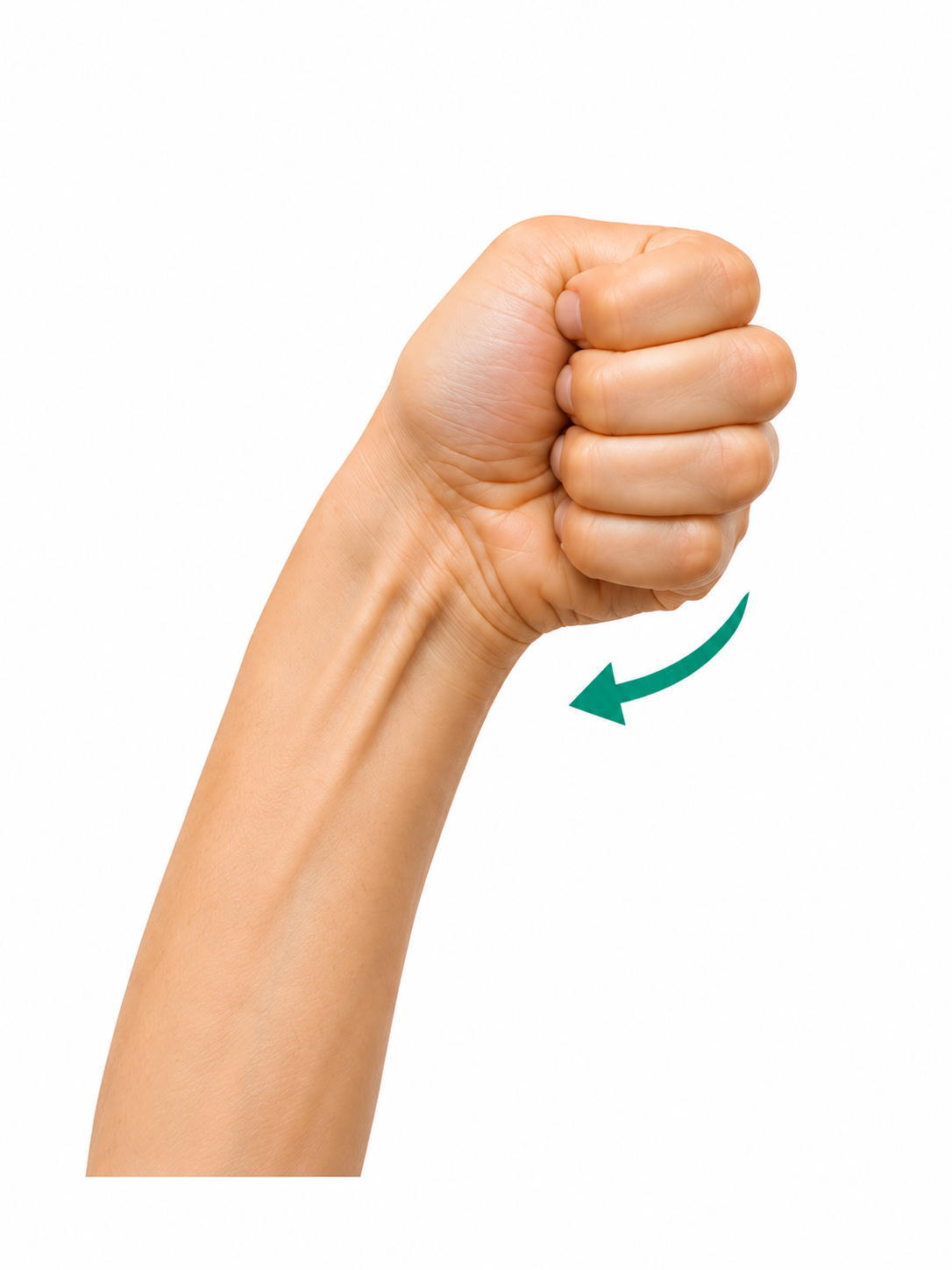
The thumb-in-fist position pictured here is commonly referred to as the Eichhoff maneuver and is sometimes called the Finkelstein test in patient materials. A true examiner-performed Finkelstein maneuver differs in hand positioning. These tests help clinicians evaluate suspected De Quervain’s tenosynovitis alongside the rest of the history and physical examination. Do not repeat this as a home stretch or force a painful test. [1]
Could thumb-side pain be something else?
| Possible cause | Helpful clues |
|---|---|
| De Quervain’s | Point tenderness near radial styloid; pain with thumb lifting or gripping. |
| Thumb CMC osteoarthritis | Pain lower at thumb base near the joint, often with pinching or opening jars. |
| Intersection syndrome | Pain higher up on the back of the forearm rather than directly at the thumb-side wrist. |
| Superficial radial nerve irritation (Wartenberg syndrome) | Burning, tingling or altered sensation over the back of the thumb/hand. |
| Scaphoid or other wrist injury | New pain after a fall or trauma; requires prompt examination for fracture. |
These clues guide an examination; they are not enough to diagnose yourself. [4]
Treatment: reducing irritation while restoring comfortable movement
Treatment is tailored to symptom severity, duration and individual goals. Common approaches include changing aggravating tasks, a well-fitted thumb-spica wrist splint, cold packs for short-term comfort, medication when appropriate, and gradual rehabilitation. If symptoms are substantial or persistent, a clinician may discuss a corticosteroid injection or referral to a hand specialist. Surgery is generally reserved for cases that do not respond to nonsurgical care. [1] [5]
Evidence perspective: A 2023 review of 30 randomized studies involving 1,663 participants found that adding short-term thumb-spica immobilization to a corticosteroid injection improved some outcomes; the additional functional benefit was statistically detectable but generally small. This is an important option to discuss when symptoms warrant it. [5]
How chiropractic care and rehabilitation may help
At ACE, a conservative-care visit can focus on identifying contributing hand-use patterns, assessing the wrist and surrounding joints, and building a practical recovery plan. Depending on the examination, care may include gentle soft-tissue techniques, appropriate mobilization of neighboring joints, ergonomic changes, bracing guidance and graded exercises. The aim is to improve everyday function and reduce mechanical irritation—not to forcefully adjust an irritated tendon sheath.
Published chiropractic case reports describe favorable recovery with a combination of conservative therapies, including exercises, activity modification, manual care and sometimes acupuncture. Because a case report follows only one patient and uses multiple treatments, it cannot establish which particular intervention caused recovery. [6] [7]
How acupuncture may help
Acupuncture may be considered as a supportive pain-management option alongside activity changes and rehabilitation. In a 2022 randomized controlled trial of 68 participants, those assigned to five acupuncture sessions over two weeks had a greater short-term reduction in reported pain than a waitlist control group. A 2024 systematic review of 14 trials involving 851 people also reported promising results, while noting that better-quality research is still needed. These findings do not show that acupuncture is a guaranteed cure or that it replaces other indicated treatments. [8] [9]
Published clinical example
A 2012 report in the Journal of the Canadian Chiropractic Association described a 49-year-old warehouse worker and recreational cyclist with De Quervain’s symptoms after a long ride. Care included soft-tissue work, mobilization, acupuncture, bracing advice and progressive home exercises; the patient’s reported symptoms resolved. It is an encouraging illustration of coordinated conservative care, but it is one case, not a comparative trial. [6]
Illustrated hand and wrist rehabilitation guide
The four exercise illustrations below cover gentle thumb movement, wrist extension, soft-ball gripping, and resisted thumb opening. The thumb-in-fist provocative maneuver has been moved to “How do clinicians diagnose it?” and is not part of the home rehabilitation program. Choose movements based on your examination findings; during a painful flare, avoid strenuous gripping or resistance and stop any exercise that increases symptoms. [10] [11]
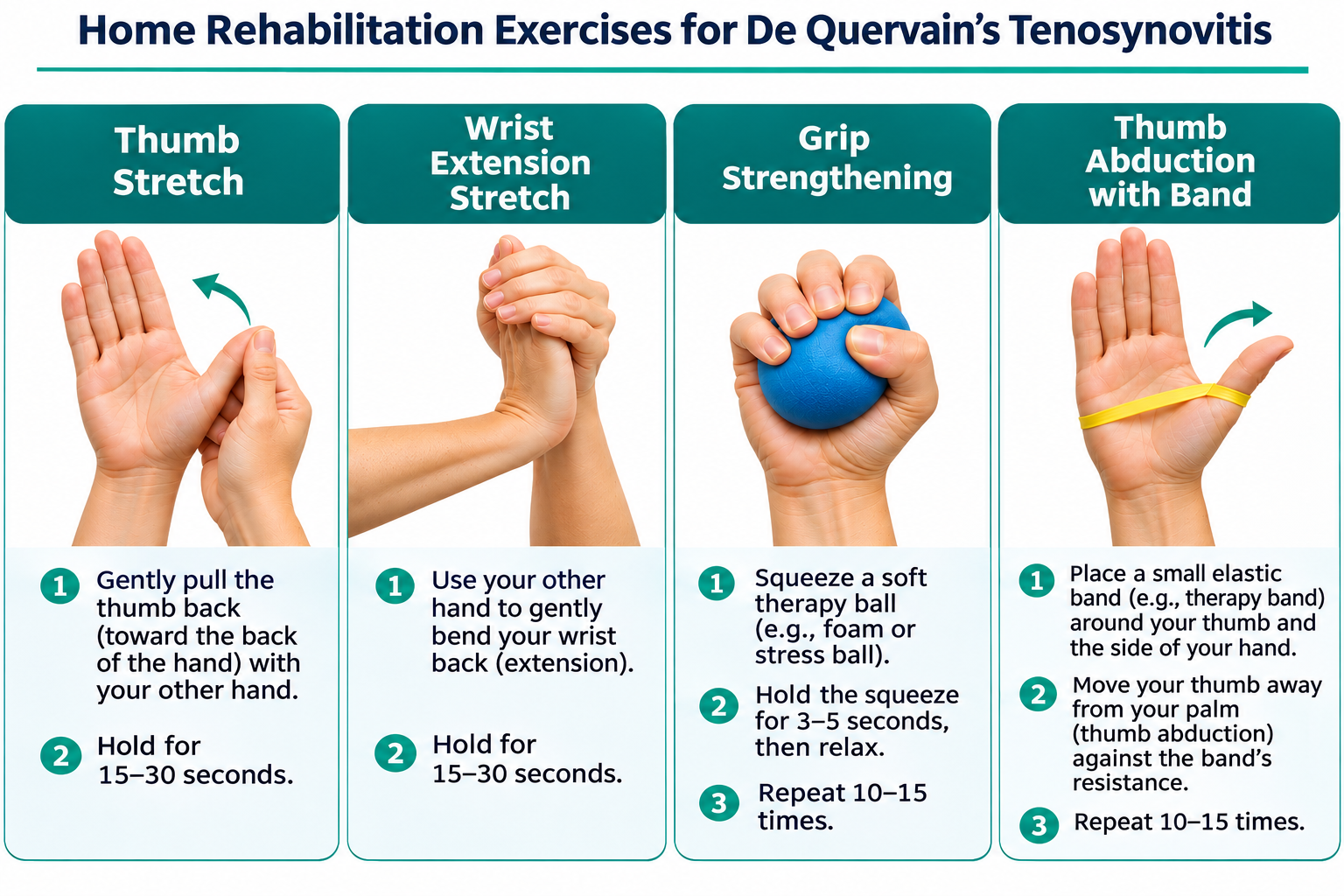
How to progress safely
- Gentle thumb movement: use only a pain-free range; do not pull sharply on an irritated tendon.
- Wrist movement: keep movements easy and controlled, and stop if thumb-side pain increases.
- Soft-ball gripping: consider once symptoms settle, with light effort and no pain afterward.
- Band-assisted thumb opening: progress later, if recommended by a clinician or hand therapist.
Practical ways to protect the wrist during daily activities
- When lifting a baby: scoop with forearms and palms rather than hooking the thumbs under the child’s arms.
- At work: alternate repetitive tasks, reduce prolonged pinch grips and use tools with larger handles when possible.
- With a phone: use both hands or voice input if one-handed thumb scrolling triggers discomfort.
- When lifting or carrying: keep the wrist closer to neutral and distribute weight across the hand or forearm.
- With a splint: seek fitting advice so the thumb and wrist are supported without pressure or numbness.
When should you seek medical attention?
Get prompt medical evaluation after a fall or injury, for increasing swelling or severe pain, or if you cannot use your hand normally. Fever, spreading redness/warmth, a visibly deformed wrist, or new persistent numbness or weakness should not be managed with exercises alone. If symptoms continue despite reasonable activity changes and splinting, a clinician can reassess the diagnosis and discuss additional options. [4]
Frequently asked questions
Is De Quervain’s the same as carpal tunnel syndrome?
No. De Quervain’s usually causes localized pain on the thumb side of the wrist. Carpal tunnel syndrome involves pressure on the median nerve and more commonly causes tingling, numbness or burning in the thumb, index and middle fingers.
Is this always an inflammatory condition?
Despite the word “tenosynovitis,” long-standing disease often involves tissue thickening and tendon-sheath changes. The amount of actual inflammation varies, which is one reason treatment focuses on symptom control and restoring function rather than treating a single presumed cause. [2]
Can it improve without surgery?
Yes. Many people improve with activity modifications, bracing, rehabilitation and other nonsurgical measures; others may benefit from a corticosteroid injection. Persistent severe cases warrant an individualized hand-specialist discussion. [1] [5]
Thumb-side wrist pain interfering with your day?
ACE California Health Clinic offers individualized chiropractic, acupuncture and rehabilitation care in Santa Clara. Schedule an evaluation to clarify the cause and discuss a suitable plan.
Patient education: This article provides general information, not a diagnosis or an individualized treatment plan. Care recommendations depend on examination findings, symptoms, medical history and professional judgment. Exercises are not suitable for everyone.
Medical references and case studies
- American Academy of Orthopaedic Surgeons. De Quervain’s Tenosynovitis. AAOS OrthoInfo.
- Challoumas D, et al. Management of de Quervain Tenosynovitis: A Systematic Review and Network Meta-Analysis. JAMA Netw Open. 2023;6(10):e2337001. doi:10.1001/jamanetworkopen.2023.37001.
- American Academy of Physical Medicine and Rehabilitation. De Quervain Tenosynovitis. AAPM&R.
- Journal of Urgent Care Medicine. Urgent Care Evaluation and Management of De Quervain Tenosynovitis. Clinical review.
- Challoumas D, et al. JAMA Network Open 2023 systematic review (30 studies, 1,663 participants). Full-text research.
- Howell ER. Conservative care of De Quervain’s tenosynovitis/tendinopathy in a warehouse worker and recreational cyclist: a case report. J Can Chiropr Assoc. 2012. Full text.
- Conservative management of De Quervain’s stenosing tenosynovitis: a case report. J Can Chiropr Assoc. 2012. PubMed.
- Acupuncture for de Quervain’s tenosynovitis: A randomized controlled trial. 2022. PubMed.
- A systematic review and meta-analysis of acupuncture for De Quervain’s tenosynovitis treatment. 2024. PubMed.
- East Kent Hospitals NHS Hand Therapy Service. De Quervain’s Tenosynovitis: Level 1 to 3 exercises. NHS patient leaflet.
- NHS Dynamic Health physiotherapy service. De Quervain syndrome. NHS physiotherapy guidance.