
What is carpal tunnel syndrome?
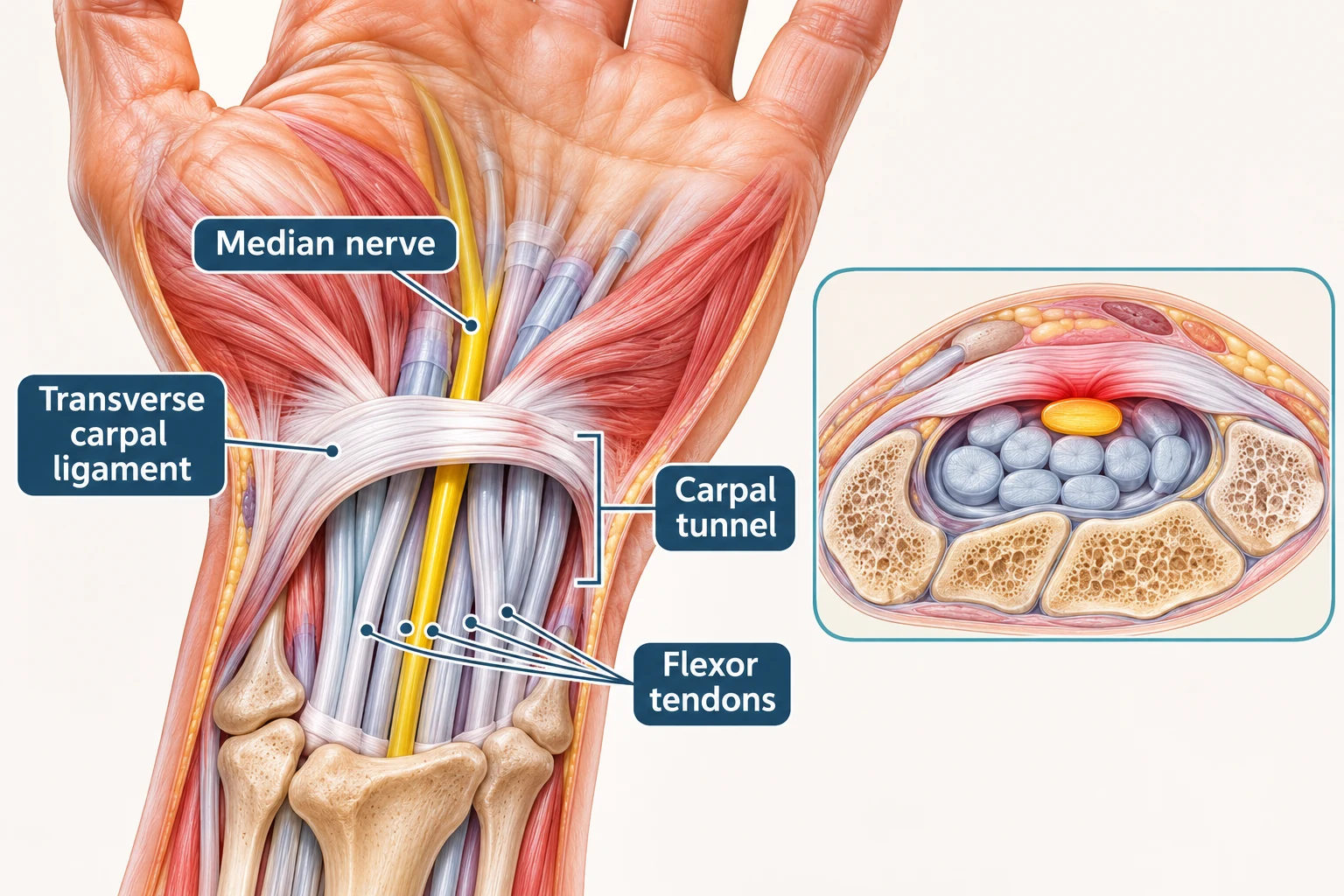
Carpal tunnel syndrome (CTS) occurs when the median nerve is compressed at the wrist. The nerve passes through a narrow channel made of wrist bones and a strong ligament, alongside the tendons that bend your fingers. When pressure rises in that confined space, the nerve can produce numbness, tingling, burning, pain, or weakness.[1][2]
Symptoms often begin gradually and are especially noticeable at night. Some people wake up and shake their hand to make the tingling settle. Others notice symptoms while driving, using a phone, holding a book, or doing work that requires sustained gripping.
Quick clue: Tingling in the thumb, index, middle and thumb-side of the ring finger—especially at night—is a classic pattern. Persistent little-finger numbness suggests checking for other causes, too.
Common causes and risk factors
Most cases develop from a combination of factors, rather than one isolated activity or injury. Anything that makes the tunnel narrower, increases pressure within it, or makes the median nerve more vulnerable can contribute.[1][2]
Swelling around the finger tendons
Irritation or thickening of tissues around the flexor tendons can reduce the room available for the median nerve.
Wrist position and forceful gripping
Prolonged bending of the wrist, forceful gripping and vibrating tools can increase pressure or aggravate existing symptoms. Ordinary keyboard use alone is not an established cause.
Wrist injury or anatomy
A previous fracture, local swelling or a naturally smaller tunnel may increase susceptibility to compression.
Medical and hormonal factors
Diabetes, rheumatoid arthritis, thyroid disorders, pregnancy-related fluid retention and certain other conditions are associated with CTS.

Common signs and symptoms
- Nighttime numbness or tingling
- Burning, pins-and-needles or hand discomfort
- Symptoms in the thumb, index and middle fingers
- Symptoms that improve briefly after shaking the hand
- Discomfort during sustained gripping or driving
- Clumsiness or dropping objects
- Reduced pinch or grip strength
- In more advanced cases, muscle loss at the thumb base

Symptoms can also travel into the forearm. Pain or numbness spreading from the neck, or symptoms predominantly in the little finger, may point to a different or additional source.[3]
What else can feel like carpal tunnel syndrome?
Hand tingling does not always mean the median nerve is trapped at the wrist. A careful history and examination help distinguish several overlapping conditions.[3][4]
| Condition | Typical clues | How it differs from CTS |
|---|---|---|
| Carpal tunnel syndrome | Night tingling; thumb, index and middle fingers | Median nerve compressed at the wrist |
| Cervical radiculopathy | Neck pain with symptoms traveling into arm or hand | Nerve root irritation originates at the neck; patterns can overlap |
| Pronator syndrome | Forearm pain with hand tingling | Median nerve may be compressed farther up the forearm |
| Ulnar neuropathy | Ring and little finger tingling | Different nerve; often affected around the elbow or wrist |
| De Quervain’s tenosynovitis | Thumb-side wrist pain with lifting and gripping | Tendon-related pain, usually without classic median-nerve numbness |
| Wrist/thumb arthritis | Joint pain, stiffness, local tenderness | Symptoms concentrate in a joint; numbness may be absent unless conditions coexist |
| Generalized peripheral neuropathy | Symptoms in both hands, often feet too | More diffuse nerve involvement |
The term “double crush” is sometimes used when nerve problems exist at more than one site. Coexisting findings require individualized interpretation.
How clinicians evaluate carpal tunnel syndrome
An examination looks beyond the wrist. Your clinician may review the timing and location of symptoms, sleep disturbance, hand strength, thumb muscle bulk, sensation and wrist/neck function. Specific examination maneuvers can contribute useful information, but no single bedside maneuver establishes the diagnosis.[3][4]
When symptoms are unusual, persistent or severe, nerve conduction studies and electromyography may help locate the nerve problem, measure severity or assess other diagnoses. Ultrasound may be useful in selected cases.
How chiropractic and acupuncture care may help
For appropriately selected patients, a personalized conservative plan may combine hands-on care, acupuncture, a comfortable nighttime wrist splint, home exercises and modifications to the activities that trigger symptoms. The goal is to improve comfort and hand function while monitoring nerve symptoms and strength.
Chiropractic and hands-on care
A chiropractor may assess wrist and forearm motion as well as relevant elbow, shoulder and neck findings. Care is chosen according to examination findings, symptom severity and patient goals.
- Gentle wrist and upper-extremity mobilization when appropriate
- Soft-tissue treatment for involved forearm muscles
- Movement coaching, activity modification and ergonomic guidance
- Selected nerve and tendon gliding with a home rehabilitation plan
- Coordination of further testing or referral when needed
Acupuncture and electroacupuncture
Acupuncture may be included as an adjunct to a broader plan for wrist and hand symptoms. Treatment can be tailored to pain, tingling, sleep disruption and functional goals while tracking response over time.
- Symptom-focused acupuncture for wrist and hand discomfort
- Electroacupuncture when clinically appropriate
- Integration with splinting, activity changes and rehabilitation
- Regular reassessment of sensory symptoms and function
Neither a published case outcome nor a general treatment description predicts the response of an individual patient. A meaningful plan should be guided by the diagnosis, severity, response to care and follow-up findings.
What published cases and studies show
Chiropractic case report • 42-year-old woman • 1994
A report by Valente and Gibson described a woman with wrist pain, tingling and numbness and nerve testing supporting CTS. After four weeks of chiropractic treatment involving the cervical spine, elbow and wrist, the authors reported improved grip strength, nerve-test results and symptoms. This is one published patient's outcome, not an ACE clinic case.[5]
Electroacupuncture pilot study • 12 patients / 17 wrists • 2025
In a small clinical study, participants received eight electroacupuncture sessions over four weeks. Researchers observed improvements in pain, self-reported symptoms and function, as well as reduced ultrasound-measured median nerve size. Nerve conduction measurements did not significantly change. This was a small uncontrolled study, useful as an early clinical observation.[10]
Gentle home stretches and exercises
Gentle movement and comfortable wrist positioning may be useful in a personalized home program. The illustrated movements below are examples for patient education, not a one-size-fits-all prescription. Ask your clinician which movements and repetitions fit your symptoms. Stop an exercise if it increases pain, numbness, tingling or weakness.[11]

1Gentle median nerve glide
- Start with your elbow comfortably bent and your wrist near neutral.
- Open your hand and gently straighten your fingers and thumb.
- Slowly adjust the wrist and elbow within a comfortable range, then return to the start.
- Do not hold a position that brings on tingling or pulls sharply along the nerve.
Try: 5 gentle repetitions as tolerated. A glide is a controlled, moving exercise—not a sustained nerve stretch.
2Tendon glide sequence
- Start with the wrist straight and fingers comfortably extended.
- Move into a hook fist by bending the two outer joints of each finger.
- Make a gentle full fist.
- Move to a tabletop position with the large knuckles bent and the finger joints straight.
- Move to a straight fist, then return to an open hand.
Try: 5 slow cycles as tolerated. See the AAOS exercise program for further clinical guidance.
3Gentle wrist flexor stretch
- Extend your arm with your palm facing upward.
- With the other hand, gently guide the fingers and wrist backward toward wrist extension.
- Feel a mild stretch on the palm side of the forearm—not electric tingling in the fingers.
- Return to neutral without forcing the wrist.
Try: Hold 10–15 seconds, up to twice, only if comfortable.
4Gentle wrist extensor stretch
- Extend your arm with your palm facing downward.
- Use the other hand to gently guide your wrist downward into flexion.
- Feel a mild stretch along the back of the forearm, then return to neutral.
- Keep the motion comfortable and avoid provoking numbness.
Try: Hold 10–15 seconds, up to twice, only if comfortable.
Daily wrist-position reset: Relax your shoulders, avoid prolonged forceful gripping, change tasks periodically, and aim to keep the wrist near neutral while typing or resting. Ask your healthcare professional whether a comfortable nighttime neutral-wrist splint is suitable.
These original AI-generated educational illustrations were reviewed and approved by the ACE clinic owner for patient education. They are not diagnostic imaging or individualized exercise prescriptions.
When should you get your wrist checked?
Schedule an evaluation if numbness keeps returning, interrupts your sleep, interferes with work, or does not settle with simple changes. Prompt assessment is especially important for constant numbness, progressive thumb weakness, visible muscle wasting or repeated dropping of objects.
Carpal tunnel questions patients ask
Is my hand tingling from my wrist or my neck?
Either is possible. Carpal tunnel often affects the thumb, index and middle fingers and is common at night. A neck nerve problem may include neck pain or symptoms extending along the arm. The symptoms can overlap, so examination matters.
Can carpal tunnel syndrome affect both hands?
Yes. Symptoms may begin in one hand or affect both. The pattern and severity can differ between sides.
Does a nighttime wrist brace help?
A splint that holds the wrist near neutral can reduce pressure during sleep and often provides symptom relief. A clinician can help choose the right fit and determine how long to use it.[2]
Can chiropractic and acupuncture be combined?
They can be considered together as part of an individualized conservative plan, alongside positioning, activity modification and rehabilitation. The choice depends on your examination findings and follow-up response.
When are nerve tests useful?
Nerve conduction studies or EMG can be especially helpful when symptoms are atypical, a different nerve condition is suspected, or the severity needs clarification.
The ACE Wrist Pain Series
Carpal Tunnel Syndrome
De Quervain's Tenosynovitis
Wrist Sprain & Ligament Injuries
Wrist Arthritis
Parts 2–4 are planned articles; links will be added after those pages are published.
Wrist pain, numbness or nighttime tingling?
ACE California Health Clinic offers chiropractic, acupuncture and rehabilitation services in Santa Clara. Dr. John J. Lee, D.C., L.Ac., can evaluate musculoskeletal and nerve-related findings and discuss appropriate conservative care or referral options.
345 Saratoga Ave., Santa Clara, CA 95050
Phone: 408-984-6000
References & further reading
- NIAMS. Carpal Tunnel Syndrome: Symptoms & Causes.
- American Academy of Orthopaedic Surgeons (AAOS), OrthoInfo. Carpal Tunnel Syndrome.
- Wipperman J, Penny ML. Carpal Tunnel Syndrome: Rapid Evidence Review. American Family Physician. 2024.
- Review. Diagnostic Dilemmas in Carpal Tunnel Syndrome and Cervical Spine Disorders. 2025.
- Valente R, Gibson H. Chiropractic manipulation in carpal tunnel syndrome. J Manipulative Physiol Ther. 1994.
- Davis PT, Hulbert JR, Kassak KM, Meyer JJ. Comparative efficacy of conservative medical and chiropractic treatments for carpal tunnel syndrome: a randomized clinical trial. J Manipulative Physiol Ther. 1998.
- Randomized study. The effectiveness of mobilization with movement on patients with mild and moderate carpal tunnel syndrome. 2023.
- Dong X, et al. Acupuncture for carpal tunnel syndrome: A systematic review and meta-analysis of randomized controlled trials. 2023.
- Randomized trial. Electroacupuncture and splinting versus splinting alone to treat carpal tunnel syndrome. 2016.
- Ntoutsouli AM, et al. Effects of electroacupuncture on carpal tunnel syndrome: a clinical, electrophysiological and ultrasonographical pilot study. Acupunct Med. 2025.
- AAOS OrthoInfo. Therapeutic Exercise Program for Carpal Tunnel Syndrome.
Educational information only. Diagnosis and treatment should be individualized. Original AI-generated medical and exercise illustrations are for patient education and were approved by the ACE clinic owner; individual exercise suitability should be assessed by a clinician.