
ACE Shoulder Health Series — Part 1 of 3
Have you noticed shoulder pain after pitching a baseball, throwing a football, or playing catch with your children? Maybe you felt a sharp ache after an overhead press at the gym. Or perhaps you spent the weekend painting a ceiling—and now even reaching for a cup on a high shelf hurts.
Shoulder discomfort may start suddenly after a fall or heavy lift. More often, it develops gradually after repeated throwing, swimming, racquet sports, or long days of overhead work. Sometimes the pain shows up only when you lie on that shoulder at night.
Could it be a rotator cuff injury? Possibly—but not every painful shoulder has a torn tendon. Understanding how the pain started, whether the arm feels weak, and which movements are difficult can help guide an appropriate examination and recovery plan.
Common searches · Common situations
How did your shoulder pain begin?
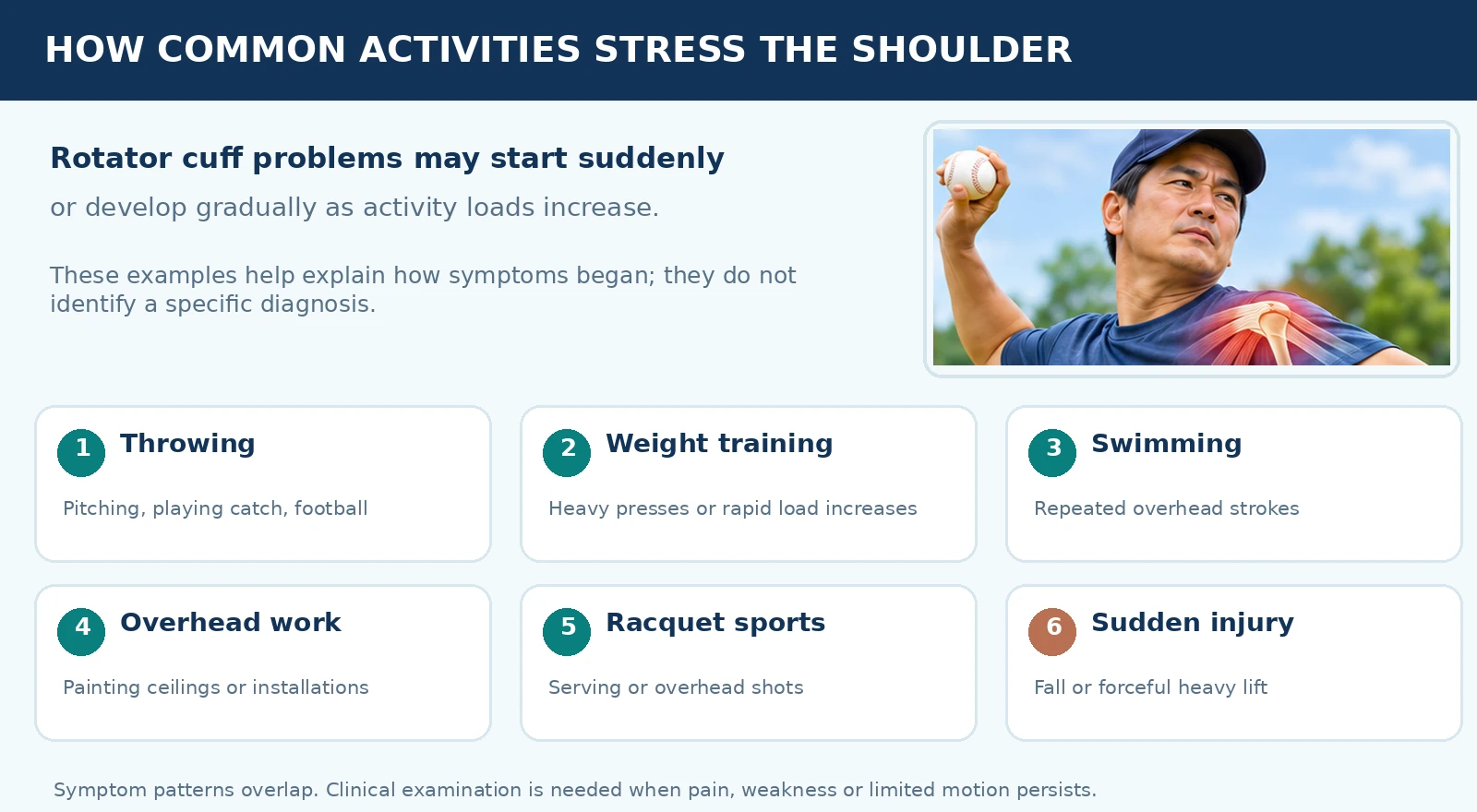
These are examples of activities that may overload or injure the rotator cuff. They do not diagnose a rotator cuff tear; several shoulder conditions can cause similar pain.
Shoulder pain after pitching a baseball
Repeated high-speed throwing can overload the shoulder stabilizers. Pain, reduced throwing performance, or a sudden change in strength deserves attention.
Shoulder pain after lifting weights
Bench presses, overhead presses, and heavy or rapidly increased training loads can aggravate shoulder tendons. A forceful lift can occasionally cause an acute injury.
Shoulder pain after painting a ceiling
Prolonged reaching and overhead work can make a previously tolerable shoulder load painful—sometimes most noticeable later in the day.
Shoulder pain after tennis or pickleball
Serves and overhead shots involve repeated shoulder rotation and control. Pain during a swing has several possible explanations.
Shoulder pain after swimming
Frequent overhead strokes may irritate shoulder structures, particularly when training volume increases faster than the shoulder can tolerate.
Shoulder pain after playing golf
A painful backswing or follow-through can involve the shoulder, although neck, joint, or other soft-tissue problems can mimic rotator cuff symptoms.
Shoulder pain after lifting a suitcase or box
A heavy reach, especially when the load is away from your body, can trigger shoulder symptoms. Sudden weakness requires a more cautious approach.
Shoulder pain after a fall
Falling onto an outstretched arm or catching yourself may injure a tendon or other structures. New inability to lift the arm warrants prompt medical assessment.
SEO is not a diagnosis: these searches bring readers to the article, but only a clinical evaluation can determine whether the rotator cuff is involved.
What does the rotator cuff actually do?
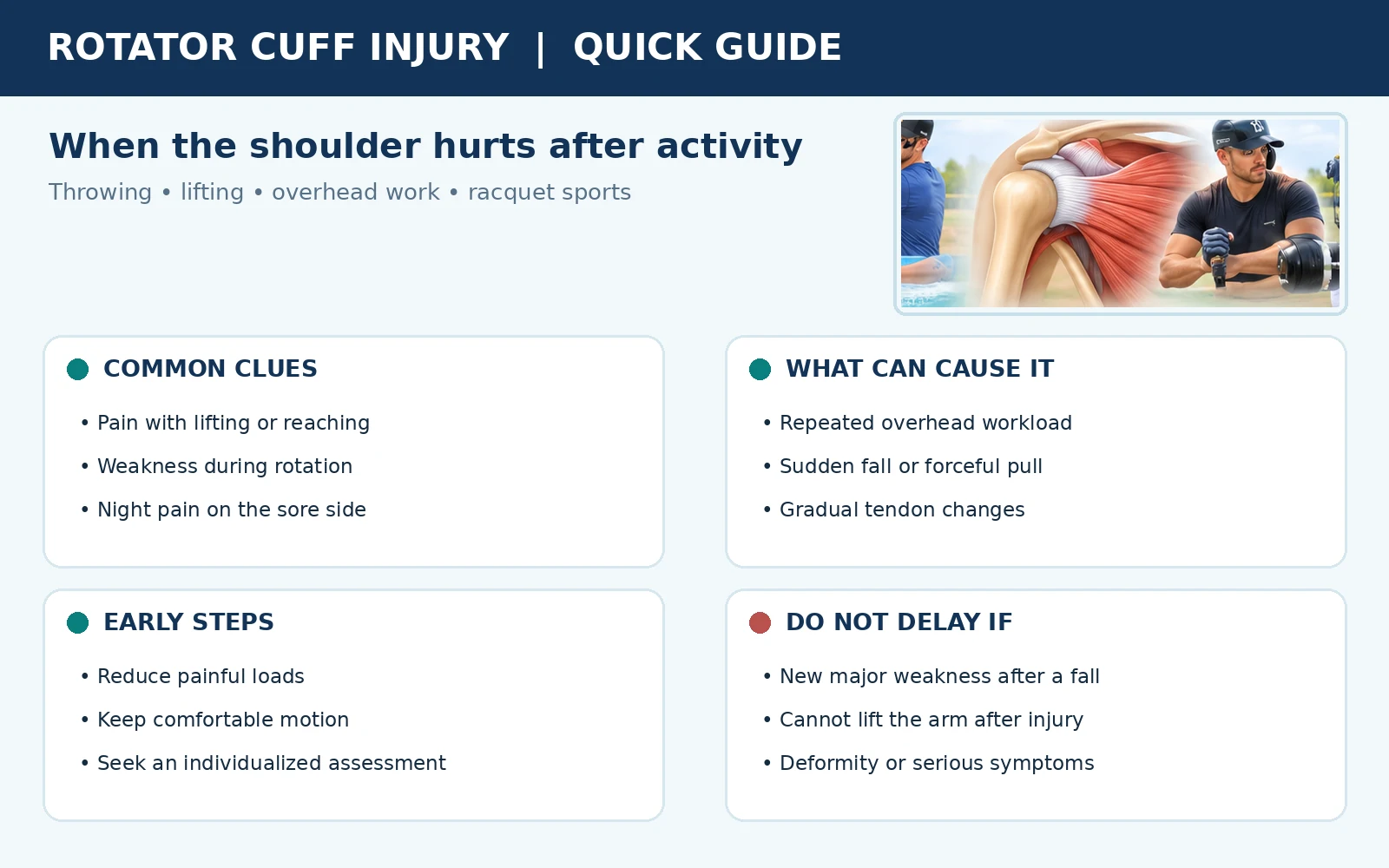
Your shoulder has an impressive range of motion. You can reach overhead, take off a jacket, wash your hair, and carry groceries. But that flexibility also means several structures must work together to keep the upper-arm bone steady as you move.
The rotator cuff is a group of four muscles and their tendons: supraspinatus, infraspinatus, teres minor, and subscapularis. The tendons attach around the head of the upper-arm bone. Together, they help lift and rotate the arm and keep the ball of the shoulder centered in its socket. A fluid-filled bursa nearby helps structures glide as the arm moves.
When a tendon becomes painful, overloaded, or torn, everyday movement can feel harder. However, the term “rotator cuff injury” is broad. A painful tendon does not automatically mean a tendon has torn, and a tear seen on an image does not automatically explain all the pain someone feels.
The practical question is not just “Is there a tear?” It is also “What can this shoulder currently do, what makes it worse, and which treatment approach is safe for this person?” [1, 2]
Tendon irritation, partial tears, and full-thickness tears
These terms are sometimes used interchangeably in casual conversation, but they describe different problems. Understanding the distinction can make a diagnosis and treatment conversation much less confusing.
| Type | What it means | Why it matters |
|---|---|---|
| Rotator cuff tendinopathy | A tendon-related pain problem often associated with loading and changes in the tendon tissue; it does not necessarily mean a tear. | Education, gradual loading, and activity modification are often central to care. |
| Partial-thickness tear | Some tendon fibers are disrupted, but the defect does not pass through the full tendon thickness. | Many cases can begin with a structured nonsurgical program; severity and function matter. |
| Full-thickness tear | The tear crosses the whole tendon thickness. It may involve part of the tendon’s width or the entire attachment. | Recent traumatic tears, major weakness, and functional demands may warrant early orthopaedic review. |
Three different descriptions—not three pain levels
TendinopathyTendon-related pain; a tear is not required.
Partial-thickness tearSome fibers disrupted; does not cross full thickness.
Full-thickness tearDefect crosses the full tendon thickness.
Educational classification chart—not a scale of pain severity or a substitute for imaging.
A small degenerative tear may be discovered incidentally during imaging. On the other hand, a sudden tear after a fall may lead to immediate weakness. Imaging findings need to be interpreted alongside the history and examination, not treated as a diagnosis in isolation. [1, 3]
Common symptoms: what patients tend to notice
Rotator cuff symptoms frequently show up in ordinary tasks long before someone uses the words “rotator cuff.” They may feel pain along the side or front of the shoulder, sometimes extending into the upper arm. Reaching to a high cabinet, carrying a bag away from the body, or placing an arm into a sleeve can become uncomfortable.
Some people notice night pain, especially when lying on the affected side. Others describe weakness when lifting the arm, rotating it outward, or slowly lowering something from a shelf. These symptoms can appear gradually or begin abruptly after an injury.
With liftingPain reaching outward or overhead; sometimes weakness.
With sleepingAching when lying on that shoulder or difficulty finding a comfortable position.
With everyday tasksDifficulty dressing, combing hair, or putting something away.
After a sudden injurySharp pain, a pop, or new inability to lift the arm calls for prompt assessment.
These signs are not unique to the rotator cuff. Arthritis, shoulder stiffness, calcific tendinopathy, neck-related nerve problems, and other conditions may look similar. Severe symptoms or rapid loss of function require timely evaluation rather than a self-diagnosis. [1, 4]
Why rotator cuff problems develop
One route is gradual overload. Repetitive lifting, overhead work, throwing sports, or an abrupt change in exercise volume may expose tendons to more load than they currently tolerate. Pain may begin as a nuisance during activity and eventually appear in ordinary daily tasks.
Another route is age-associated tendon change. Tendons can become less resilient with time, and degenerative tears are more common with increasing age. This does not mean an active older adult must stop using the shoulder; it means exercises and loading should be matched to symptoms, strength, and goals.
The third route is acute trauma: a fall on an outstretched hand, sudden pull, or lifting accident can cause a new tear. The setting and timing matter. A previously comfortable shoulder that suddenly becomes weak after a fall needs a different level of attention than a mildly sore shoulder after a week of painting a ceiling.
Risk factors can overlap. Age, overhead occupational demands, and repetitive sports exposure may each contribute. No single risk factor proves a rotator cuff injury. [1]
What you can observe at home—and what not to test
Keep observations simple. Notice which tasks hurt, whether the discomfort follows a specific injury, and whether you have true weakness or are stopping because a movement is painful. Compare how your shoulder behaves during normal, comfortable daily activities rather than trying to force a test.
Useful notes for an appointment include the date symptoms began, a possible lifting or falling event, which direction of movement is difficult, whether pain interrupts sleep, and any new numbness or tingling. Mention whether the pain is getting better, staying the same, or worsening.
Do not ask someone else to push your arm through a painful range. Do not repeat heavy overhead lifts to “prove” you are injured. And do not rely on a single online shoulder test to distinguish a strained tendon from a tear. Forceful self-testing can aggravate symptoms and can miss important injuries.
Important: If there was a fall, a sudden pop followed by significant weakness, or inability to raise your arm, skip home exercises and arrange prompt medical assessment. [1, 4]
How a healthcare professional evaluates the shoulder
The starting point is a history and examination. A clinician will ask how the pain began, whether trauma occurred, what work or sport requires of the shoulder, and how sleep and daily routines have changed. They may also screen the neck and nerves because pain can sometimes be referred into the shoulder.
The examination often considers active motion (how far you move your arm yourself), passive motion (how far it moves when supported and guided), strength, tenderness, and selected orthopedic tests. No one test is a perfect diagnosis. Comparing painful movement with actual loss of power can help guide the next step.
Do you need an X-ray, ultrasound, or MRI?
Not everyone needs advanced imaging at the first visit. For typical suspected rotator cuff tendinopathy without trauma or warning signs, a clinical examination and initial management are often reasonable. The 2025 physical therapy guideline advises against routine diagnostic imaging at the start of management for this presentation.
An X-ray can assess bones, arthritis, and other explanations for pain, but generally does not directly show rotator cuff tendon tears. Ultrasound and MRI can evaluate tendons and suspected tears. Imaging may be more helpful after a significant injury, for major persistent weakness, when progress is not as expected, or when specialist planning would change treatment. The right test depends on the clinical question. [1, 2, 3]
Treatment: why rehabilitation is often the foundation
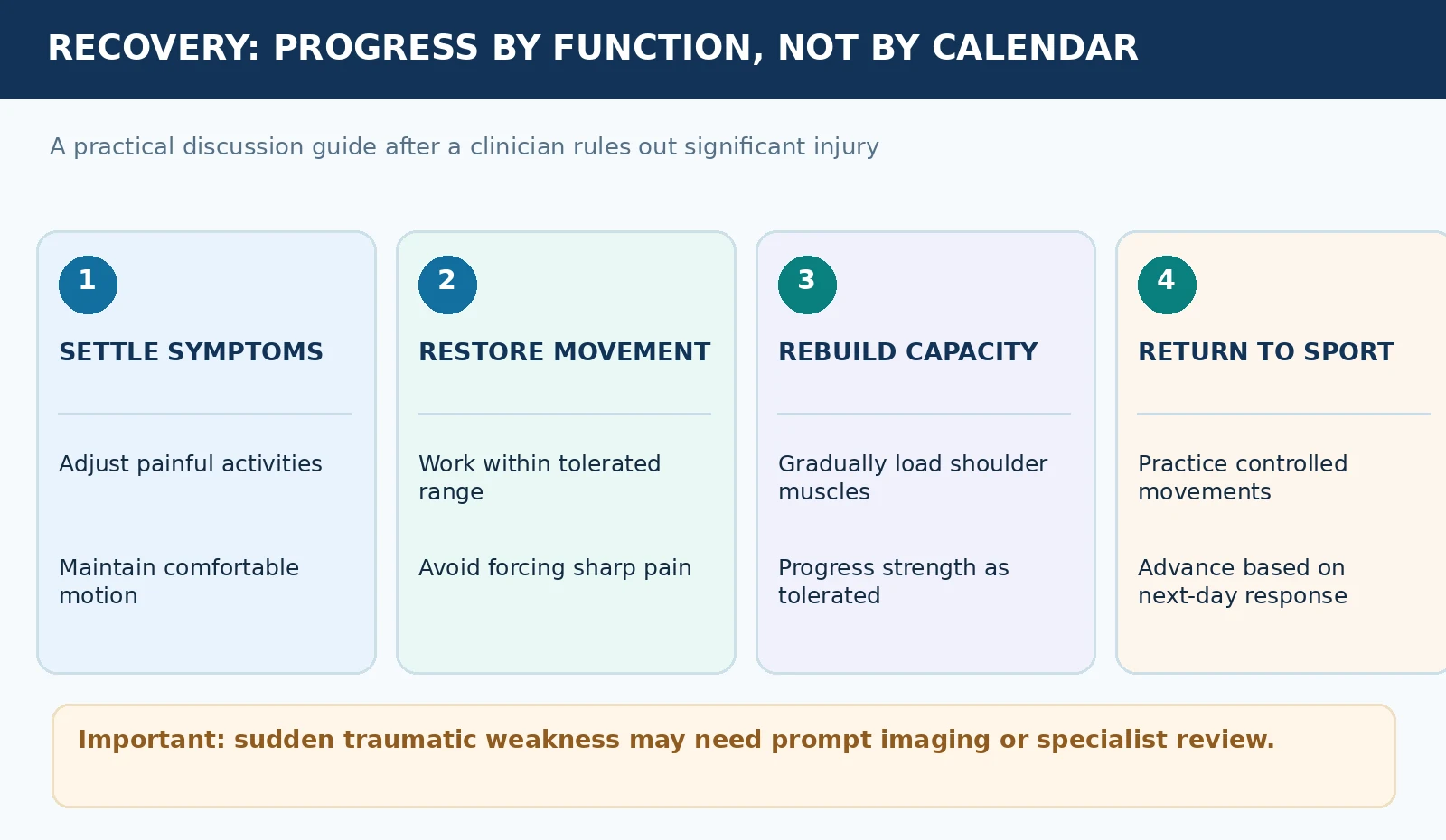
Many rotator cuff-related conditions improve with an appropriately chosen nonsurgical program. The first goal is to make everyday activities more tolerable while preserving the shoulder’s useful motion. The next is to build strength and confidence gradually, without repeatedly provoking a flare.
A rehabilitation plan may address shoulder motion, rotator cuff and shoulder-blade strength, lifting technique, and a graduated return to daily activities. Progress is better judged by function—sleeping more comfortably, reaching for objects with better control, and recovering your usual work or exercise capacity—than by a single “pain score.”
Treatment must fit the injury. Nontraumatic tendon pain or selected partial tears often begin with education and therapeutic exercise. A large, recent traumatic tear with obvious weakness may benefit from early orthopaedic assessment rather than an extended trial of routine care. The 2025 AAOS guideline finds that both physical therapy and surgery can improve outcomes for selected symptomatic small-to-medium full-thickness tears, while noting that some tears can enlarge over time without repair. [3]
Where do chiropractic care and supportive modalities fit?
A chiropractic and rehabilitation setting may help assess movement, discuss modifications to irritating activities, and guide appropriately selected mobility and strengthening exercises. Some supportive manual or soft-tissue approaches may be used for comfort and movement, but they do not reattach a torn tendon. Likewise, acupuncture may be discussed as an adjunct for symptom management in selected cases; it should not be presented as a way to mend a structural tear or replace needed specialist assessment.
Medication and injections can sometimes be considered by a licensed prescriber, based on individual risks and treatment goals. Steroid injections may offer symptom relief for some patients, but repeated injections carry trade-offs. A clinician should review those details rather than treating an injection as an automatic first step. [1, 2]
Practical home-care ideas while awaiting evaluation
For mild, gradual-onset shoulder discomfort without trauma or new major weakness, sensible activity changes can reduce irritation. The aim is neither strict bed rest nor pushing through intense pain; it is to keep useful movement while avoiding loads the shoulder cannot currently manage.
- Reduce the most provocative reach. Temporarily move frequently used objects to waist or chest height. Use a step stool only when safe, and avoid lifting heavy objects overhead while symptoms flare.
- Adapt work tasks. Break long overhead sessions into shorter blocks. Keep frequently used items close, and consider adjusting workstation or tool height.
- Find a better sleep position. Avoid direct pressure on the painful shoulder if it aggravates symptoms. Try supporting the affected arm with a pillow while lying on the opposite side or on your back.
- Keep comfortable daily motion. Use the shoulder within a tolerable range during regular activities, unless a clinician has told you to protect an injury. Prolonged unnecessary immobilization can contribute to stiffness.
- Try a brief cold pack for symptom relief if helpful. Wrap the pack in a towel; do not place ice directly on skin. This is a comfort strategy, not tendon repair.
- Track the next-day response. If an activity causes sharp pain, marked weakness, or a major flare that continues, reduce the load and seek individualized guidance rather than repeating it.
Exercises such as gentle assisted motion, isometrics, or resistance-band strengthening can be useful at the right stage. However, the dose and direction matter. Someone with a new traumatic tear or recent surgery needs individualized restrictions. For that reason, this article does not prescribe a universal set of repetitions or a one-size-fits-all progression. [1, 2]
Returning to work, sports, and exercise
A return-to-activity plan should match the demands of the task. Reaching a low shelf is not the same as painting a ceiling for hours, carrying heavy boxes, swimming laps, or repeatedly serving a tennis ball. The shoulder should regain enough motion, control, and strength for the specific activity.
With mild tendon-related symptoms, a clinician may help you gradually increase load while monitoring pain and next-day response. For repetitive overhead athletes, technique and training volume also matter. A person who performs heavy occupational lifting may need temporary duty modifications and a staged return to full loads.
Progress is not always a straight line. Improvement may be noticeable over weeks, while restoring tolerance for demanding overhead activity may take longer. Recovery after surgical repair can take several months and often requires staged protection and therapy. Avoid promising yourself a fixed deadline based on a generic internet chart; prognosis depends on whether the problem is tendinopathy, a partial tear, or a complete tear, as well as the size, chronicity, age, health, and activity demands. [1, 5]
| Before resuming a demanding activity | Questions worth asking |
|---|---|
| Overhead work | Can you reach repeatedly with good control, without a substantial next-day flare? |
| Strength training | Has your clinician cleared the load and movement pattern for your injury type? |
| Throwing or racquet sports | Have you rebuilt motion, rotation strength, and a gradual practice schedule? |
| After surgery | Does the surgeon's phase-specific rehabilitation plan allow this motion or load? |
When to seek prompt or emergency care
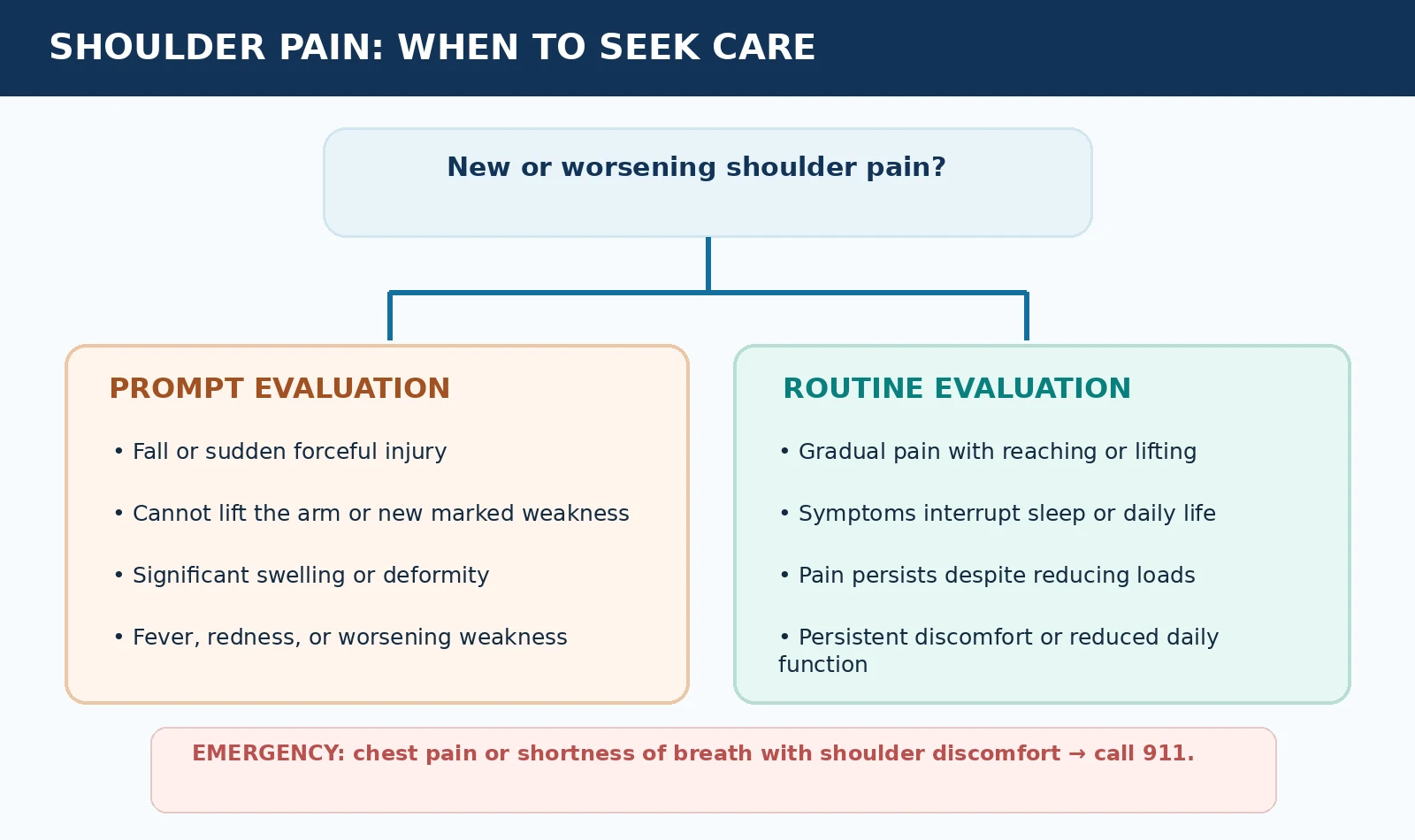
Seek prompt medical evaluation after a fall or sudden injury if you have notable new weakness, cannot raise the arm, have a visible deformity, or experience severe swelling. A suspected acute full-thickness tear or fracture should not be managed with unsupervised stretching or lifting.
Seek urgent medical attention for a hot, red, swollen joint with fever, new persistent loss of sensation, a limb that feels unusually cold or lacks normal circulation, or severe pain that rapidly worsens. If shoulder or arm discomfort occurs with chest pressure, shortness of breath, sweating, or other symptoms concerning for a heart problem, call 911 rather than assuming it is a shoulder injury.
For non-emergency symptoms, arrange an assessment if discomfort has not improved after about two weeks of sensible modifications, is progressing, repeatedly disrupts sleep, or interferes with work and daily life. Earlier assessment is sensible if you have significant functional weakness. [1, 4]
What to expect from a shoulder visit at ACE
At ACE California Health Clinic in Santa Clara, a shoulder complaint can begin with a review of how symptoms started, which movements matter most, and whether the neck or nerves may also be involved. An evaluation may assess comfortable movement, strength, activity tolerance, and possible reasons another type of medical assessment is needed.
When appropriate for the findings, conservative care may include patient education, modified activity guidance, corrective exercise, rehabilitation, and supportive hands-on treatments. The choice depends on the likely diagnosis and how the shoulder responds, not simply on the presence of pain.
We do not want patients to interpret a suspected tendon tear as a reason to avoid all movement or, conversely, to push through intense pain. The responsible next step is an examination that identifies whether rehabilitation, additional imaging, or orthopaedic referral is most appropriate.
Learn more about our sports-injury care and rehabilitation services.
Frequently asked questions about rotator cuff injuries
Can rotator cuff pain go away without surgery?
Often, yes. Many people with tendinopathy or selected tears regain useful comfort and function with education and rehabilitation. A structural tear may remain even while symptoms improve, so clinical follow-up still matters. [1, 3]
Does a torn rotator cuff always hurt?
No. Some tears cause little or no pain, and imaging may reveal a tear that is not the main cause of a person's current symptoms. The findings need clinical context. [1]
Do I need an MRI right away?
Not necessarily. Typical, nontraumatic tendon-related pain can often be evaluated without immediate MRI. A new major injury, significant weakness, or specialist planning can change the imaging decision. [1, 2]
Is it okay to exercise if my shoulder hurts?
Appropriate movement and gradual strengthening are often helpful, but the right exercises depend on the type and severity of the injury. Sudden weakness after trauma is a reason to obtain an assessment before trying a strengthening routine. [2]
Can acupuncture or chiropractic adjustments repair a torn tendon?
No. Supportive care may be considered for comfort or movement when appropriate, but it should never be described as reconnecting a torn tendon. Structural tears require an individualized discussion of rehabilitation and, sometimes, surgery.
How long does rotator cuff recovery take?
There is no single timeline. Mild tendon irritation may improve over weeks, while demanding activity recovery may take months. Recovery after surgical repair is commonly measured in months and may take up to a year. Follow your clinician's plan rather than a fixed online schedule. [5]
Why does my shoulder hurt after pitching a baseball?
Repeated throwing places high demands on shoulder stabilizers. Rotator cuff overload is one possibility, but the labrum and other structures can also contribute. Persistent pain or reduced throwing performance warrants evaluation.
Why does my shoulder hurt after lifting weights?
Heavy presses, sudden increases in training volume, and awkward or forceful lifting can aggravate shoulder structures. Persistent weakness or pain after an acute lifting event deserves assessment.
Can painting a ceiling cause rotator cuff pain?
Prolonged overhead activity can aggravate tendon-related shoulder symptoms. But pain after painting is not proof of a tear; the examination considers movement, strength, and other shoulder conditions.
The bottom line
Shoulder pain with reaching, lifting, or sleeping may reflect a rotator cuff problem, but the label alone does not tell you whether a tendon is torn. For many gradual-onset cases, appropriately guided rehabilitation is a reasonable first step. A sudden injury with substantial weakness needs more urgent attention. A careful assessment can help separate these situations and plan a safe return to normal activity.
Shoulder pain affecting your routine?
ACE California Health Clinic provides chiropractic, acupuncture, and rehabilitation-oriented care in Santa Clara. Call (408) 984-6000 or explore ACE California Health Clinic. For severe injury or emergency symptoms, seek urgent medical attention instead of waiting for an appointment.
Medical references
- American Academy of Orthopaedic Surgeons. Rotator Cuff Tears. OrthoInfo.
- Desmeules F, et al. Rotator Cuff Tendinopathy: Diagnosis, Nonsurgical Medical Care, and Rehabilitation. JOSPT/APTA Clinical Practice Guideline, 2025 (applies to tendinopathy and partial-thickness tears; not full-thickness tears).
- American Academy of Orthopaedic Surgeons. Management of Rotator Cuff Injuries Clinical Practice Guideline. August 2025.
- National Health Service. Shoulder pain: when to get help.
- American Academy of Orthopaedic Surgeons. Rotator Cuff Tears: Surgical Treatment Options.
- American College of Radiology. ACR Appropriateness Criteria: Chronic Shoulder Pain (imaging pathway, revised 2022).
Medical education disclaimer: This article is for general educational purposes and is not a diagnosis or a substitute for advice from a qualified healthcare professional. If you have severe, sudden, or worsening symptoms—or think you may have an emergency—seek urgent medical care or call 911.
Illustration notice: Hero image is AI-generated for illustration only. It does not depict a real patient or a clinically validated anatomy diagram. Editorial and clinical review are pending.
More in the Shoulder Health Series
Upcoming Part 2: Frozen Shoulder — Why Your Shoulder Becomes Painful and Stiff. Upcoming Part 3: Rotator Cuff Injury vs. Frozen Shoulder — How to Tell the Difference.
The other two articles are planned, not yet published. Links will be added when live.