
Do You Always Need an X-Ray or MRI After a Car Accident? What About CT?
No single scan is automatically right after every collision. The first decision is whether imaging is needed at all; the second is which test answers the clinical question with the best risk-benefit balance.
After a car accident, imaging decisions depend on the body region, the crash mechanism, symptoms, examination findings, and validated trauma decision rules. X-ray, CT, and MRI are not interchangeable. In some low-risk situations no imaging is recommended; in other scenarios CT or MRI may be the more appropriate test.
1-page visual summary
This visual summarizes the imaging decision: first assess urgency and body region, then choose no imaging, X-ray, CT, or MRI based on the clinical question.
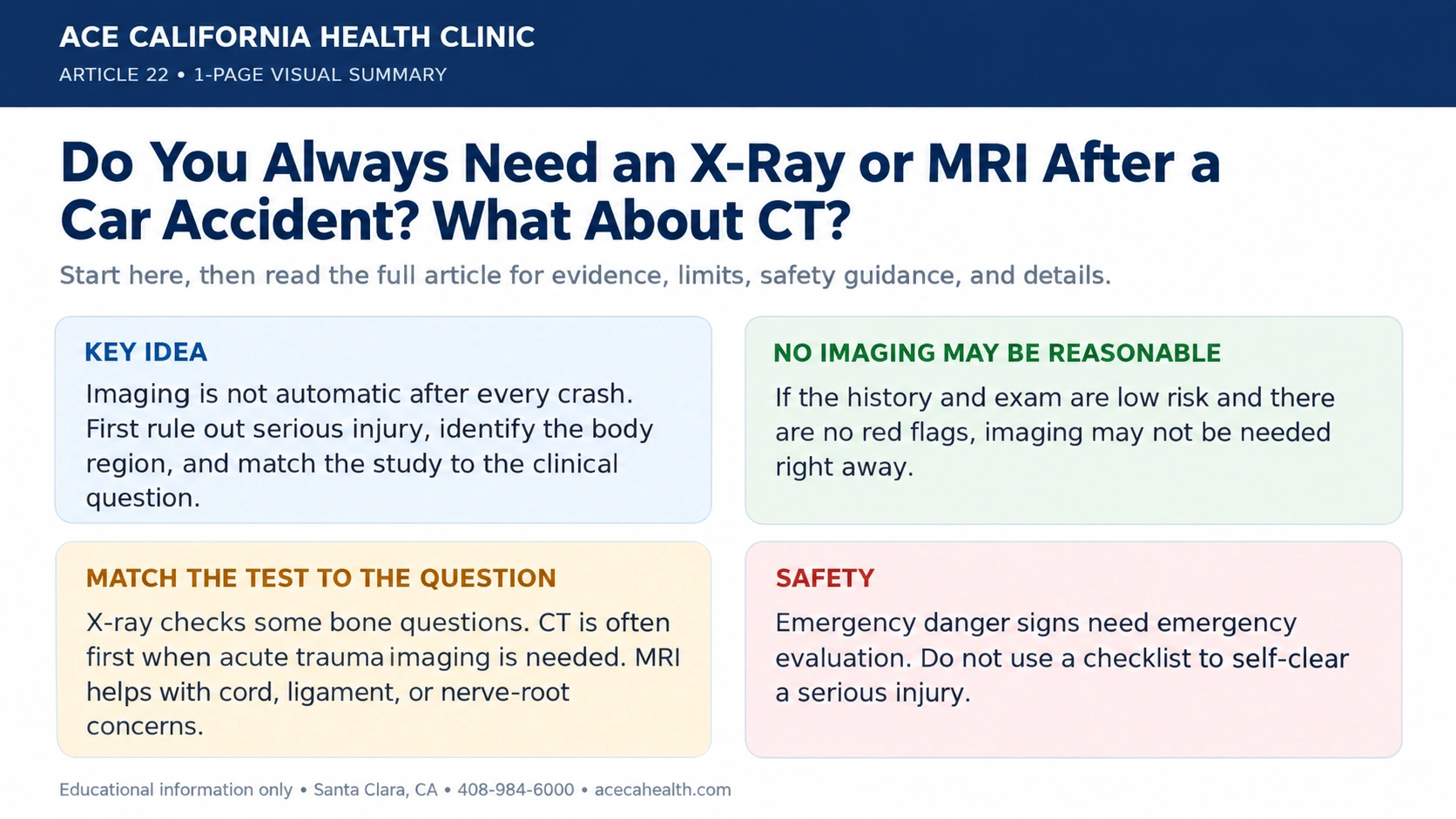
The short answer
A crash by itself does not determine the scan. The clinician first asks whether there is a meaningful risk of fracture, intracranial injury, spinal cord or nerve injury, or another problem for which imaging would change immediate management. If the clinical scenario is low risk, imaging may not be needed. If risk is higher, the appropriate first study may be CT rather than a plain X-ray or MRI.
For possible concussion or mild traumatic brain injury, symptoms can appear immediately or may not be noticed for hours or days. Worsening headache, repeated vomiting, seizure, marked confusion, unusual drowsiness, slurred speech, unequal pupils, or new weakness/numbness are among the danger signs that warrant emergency evaluation.[1]
First question: do you need imaging at all?
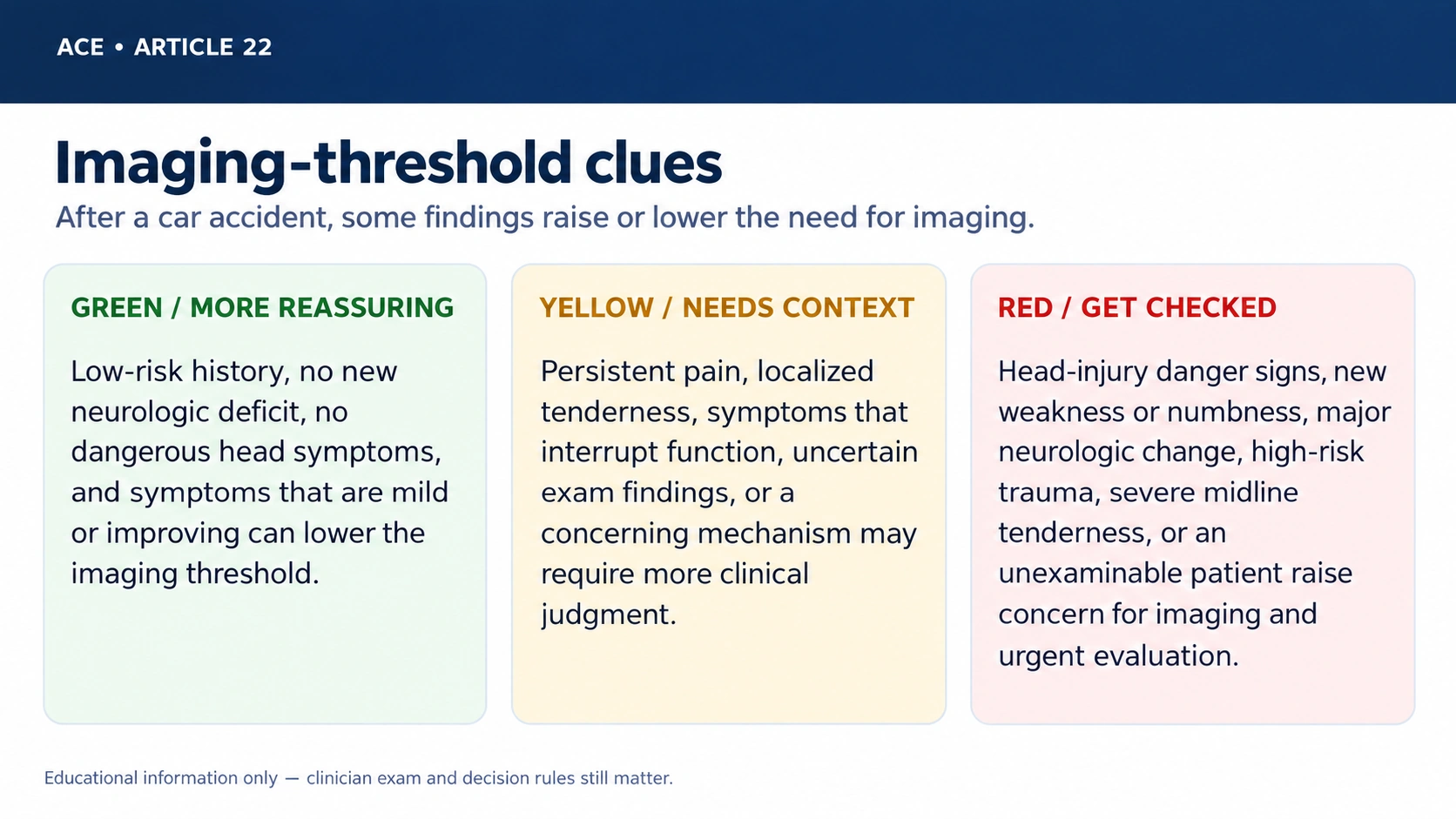
Imaging should answer a clinical question. Trauma guidelines use the mechanism of injury, age, neurologic status, examination findings, and validated decision rules to determine whether a scan is appropriate. These rules are designed for trained clinicians; they are not a do-it-yourself clearance checklist.
For adults with acute cervical blunt trauma who meet low-risk criteria under the Canadian C-Spine Rule or NEXUS, the American College of Radiology (ACR) rates cervical radiography, CT, and MRI as usually not appropriate for initial imaging. When those clinical criteria indicate that cervical imaging is needed, ACR rates noncontrast CT of the cervical spine as usually appropriate and plain radiography as usually not appropriate for the initial study.[3]
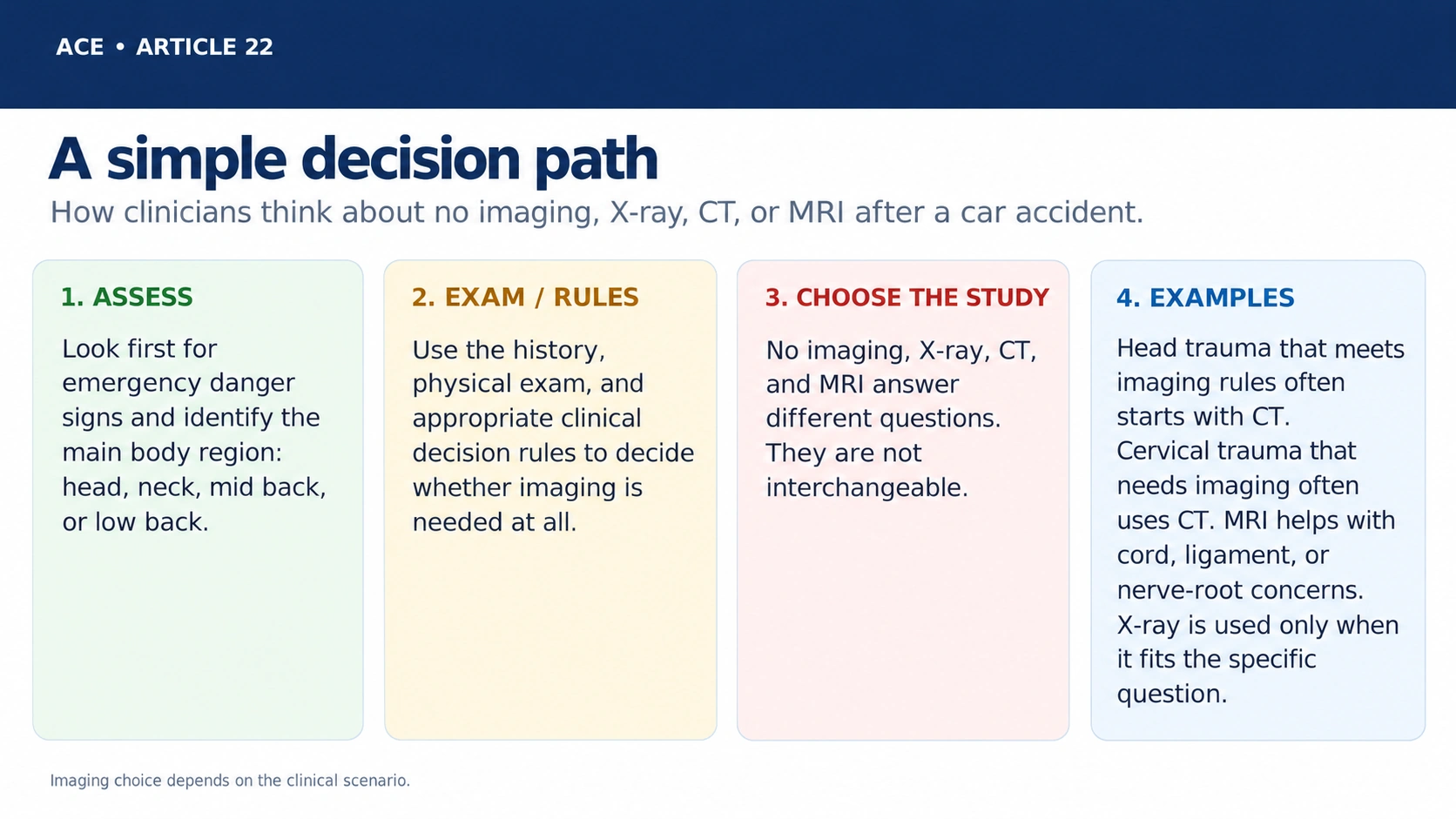
X-ray, CT, and MRI answer different questions
X-ray
Plain radiographs use ionizing radiation and can still be useful for selected body regions and suspected injuries. But they are not automatically the best first study for every post-collision complaint. For adult acute cervical blunt trauma when imaging is indicated, ACR favors CT over cervical radiographs for the initial study.[3]
CT
CT also uses ionizing radiation but produces cross-sectional images quickly. In several acute-trauma scenarios it is the preferred initial test when imaging is indicated—for example, noncontrast head CT in mild acute head trauma when a validated clinical decision rule calls for imaging, and noncontrast cervical CT when cervical imaging is indicated after blunt trauma.[2][3]
MRI
MRI does not use ionizing radiation and is often used selectively when the concern is ligamentous injury, spinal cord injury, nerve-root injury, or another soft-tissue/neural question. ACR rates noncontrast MRI of the affected spine region as usually appropriate as the next study when ligamentous, spinal cord, or nerve-root injury is suspected or confirmed after blunt trauma.[3]
No imaging
Some presentations do not benefit from routine imaging. ACR notes that acute uncomplicated low back pain without red flags generally does not warrant initial imaging; this is different from a high-risk or unexaminable trauma presentation.[4]
If there may be a head injury
For mild acute head trauma with a Glasgow Coma Scale score of 13–15, ACR separates patients by whether a validated clinical decision rule indicates imaging. When imaging is indicated by that rule, noncontrast head CT is rated usually appropriate; MRI is generally not the initial test in that scenario.[2]
This does not mean every headache after a collision needs a CT scan. It means the imaging threshold depends on the complete clinical picture. CDC danger signs after a possible mild traumatic brain injury require emergency medical evaluation rather than waiting for a routine office visit.[1]
If the concern is the neck or cervical spine
Adult cervical-spine trauma is one of the clearest examples of why “X-ray or MRI?” is not the right first question. If validated low-risk criteria indicate that imaging is not required, routine cervical imaging is generally not recommended. If clinical criteria indicate that imaging is required, ACR rates noncontrast cervical CT as usually appropriate for the initial study.[3]
MRI enters the pathway for a different reason. When the exam or prior imaging raises concern for ligamentous injury, spinal cord injury, or nerve-root injury, noncontrast MRI of the involved spine region is usually appropriate as a next study.[3]
If the concern is the mid or low back
For acute thoracic or lumbar blunt trauma in a high-risk or unexaminable adult, ACR rates noncontrast CT of the involved spine region as usually appropriate for initial imaging, while radiography and MRI are generally not the preferred initial studies in that specific scenario.[3]
That is different from ordinary acute low back pain without red flags or significant trauma. In that non-trauma, uncomplicated scenario, ACR states that imaging is typically not warranted initially and rates routine lumbar radiography, CT, and MRI as usually not appropriate.[4]
The distinction matters: “back pain after a crash” cannot be reduced to a generic rule that everyone needs a scan—or that nobody does.
When MRI may become more relevant
MRI is particularly useful when the question involves neurologic structures or soft tissues that are not adequately answered by the initial trauma study. Examples include suspected spinal cord, ligamentous, or nerve-root injury after blunt trauma.[3]
MRI is not automatically “better” because it shows more soft-tissue detail. A test is useful when it addresses the clinical question at the right time and its result can reasonably change management.
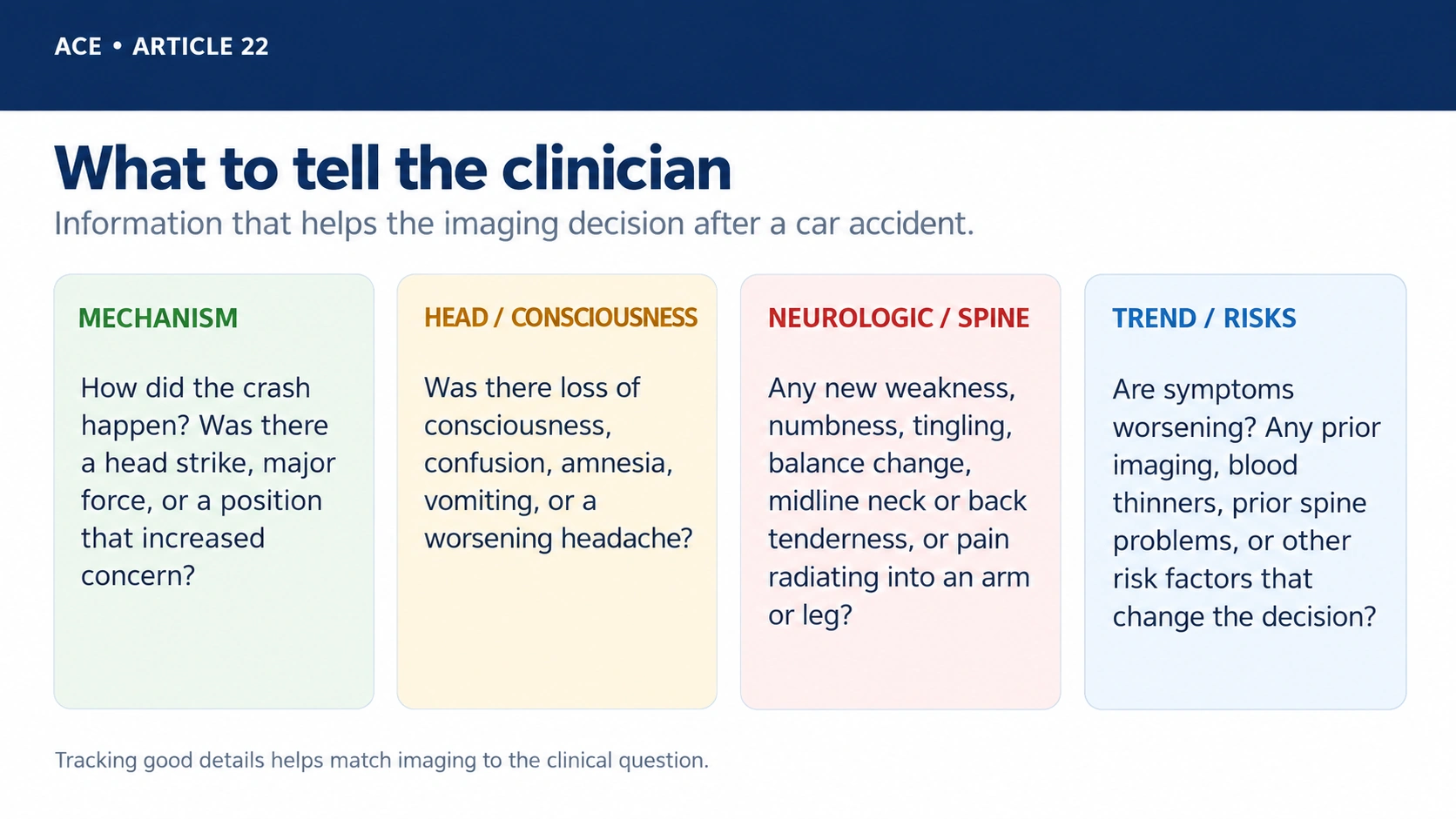
What information helps the imaging decision?
Bring a clear timeline. Useful details include:
- how the collision occurred and where you were seated;
- whether your head struck anything or you lost consciousness, felt confused, or had memory gaps;
- new numbness, tingling, weakness, balance problems, or loss of coordination;
- neck, mid-back, or low-back pain location and whether there is midline tenderness;
- worsening headache, repeated vomiting, unusual drowsiness, seizure, or other neurologic change;
- what imaging or emergency evaluation has already been performed;
- medications and health factors that may change risk, such as anticoagulant use or known bone fragility.
When to seek prompt or emergency medical care
Do not wait for a routine imaging discussion if the situation may be emergent.
Seek emergency medical evaluation when appropriate, especially for:
- worsening headache that does not go away, repeated vomiting, seizure, slurred speech, marked confusion, unusual drowsiness, unequal pupils, or inability to wake after a head injury;
- new weakness, numbness, decreased coordination, or rapidly changing neurologic symptoms;
- loss of bladder or bowel control, saddle/groin numbness, or rapidly progressive leg weakness;
- significant chest or abdominal pain, shortness of breath, fainting, or other signs of serious trauma.
An emergency department may choose imaging based on trauma protocols that are different from the decision process for a stable outpatient with improving symptoms.
Questions to ask about imaging in Santa Clara
Ask what question the scan is meant to answer
“What injury are we trying to rule in or rule out, and how would the result change what happens next?”
Ask why this modality
“Why is CT, MRI, X-ray, or no imaging the best fit for my current findings?”
ACE California Health Clinic can evaluate musculoskeletal complaints after a collision within the clinic’s scope and can recommend referral for medical or emergency assessment when the presentation requires care outside that scope. This article does not determine whether you personally need imaging.
Have post-collision symptoms evaluated?
For non-emergency musculoskeletal concerns, contact ACE California Health Clinic in Santa Clara. Bring any emergency records or prior imaging reports. If you have emergency danger signs, seek emergency medical care instead of waiting for a clinic appointment.
Frequently asked questions
Does every car accident require imaging?
No. The need for imaging depends on the clinical scenario. Low-risk presentations may not require imaging, while head injury, high-risk spine trauma, neurologic findings, or other concerning features may change the threshold.
If my neck hurts after a crash, is an X-ray always the first test?
No. In adults with acute cervical blunt trauma, ACR guidance uses clinical decision rules to determine whether imaging is needed. When those criteria indicate imaging, noncontrast cervical CT is generally the preferred initial study rather than plain radiographs.
When is MRI useful after a car accident?
MRI may be useful when the clinical concern involves the spinal cord, ligaments, nerve roots, or another soft-tissue/neural question. It is often a selective next study rather than the automatic first trauma scan.
Can a concussion require CT instead of MRI?
Yes. For mild acute head trauma when a validated decision rule indicates imaging, ACR rates noncontrast head CT as usually appropriate for the initial study. MRI is generally not the first test in that specific scenario.
If my low back hurts after a minor crash, do I automatically need an MRI?
No automatic rule applies. Uncomplicated acute low back pain without red flags generally does not require routine initial imaging, but significant trauma, neurologic changes, or an inability to be reliably examined can change the imaging pathway.
References
- CDC — Symptoms of Mild TBI and Concussion. Updated Sept. 15, 2025; verified for this revision Sept. 20, 2026.
- American College of Radiology — Appropriateness Criteria: Head Trauma. Verified for this revision Sept. 20, 2026.
- American College of Radiology — Appropriateness Criteria: Acute Spinal Trauma. Revised 2024; verified Sept. 20, 2026.
- American College of Radiology — Appropriateness Criteria: Low Back Pain. Verified for this revision Sept. 20, 2026.
Medical disclaimer: This article is for general education. It is not a diagnosis, an emergency screening tool, or a personal imaging recommendation. Imaging choices after trauma depend on the individual clinical scenario. Seek emergency evaluation for severe, rapidly worsening, neurologic, or otherwise concerning symptoms.