
Pickleball is easy to start, social, and fun enough that many people play more often than they expected. But the sport asks the forearm to grip, stabilize the wrist, control the paddle, absorb repeated ball contact, and reproduce the same motions hundreds of times.
That is one reason elbow pain can become a problem.
The condition many players call “pickleball elbow” is often lateral epicondylitis, also called lateral epicondylalgia or lateral elbow tendinopathy. It affects the tendon region on the outside of the elbow where several wrist-extensor muscles attach.
For a player, the important questions are usually practical:
- Why did this happen?
- How do I know whether it is actually pickleball elbow?
- Should I stop playing?
- What treatment helps?
- How long does recovery take?
- How can I keep it from coming back?
- How can ACE California Health Clinic help me return to the court?
This guide walks through that process from injury mechanism to diagnosis, treatment, rehabilitation, prognosis, prevention, and return to pickleball.
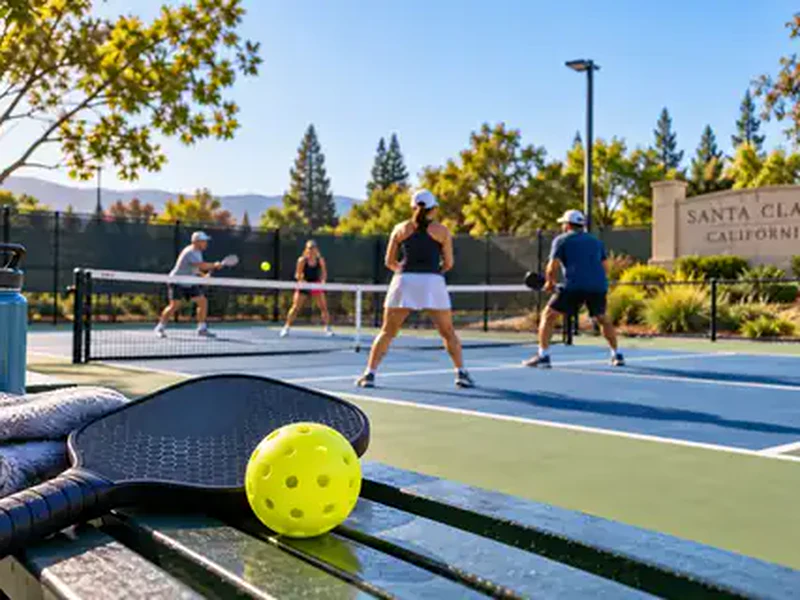
What exactly is “pickleball elbow”?
“Pickleball elbow” is not a separate medical diagnosis. It is a convenient name players use for elbow pain associated with pickleball.
When the pain is on the outside of the elbow, one common diagnosis is lateral epicondylitis or lateral elbow tendinopathy.
The involved tissues include the forearm muscles and tendons that help extend and stabilize the wrist. One muscle that is commonly discussed is the extensor carpi radialis brevis (ECRB).
These tissues are active when you:
- grip the paddle
- stabilize your wrist during contact
- hit forehands and backhands
- control volleys
- generate spin
- carry objects with the palm facing down
- lift, twist, or grip during normal daily activities
Although the term “epicondylitis” sounds like a simple inflammatory problem, persistent cases are better thought of as a tendon-loading problem. Repeated stress can exceed the tendon’s current capacity, producing pain and structural changes over time.
That matters because successful recovery usually requires more than simply waiting for inflammation to disappear. The tendon eventually needs to tolerate load again.
Why can pickleball trigger lateral elbow pain?
Pickleball looks easier on the arm than tennis because the paddle is smaller and the ball is light.
But the forearm still performs a large amount of repetitive work.
Repeated gripping
Players often grip harder during fast exchanges, difficult shots, or when they are worried about losing paddle control.
A tighter grip means the forearm muscles work harder.
Repeated wrist stabilization
The wrist does not simply swing freely during every shot. The muscles around the forearm repeatedly stabilize the wrist while force passes from the paddle into the hand and arm.
Late or off-center contact
When the ball is contacted late, away from the body, or outside the paddle’s ideal contact area, the forearm may have to work harder to control the paddle.
Sudden increases in playing volume
A common pattern is:
“I started playing once a week, loved it, and now I’m playing four or five times a week.”
Skill and enthusiasm can increase faster than tendon capacity.
Technique and equipment factors
Paddle weight, grip size, grip pressure, stroke mechanics, playing style, and how much spin a player tries to generate may affect load on the elbow.
These factors do not mean there is one “bad paddle” or one motion that causes every case. They are pieces of the workload puzzle.
Pickleball research: elbow problems are real, but not every case is lateral epicondylitis
Recent pickleball research is useful because it shows why the elbow should actually be examined rather than diagnosed from the sport alone.
A 2026 clinical series from a tertiary orthopedic and rehabilitation center reviewed 164 pickleball-related injuries. Only eight involved the elbow, so the elbow sample was small. Among those eight cases, 75% were diagnosed as lateral epicondylitis, and most known-sided elbow problems were on the paddle side.
That does not mean 75% of all pickleball players with elbow pain have lateral epicondylitis. It only describes that small clinical sample.
Another study examined 129 recreational pickleball players courtside and actually found positive tests for medial epicondylalgia were more common than positive tests for lateral epicondylalgia.
The practical lesson is important:
Do not assume every pickleball player with elbow pain has “tennis elbow.”
Location, mechanism, examination findings, nerve symptoms, trauma, and other factors all matter.
What does lateral epicondylitis usually feel like?
Common symptoms can include:
- pain or tenderness on the outside of the elbow
- pain spreading into the upper forearm
- pain when gripping the paddle
- discomfort with backhands or volleys
- pain lifting a mug, pan, bag, or other object
- pain turning a doorknob
- pain when the wrist is extended against resistance
- reduced grip strength because gripping hurts
- soreness that returns when playing volume increases
Some people mainly notice discomfort during pickleball.
Others start noticing it during ordinary activities long after the game is over.
How is pickleball elbow diagnosed?
Lateral epicondylitis is often diagnosed from the history and physical examination.
A clinician may ask:
- Where exactly does it hurt?
- When did it start?
- Was there one traumatic event or did it build gradually?
- Which pickleball strokes aggravate it?
- How often are you playing?
- Did your playing volume recently change?
- Did you recently change paddles, grip size, or technique?
- Does the pain travel farther down the forearm?
- Is there numbness or tingling?
- Do neck movements change the symptoms?
- Is gripping weak because of pain, or truly neurologically weak?
The physical examination may include:
- palpation of the outer elbow
- resisted wrist or finger extension
- grip testing
- elbow and wrist range of motion
- shoulder function
- cervical spine screening when appropriate
- neurological testing when symptoms suggest nerve involvement
- evaluation of movement and functional limitations
Do you always need an X-ray or MRI?
No.
For a typical case, history and examination are often enough.
Imaging may become useful when:
- there was significant trauma
- fracture is possible
- motion is substantially restricted
- symptoms are unusual
- the diagnosis is uncertain
- there is concern for a significant tendon tear or other pathology
- symptoms persist despite an appropriate course of conservative care
Depending on the situation, imaging may include X-ray, ultrasound, or MRI.
What else can look like pickleball elbow?
This is one of the most important parts of the evaluation.
Pain on or around the outside of the elbow can also be associated with:
- radial nerve or radial tunnel problems
- referred pain from the cervical spine
- elbow joint irritation or arthritis
- ligament injury
- tendon tear
- fracture after a fall
- shoulder or wrist dysfunction altering upper-extremity mechanics
- medial epicondylalgia when the pain is actually on the inside of the elbow
If the wrong condition is treated, recovery may stall.
That is why ACE’s first step is evaluation before treatment.
Three questions we want to answer before treating pickleball elbow
Before choosing a treatment, we want to answer three practical questions:
1. Is the pain actually coming from the elbow tendon?
Outer-elbow pain can resemble lateral epicondylitis while actually involving a nerve, the cervical spine, the elbow joint, a traumatic injury, or another tendon problem.
The first goal is to identify the most likely pain source.
2. What is keeping the tissue overloaded?
The next question is what continues to stress the area.
Possible contributors may include playing volume, grip pressure, work demands, strength deficits, mobility restrictions, technique, equipment fit, or another musculoskeletal problem.
3. What does the arm need to tolerate before returning to pickleball?
Feeling better at rest is not the same as being ready for repeated gripping, volleys, backhands, serves, and multiple games.
Treatment should therefore build toward the actual demands the player needs to tolerate on the court.
Those three answers help determine which parts of chiropractic care, acupuncture, physiotherapy, and rehabilitation exercise are appropriate for the individual patient.
Treatment: what is usually recommended?
There is no single treatment that every person with lateral epicondylitis needs.
The overall goal is to:
- reduce excessive irritation
- maintain useful movement
- rebuild tendon and muscle capacity
- correct modifiable contributing factors
- gradually return to pickleball
At ACE California Health Clinic, treatment may combine chiropractic care, acupuncture, physiotherapy, and rehabilitation exercise when those components are appropriate for the individual patient.
The treatments support different parts of the recovery process.
Step 1: modify the load without automatically shutting everything down
The irritated tendon needs a workload it can tolerate.
That may mean temporarily reducing:
- number of games
- consecutive playing days
- hard backhands
- high-volume drilling
- forceful gripping
- activities outside pickleball that provoke the same tendon
Complete rest is not always the goal.
Too much load can keep the area irritated, while prolonged avoidance of all loading does not rebuild capacity.
The better target is often relative rest followed by progressive loading.
Step 2: chiropractic care — evaluate the entire upper-extremity chain
At ACE, chiropractic care for a pickleball player is not simply “adjust the elbow.”
The evaluation can include the:
- cervical spine
- upper back
- shoulder
- elbow
- forearm
- wrist
- grip
- movement pattern used during daily tasks and sport
Why does that matter?
The forearm does not work independently. A player who has restricted shoulder motion, poor upper-back mobility, neck-related referral, wrist restriction, or altered mechanics may load the elbow differently.
When examination findings indicate a role for manual care, chiropractic treatment may include appropriate joint mobilization/manipulation, soft-tissue techniques, and movement correction.
Current research on manual therapy for lateral elbow pain suggests possible short-term benefit, but the evidence is low certainty and benefits are not clearly sustained long term.
For that reason, at ACE we view manual/chiropractic care as a supporting part of a larger program, not a replacement for progressive rehabilitation.
Step 3: acupuncture — help manage pain while recovery progresses
Acupuncture can be useful as an adjunct when pain is limiting normal use of the arm or making rehabilitation difficult to tolerate.
Research on acupuncture for lateral epicondylalgia has found short-term improvements in pain and disability, although the overall evidence quality is limited and stronger studies are still needed.
That is the right way to think about its role:
Acupuncture may help with symptoms and function while the patient continues the mechanical work of recovery.
At ACE, acupuncture may be used as an adjunct to help:
- reduce pain
- improve short-term function
- make gripping and normal movement more comfortable
- make rehabilitation easier to tolerate
It should not be presented as a substitute for rebuilding tendon capacity.
Step 4: physiotherapy — support movement and symptom control
Physiotherapy can help bridge the gap between pain control and active rehabilitation.
Depending on the examination findings, ACE may use physiotherapy approaches to:
- improve soft-tissue mobility
- reduce muscle guarding
- improve local movement tolerance
- address forearm and surrounding muscle restrictions
- improve elbow, wrist, shoulder, or upper-back mobility
- prepare the arm for strengthening exercises
- teach activity modification and home care
The exact physiotherapy methods should be chosen for the patient rather than automatically applying the same modalities to every elbow.
The purpose is to help the patient move toward active recovery.
Step 5: rehabilitation exercise — rebuild the tendon and keep the improvement
This is the backbone of longer-term recovery.
Pain relief alone does not necessarily mean the tendon is ready for repeated pickleball.
Rehabilitation gradually rebuilds the amount of force the forearm can tolerate.
An individualized program may progress through:
Early controlled loading
Exercises may begin with tolerable muscle contractions that allow the patient to load the area without producing a major flare.
Wrist-extensor strengthening
As tolerance improves, strengthening can target the wrist-extensor muscles that attach near the painful region.
This may include progressive concentric and eccentric loading.
Grip strengthening
The patient gradually rebuilds the ability to grip and control objects without excessive pain.
Forearm rotation
Pronation and supination strength matter for paddle control and many daily activities.
Shoulder and scapular strength
The shoulder and upper back help position and control the arm.
Improving strength and control higher in the chain may reduce unnecessary demand on the forearm.
Functional and pickleball-specific progression
Later stages can include:
- holding the paddle
- short controlled swings
- light volleys
- progressive backhands and forehands
- serving
- drilling
- partial games
- eventually normal match play
The American Academy of Orthopaedic Surgeons provides an epicondylitis conditioning program that uses stretching and progressive strengthening and notes that such programs are commonly continued for 6 to 12 weeks, although an individual patient’s recovery may be shorter or longer.
Should you use a brace?
A counterforce forearm strap or certain braces can reduce symptoms for some patients during activity.
A brace does not rebuild tendon capacity by itself.
It is best viewed as a tool that may help control symptoms while activity and rehabilitation are adjusted.
Fit matters, and not everyone finds a brace helpful.
What about injections or surgery?
Most patients are initially treated conservatively.
If symptoms remain persistent despite an appropriate rehabilitation program, a medical or orthopedic specialist may discuss other options.
Mayo Clinic notes that several procedures are used for resistant cases and that surgery is rarely required. Surgery is generally considered only after months of unsuccessful conservative treatment.
Corticosteroid injection is also not routinely recommended as a long-term solution because research has not shown strong sustained benefit.
ACE’s role is to recognize when progress is not following the expected pattern and when referral is appropriate.
Prognosis: how long does pickleball elbow take to heal?
There is no single recovery timeline.
Structured rehabilitation programs commonly run for approximately 6 to 12 weeks, but that does not mean every tendon problem is resolved on the same calendar. Some patients improve sooner, while longstanding or highly irritable cases may take several months.
A player may feel significantly better before the tendon has fully rebuilt its tolerance for repeated games.
Progress is better judged by function, strength, activity tolerance, and response to increasing load than by the number of weeks since treatment began.
Factors that can influence recovery include:
- how long symptoms were present before treatment
- how painful and irritable the tendon is
- age and general health
- playing frequency
- work or hobbies that also load the forearm
- adherence to rehabilitation
- strength deficits
- whether the correct diagnosis was made
- whether the player returns too quickly to the same workload
Most people are managed without surgery and can return to desired activities over time.
Instead of focusing only on a calendar date, useful recovery markers include:
- daily gripping is comfortable
- pain is steadily decreasing
- wrist-extensor strength is improving
- grip strength is improving
- normal work and household activities are tolerated
- light paddle work does not cause a major flare
- practice volume can increase without symptoms escalating
How to return to pickleball safely
A return-to-play plan should be progressive.
One possible sequence is:
Phase 1 — Daily activities
Comfortable gripping, lifting, typing, carrying, and household tasks.
Phase 2 — Paddle handling
Short periods holding the paddle and performing slow, unloaded swing patterns.
Phase 3 — Light hitting
Controlled short-court hitting and easy volleys.
Phase 4 — Stroke progression
Gradually increase forehands, backhands, serves, and spin as tolerated.
Phase 5 — Practice volume
Increase duration before increasing intensity.
Phase 6 — Match play
Return to games with limits on duration or consecutive sessions before resuming the previous schedule.
A patient should not be advanced based only on “I can tolerate the pain.”
The goal is improving capacity and function.
How to reduce the chance of pickleball elbow coming back
1. Increase playing volume gradually
Do not jump from occasional play to daily multi-hour sessions simply because the sport is enjoyable.
Tendons adapt more slowly than enthusiasm.
2. Warm up the forearm, shoulder, and trunk
A warm-up can include easy movement, wrist and forearm motion, shoulder mobility, and progressive hitting before harder rallies.
3. Avoid gripping the paddle harder than necessary
A death grip increases forearm work.
Grip firmly enough to control the paddle without maintaining unnecessary tension through every shot.
4. Review paddle and grip fit
Paddle weight, balance, and grip size can change how much work your hand and forearm perform.
Equipment changes should be individualized rather than assuming one paddle is ideal for everyone.
5. Improve stroke mechanics
Repeated late contact or inefficient strokes may increase demand on the arm.
A qualified pickleball instructor can help evaluate sport-specific technique.
6. Maintain forearm and upper-extremity strength
Do not stop strengthening as soon as the pain disappears.
Maintenance work for the forearm, grip, shoulder, and upper back can help preserve capacity.
7. Respect recovery
Back-to-back hard sessions may exceed what a recovering tendon can tolerate.
Sleep, recovery time, and total weekly workload matter.
8. Address symptoms early
A mild recurring ache is usually easier to address than a problem that has been aggravated for months.
How ACE California Health Clinic can help a pickleball player from start to finish
ACE’s advantage is not that every patient receives every treatment.
It is that the clinic can guide the patient through the entire conservative-care pathway and select the combination of chiropractic care, acupuncture, physiotherapy, and rehabilitation exercise that fits the examination findings.
Step 1 — Evaluation and working diagnosis
The first visit focuses on determining whether the presentation actually fits lateral epicondylitis.
The examination may also screen for:
- cervical referral
- nerve involvement
- shoulder contribution
- wrist dysfunction
- joint pathology
- traumatic injury
- another tendon condition
If imaging, sports-medicine consultation, or orthopedic evaluation is appropriate, referral becomes part of the plan.
Step 2 — Identify what is continuing to overload the elbow
We look beyond the painful spot.
That may include reviewing:
- recent increases in playing frequency
- grip pressure
- work or household demands
- forearm strength and endurance
- shoulder or upper-back mobility
- wrist mechanics
- equipment fit
- pickleball technique
- recovery between sessions
The purpose is to identify modifiable factors that may be keeping the tendon irritated.
Step 3 — Make movement and exercise more tolerable
Depending on the findings, chiropractic care, acupuncture, and physiotherapy may be used to help reduce symptoms, improve clinically relevant mobility, and make normal arm use or rehabilitation more comfortable.
These treatments support recovery, but they do not replace progressive tendon loading.
Step 4 — Rebuild capacity with rehabilitation exercise
Rehabilitation is progressed according to the patient’s tolerance and goals.
The program may address:
- wrist-extensor capacity
- forearm strength
- grip
- pronation and supination control
- shoulder and scapular strength
- functional lifting and carrying
- tolerance for repeated paddle use
This is where short-term symptom improvement is converted into longer-term capacity.
Step 5 — Progress back to pickleball
As strength and tolerance improve, rehabilitation becomes more sport-specific.
We can gradually reintroduce:
- paddle gripping
- forehands and backhands
- volleys
- serves
- drilling
- longer practice sessions
- partial games
- normal match play
Progression is based on how the arm responds, not simply on whether the patient can tolerate pain.
Step 6 — Prevention and maintenance
Before discharge, we want the patient to understand what may have contributed to the problem and how to reduce the chance of recurrence.
That may include:
- controlling weekly playing volume
- maintaining forearm and shoulder strength
- improving warm-up habits
- reducing unnecessary grip tension
- reviewing equipment fit
- improving technique
- allowing adequate recovery
If progress does not follow the expected pattern, the plan is reassessed and referral is made when appropriate.
The goal is not simply to get you back on the court. It is to help you build enough capacity to stay there.
When elbow pain needs prompt medical attention
Pickleball also involves falls and traumatic injuries.
Seek prompt medical evaluation if elbow pain follows a significant fall or injury and you have:
- obvious deformity
- major swelling or bruising
- inability to move the elbow normally
- inability to use the arm
- a suspected fracture or dislocation
- sudden major weakness
- persistent numbness or tingling
- severe pain that is rapidly worsening
Those symptoms deserve appropriate medical evaluation rather than being treated as routine “pickleball elbow.”
Final thoughts
Pickleball elbow is usually not a reason to give up a sport you enjoy.
But repeatedly playing through an irritated tendon without changing the factors that overloaded it can turn a manageable problem into a long-lasting one.
Successful treatment usually follows a sequence:
identify the correct problem → reduce excessive irritation → restore movement → progressively rebuild strength → return to pickleball → prevent recurrence
At ACE California Health Clinic, that process can combine chiropractic care, acupuncture, physiotherapy, and rehabilitation exercise based on what the examination shows.
Different treatments have different jobs. Chiropractic care can address clinically relevant joint and movement findings. Acupuncture and physiotherapy may help make movement and rehabilitation more comfortable. Rehabilitation exercise progressively rebuilds the strength, endurance, and tendon capacity needed for longer-term return to sport.
Together, the goal is to move beyond temporary symptom relief toward:
getting you back to pickleball comfortably—and helping you stay active.
ACE California Health Clinic
345 Saratoga Ave.
Santa Clara, CA 95050
408-984-6000
If elbow pain is affecting your grip, backhand, daily activities, or ability to play pickleball, ACE California Health Clinic can evaluate the problem and determine whether chiropractic care, acupuncture, physiotherapy, rehabilitation exercise—or referral for additional evaluation—is appropriate.
Call 408-984-6000 to schedule an evaluation.
Frequently Asked Questions
Is pickleball elbow the same as tennis elbow?
Often, people use “pickleball elbow” to describe lateral epicondylitis, the same condition commonly called tennis elbow. But pickleball players can develop other elbow problems too, including medial epicondylalgia, nerve-related pain, traumatic injuries, and referred pain.
Do I have to stop playing pickleball completely?
Not always. Some patients can continue modified activity while reducing provoking loads. Others need a temporary break. The decision depends on pain severity, function, examination findings, and how symptoms respond to activity.
Can acupuncture help pickleball elbow?
Research suggests acupuncture may provide short-term improvement in pain and disability for lateral epicondylalgia, although the evidence quality is limited. At ACE it is used as an adjunct, not a replacement for progressive rehabilitation.
Can chiropractic care help?
Chiropractic care can be useful when examination identifies relevant joint, mobility, or biomechanical issues through the neck, upper back, shoulder, elbow, or wrist. Manual therapy may provide short-term symptom benefit, but rehabilitation remains important for rebuilding tendon capacity.
What is the most important part of treatment?
For many patients, progressive rehabilitation and load management are central to long-term recovery. Symptom-relieving treatments can make that process easier, but strength and capacity still need to be rebuilt.
How long does recovery take?
Structured rehabilitation programs often run for approximately 6 to 12 weeks, but recovery is individual. Some patients improve sooner, while longstanding or more irritable tendon problems may take several months. Progress should be based on function, strength, activity tolerance, and response to increasing load rather than the calendar alone.
When should I get imaging?
Many typical cases can be evaluated without imaging. Imaging may be considered after significant trauma, when the diagnosis is uncertain, when a fracture or significant tear is suspected, or when symptoms do not improve as expected.
Medical disclaimer: This article is for general educational purposes and does not replace an individual examination, diagnosis, or treatment plan. Treatment recommendations depend on the patient’s history, examination findings, diagnosis, goals, and overall health. Seek urgent or appropriate medical care for severe trauma, deformity, rapidly worsening symptoms, significant neurological symptoms, or other concerning findings.
References & further reading
- Mayo Clinic: Tennis elbow — diagnosis and treatment
- Mayo Clinic Orthopedics & Sports Medicine: Tennis Elbow (Lateral Epicondylitis)
- AAOS: Therapeutic Exercise Program for Epicondylitis
- Cochrane Review: Manual therapy and exercise for lateral elbow pain
- Systematic review: Acupuncture and electroacupuncture for lateral epicondylalgia
- Recreational pickleball players: medial and lateral epicondylalgia clinical tests
- Pickleball-related injuries treated at a tertiary academic center over five years