
Seat-Belt Soreness After a Crash: What It Can Mean
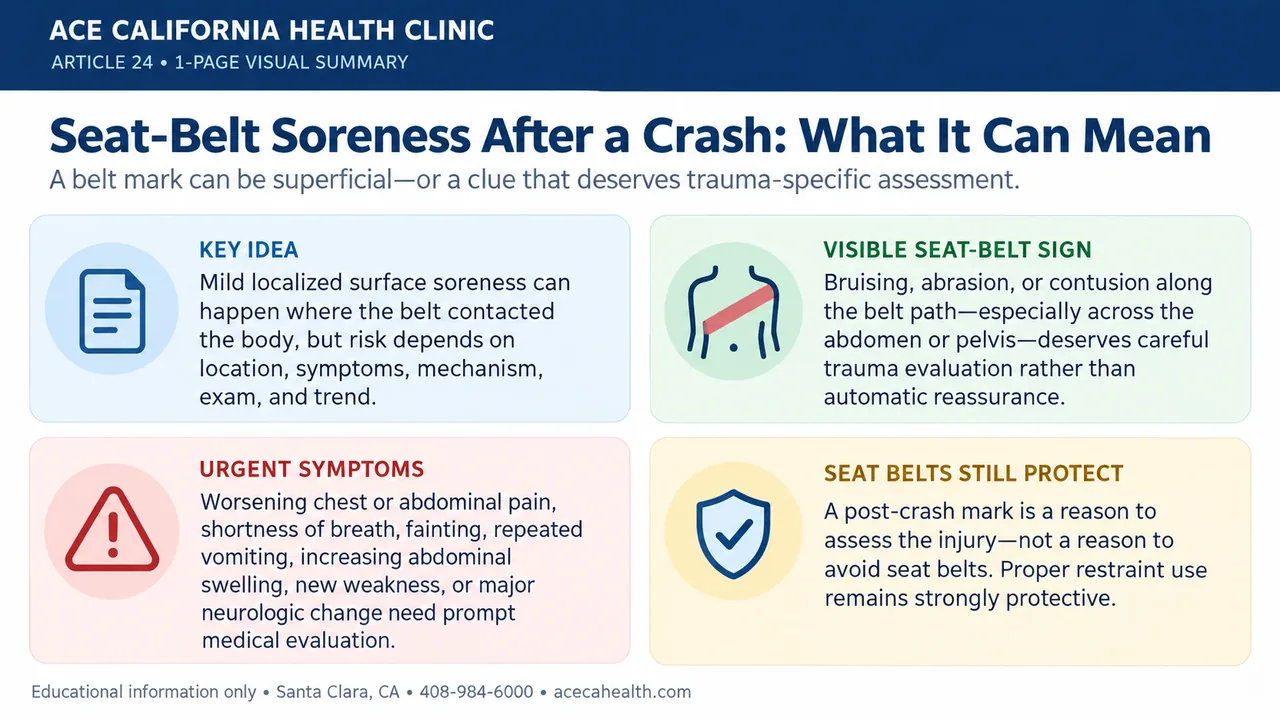
Seat-belt soreness can be superficial, but a visible belt-pattern bruise or abrasion—especially across the abdomen—can be a clue that the torso absorbed meaningful crash force. The key is not the mark alone; it is the mark, the crash mechanism, the symptoms, and the clinical examination together.
A seat belt is designed to restrain the body during a collision. That lifesaving force can also leave temporary soreness, redness, bruising, or abrasion. Most importantly, a post-crash mark is not a diagnosis by itself—and the absence of a mark does not prove that no internal injury occurred.
1-page visual summary
Start here for the major distinctions, then continue for evidence, limitations, and safety guidance.
The short answer
Seat-belt soreness after a crash is not one single clinical situation. At one end is mild, localized surface tenderness where the belt contacted the chest or pelvis. At the other is a visible seat-belt sign—a bruise, abrasion, or contusion along the restraint path—plus symptoms or examination findings that raise concern for chest, abdominal, pelvic, or spinal injury.
The safe question is therefore not “Is a belt mark normal?” but “What exactly is present, where is it located, is it getting better or worse, and are there signs of internal injury?”
What seat-belt soreness can mean
During a collision, the shoulder and lap portions of the restraint spread force across the body to reduce ejection and other catastrophic injury. That force can irritate skin, subcutaneous tissue, muscle, ribs, or the abdominal wall. A person may notice tenderness, redness, or bruising where the belt crossed the chest, shoulder, lower abdomen, or pelvis.
Mild surface soreness is not the same thing as an internal injury, but symptom intensity by itself cannot reliably make that distinction. The crash mechanism, location of the mark, vital signs, abdominal or chest examination, neurologic findings, and progression over time all matter.
What clinicians mean by a “seat-belt sign”
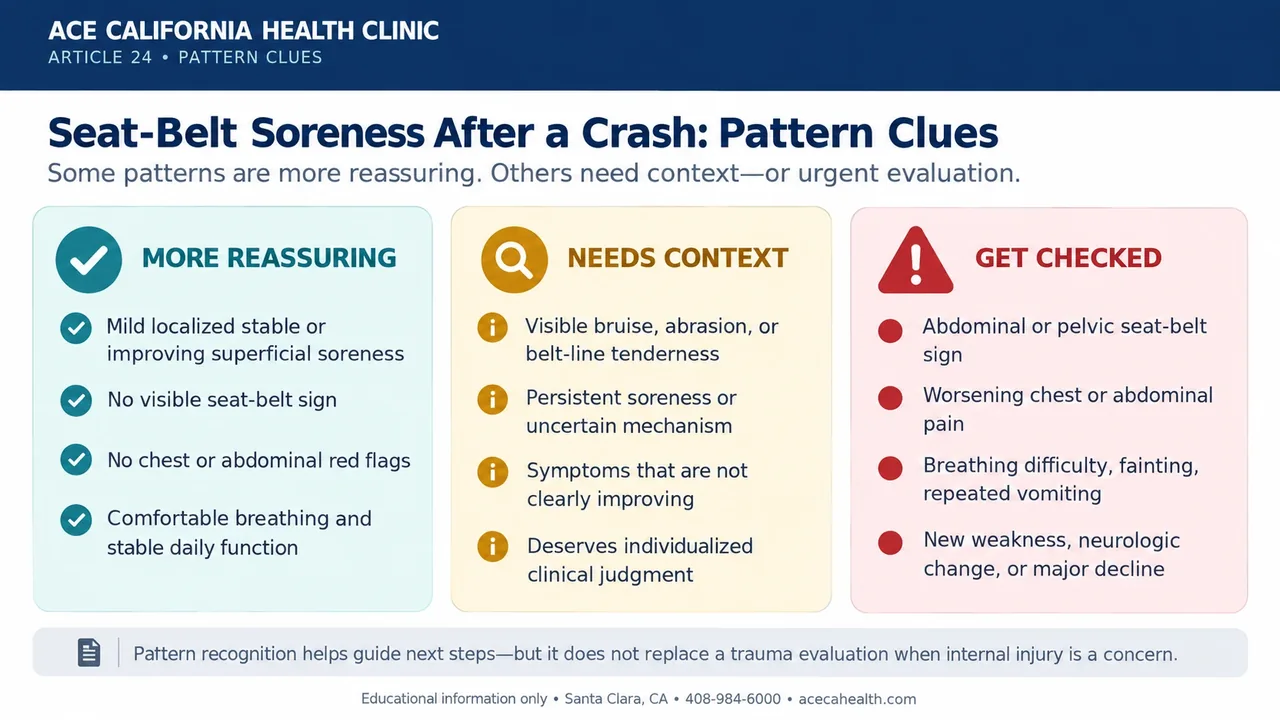
In trauma literature, a seat-belt sign generally refers to visible bruising, abrasion, or contusion in the distribution of the restraint. The 2025 American College of Radiology (ACR) Minor Blunt Trauma criteria include a specific adult scenario for a motor-vehicle collision with an abdominal/pelvic seat-belt sign. In that setting, possible injuries include solid-organ, mesenteric, or bowel injury, and CT of the abdomen and pelvis with IV contrast is rated Usually Appropriate as initial imaging. [1]
This does not mean that every visible mark equals internal injury or surgery. In a 2020 trauma-center cohort of 425 patients with an abdominal seat-belt sign, 36.1% had some intra-abdominal injury on CT and 13.6% required laparotomy. The study also reported very high sensitivity of modern CT in that specific cohort. [2] The practical message is that the sign raises concern and should be evaluated in context—not that a patient should self-diagnose based on the skin appearance.
Why location matters: chest versus abdomen
Chest / shoulder belt area
Soreness or bruising over the chest can come from chest-wall contact, but severe or worsening chest pain, shortness of breath, faintness, coughing blood, or major breathing limitation changes the urgency. Rib, lung, cardiac, and other thoracic injuries cannot be ruled out by the skin appearance alone.
Abdomen / lap-belt area
A visible abdominal seat-belt sign deserves particular attention because bowel, mesenteric, solid-organ, abdominal-wall, and other injuries may occur after blunt force. Worsening pain, increasing tenderness, distention, repeated vomiting, fainting, or systemic deterioration should not be managed as routine soreness.
A safer decision path after a crash
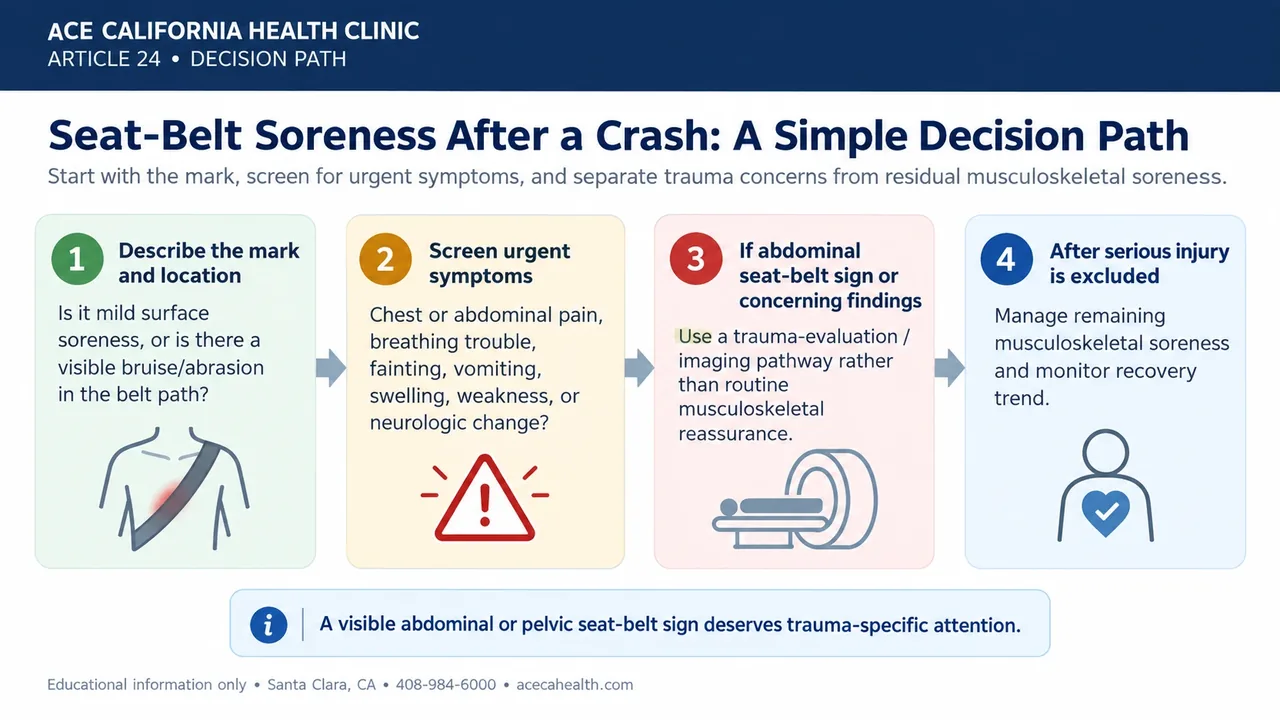
1. Describe the finding
Where did the belt cross? Is there only tenderness, or also redness, abrasion, bruising, swelling, or a distinct belt-shaped mark?
2. Check the symptom pattern
Is pain stable or worsening? Is there abdominal tenderness, breathing difficulty, dizziness, vomiting, neurologic change, or a major loss of function?
3. Match the evaluation to the risk
A clinician may use mechanism, vital signs, examination findings, and trauma imaging criteria to decide whether emergency evaluation or imaging is needed.
4. Only after urgent injury is excluded
If the remaining problem is superficial or musculoskeletal, follow-up can then focus on comfort, mobility, function, and recovery.
What to track over the next hours and days
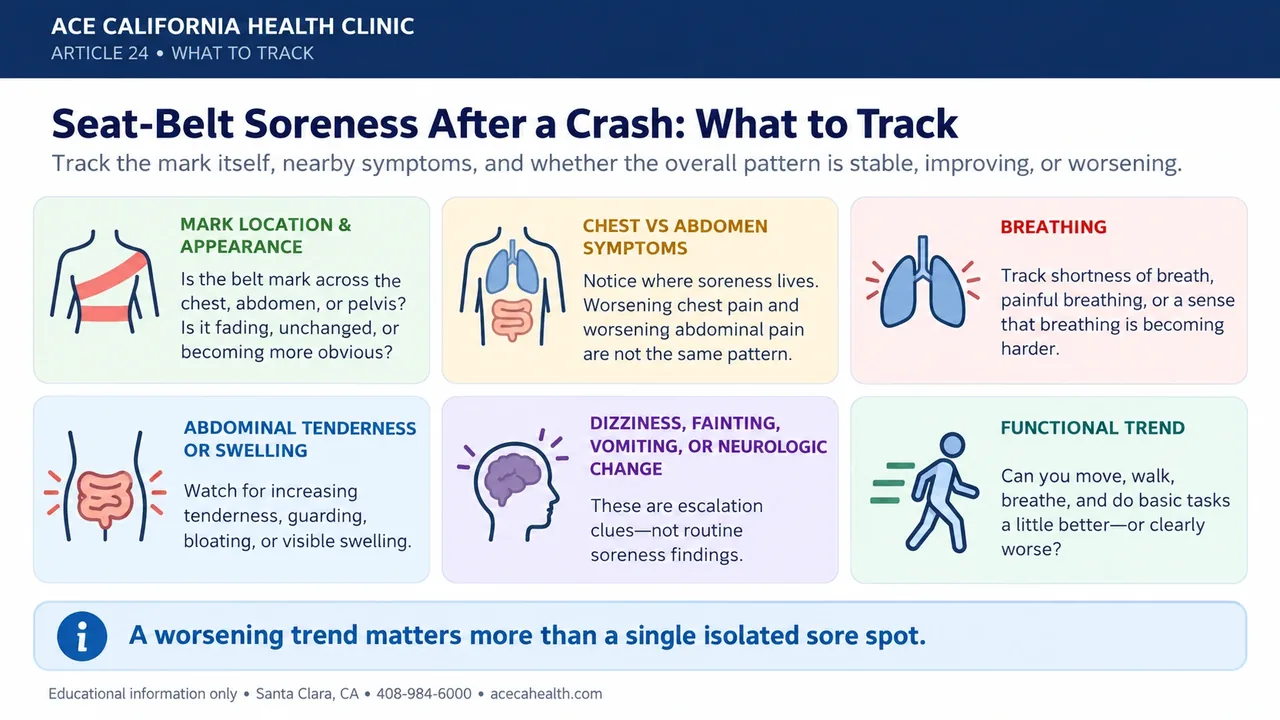
After an initial medical assessment, changes over time matter. Useful observations include:
- whether the mark is only superficial or accompanied by deeper chest/abdominal tenderness;
- whether pain is improving, stable, or worsening;
- new abdominal swelling, repeated vomiting, dizziness, fainting, or unusual weakness;
- shortness of breath or increasing pain with breathing;
- new numbness, weakness, balance difficulty, confusion, severe headache, or other neurologic change;
- changes in walking, sleeping, eating, driving, or other normal function.
When imaging may enter the picture
Imaging after a crash should answer a specific trauma question. For an adult with minor blunt trauma from an MVC and an abdominal/pelvic seat-belt sign, the current ACR Minor Blunt Trauma criteria rate CT abdomen and pelvis with IV contrast as Usually Appropriate initial imaging. [1]
That recommendation is different from saying “every sore spot needs a scan.” A clinician still considers hemodynamic stability, mechanism, examination findings, symptom progression, and the body region involved. Chest, head, neck, and abdominal trauma each have different imaging pathways.
Older and newer seat-belt-sign studies consistently support heightened vigilance, while modern CT has improved the ability to evaluate stable patients. [2][3] A negative high-quality evaluation may be reassuring, but discharge and follow-up decisions still depend on the complete clinical picture and return precautions.
When to seek prompt or emergency medical care
Do not treat these as routine belt soreness
Seek prompt medical assessment—and emergency care when severe—if there is worsening abdominal pain or marked tenderness, abdominal swelling, repeated vomiting, fainting or near-fainting, shortness of breath, severe or worsening chest pain, coughing blood, confusion, severe or worsening headache, new weakness or numbness, major balance difficulty, or rapidly declining function.
If the crash was high energy, the person is medically fragile, takes anticoagulants, has altered consciousness, or cannot be examined reliably, the threshold for trauma evaluation may also be different. Online guidance cannot safely clear those situations.
What happens after serious injury is excluded?
Once urgent chest, abdominal, neurologic, or other traumatic injury has been appropriately excluded, the remaining soreness may be managed according to the actual findings. That can include temporary activity modification, comfortable movement, local symptom care, and reassessment of neck, back, shoulder, rib, or chest-wall function as appropriate.
The important sequence is triage first, routine musculoskeletal care second. Manual care, acupuncture, rehabilitation, or exercise should not be used as a substitute for trauma evaluation when internal injury is still a reasonable concern.
A belt mark is not a reason to stop wearing seat belts
Seat belts remain a critical protective restraint. NHTSA reports that, for front-seat passenger-car occupants, wearing a seat belt reduces the risk of fatal injury by about 45% and moderate-to-critical injury by about 50%. [4] The fact that a restraint can leave soreness or a mark in a crash does not mean the restraint was harmful overall.
The useful takeaway is: wear the seat belt every trip, and take a meaningful post-crash belt mark seriously enough to assess it properly.
Questions to ask after a crash in Santa Clara
- Does this look like superficial belt contact, or a true seat-belt sign that changes the trauma evaluation?
- Are my chest or abdominal findings concerning enough for emergency-department or trauma evaluation?
- If imaging is recommended, what specific injury are we trying to rule in or rule out?
- What symptoms should make me return for urgent or emergency care?
- After serious injury is excluded, what functional limits should I track during recovery?
Need follow-up after urgent injuries have been ruled out?
ACE California Health Clinic can evaluate residual musculoskeletal symptoms and coordinate referral when the clinical picture requires care outside our scope.
Frequently asked questions
Is a seat-belt bruise always dangerous?
No. A bruise or abrasion is not itself a diagnosis. But a visible abdominal seat-belt sign is associated with a higher risk of internal injury in trauma populations and should be assessed in the context of the crash, symptoms, and examination. [1][2]
Can I have an internal injury without a visible belt mark?
Yes. Skin findings alone cannot reliably rule internal injury in or out. Symptoms, mechanism, vital signs, examination findings, and appropriate imaging decisions matter more than the presence or absence of a mark by itself.
Does an abdominal seat-belt sign mean I automatically need surgery?
No. The sign raises concern; it does not automatically mean surgery. Current ACR criteria support CT abdomen/pelvis with IV contrast as the initial imaging pathway for the adult MVC seat-belt-sign scenario, and treatment depends on what the evaluation actually shows. [1]
What if the soreness is mild and getting better?
That is generally more reassuring than worsening pain, but it is not a substitute for appropriate post-crash assessment when the mechanism, location, visible mark, or associated symptoms raise concern. Continue to watch the trend and follow the return precautions you were given.
Should I avoid wearing a seat belt because it caused soreness?
No. Seat belts substantially reduce the risk of fatal and serious injury in crashes. [4] Post-crash soreness or a belt mark should prompt appropriate evaluation—not avoidance of seat belts.
References
- American College of Radiology. ACR Appropriateness Criteria® Minor Blunt Trauma. Current 2025 criteria; Variant 4 addresses adult MVC with abdominal/pelvic seat-belt sign.
- Shreffler J, et al. Patients with Abrasion or Ecchymosis Seat Belt Sign Have High Risk for Abdominal Injury, but Initial Computed Tomography is 100% Sensitive. J Emerg Med. 2020.
- Bansal V, et al. The utility of seat belt signs to predict intra-abdominal injury following motor vehicle crashes.
- National Highway Traffic Safety Administration. Seat Belt Safety.
This article is for general education and cannot diagnose an injury or determine whether imaging, emergency care, or treatment is appropriate for you. After a crash, seek emergency care for severe or rapidly worsening symptoms, breathing difficulty, fainting, major neurologic change, or other signs of serious injury.