
Whiplash Recovery Timeline: Why There Is No One-Size-Fits-All Answer
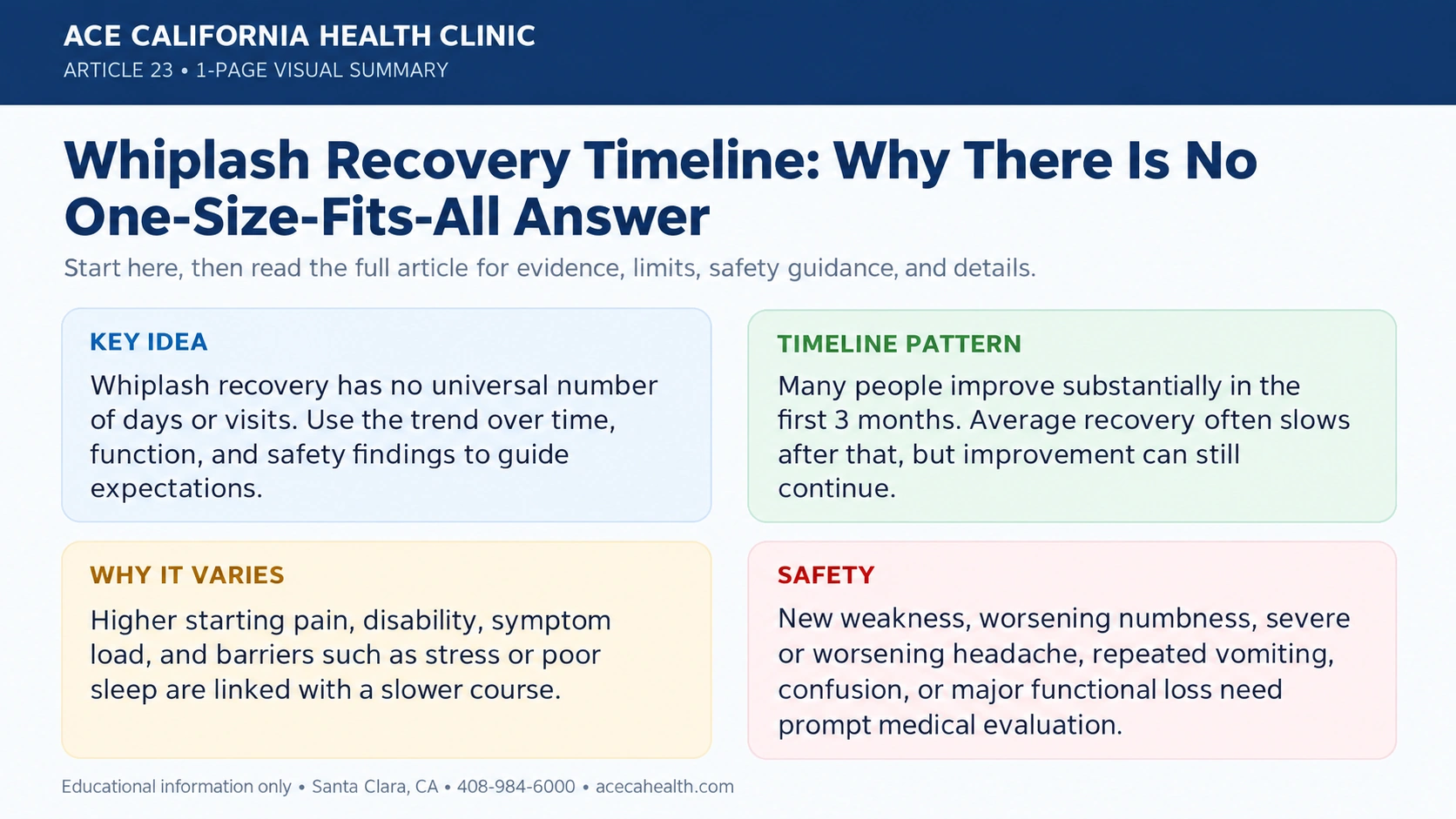
Whiplash does not run on a universal clock. Research shows wide variation: many people improve substantially in the first few months, while others recover more slowly or continue to have symptoms.
A useful recovery timeline is not a promise that you should be pain-free by a certain day. It is a framework for watching the direction of change, measuring function, and knowing when a slower-than-expected course deserves reassessment.
1-page visual summary
Use the timeline as a set of checkpoints, not a deadline.
The short answer
There is no scientifically defensible “normal number of days” or fixed number of visits that applies to every person with whiplash. A systematic review and meta-analysis found extremely variable recovery rates across studies. In the higher-quality cohorts, a substantial proportion of recovery occurred during the first three months after the crash; average pain and disability also improved most rapidly during those initial months and changed less after roughly three months.[1]
That three-month point is not a biological deadline. It describes a group-level pattern. Some people recover sooner, some later, and some have persistent symptoms that need continued evaluation and management. A best-evidence synthesis reported that about half of people in the studies it reviewed still reported neck-pain symptoms at one year.[2] That historical estimate should not be used as a personal forecast.
A practical timeline without false precision
Use time as context
Ask whether pain, disability and function are moving in a better direction over days and weeks.
Avoid calendar promises
Do not assume a specific day, week or visit count guarantees recovery.
First days and weeks: establish safety and the early trajectory
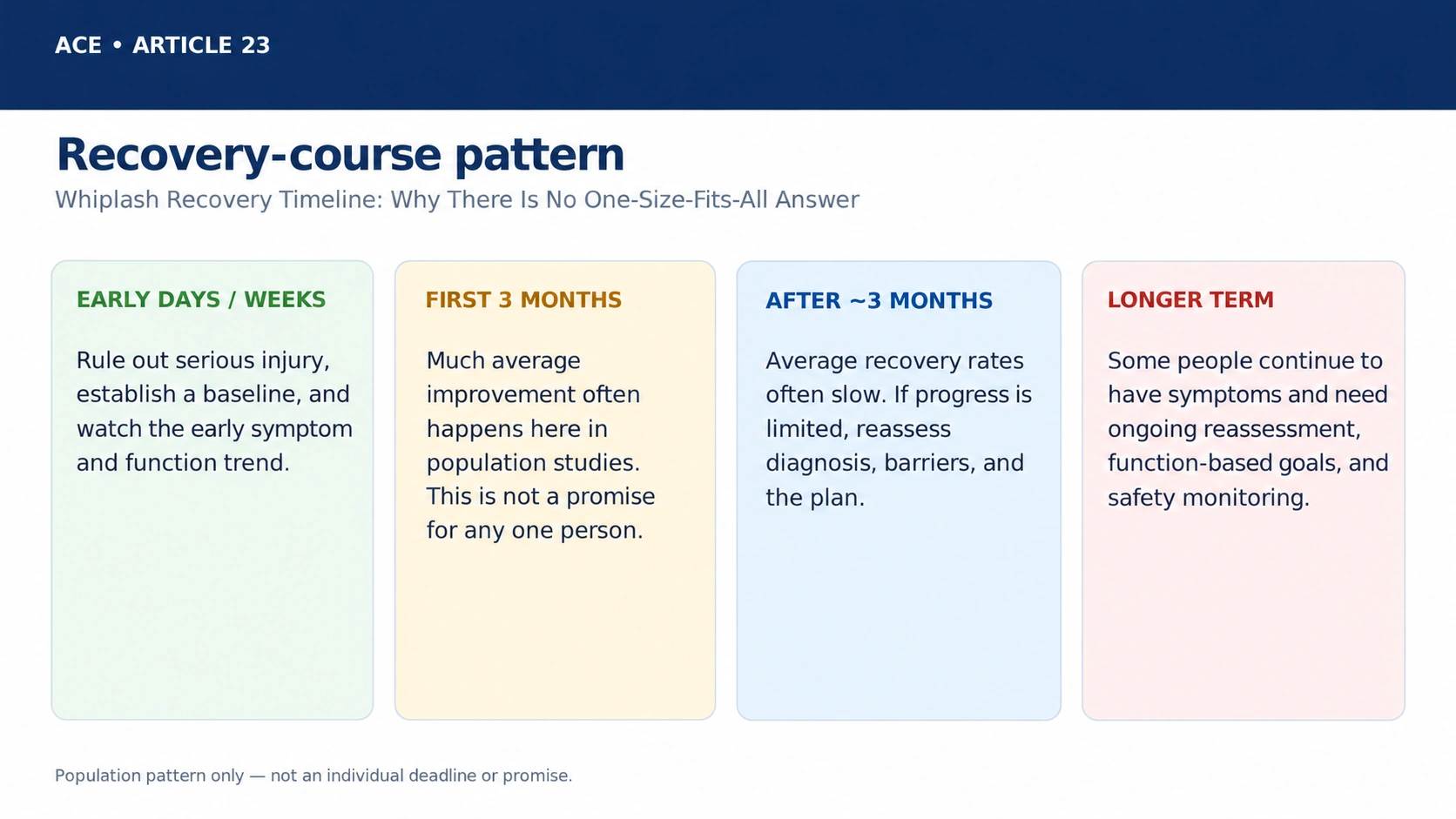
Early after a collision, the first job is not to predict the final recovery date. It is to identify anything that requires urgent medical attention, document the starting level of pain and disability, and establish what normal activities are currently limited. Symptoms can also evolve after the crash. For a focused discussion of when symptoms may first appear, see ACE’s existing guide, Why Whiplash Symptoms May Be Delayed After a Car Accident. This article focuses on what happens after the recovery course is underway.
At this stage, useful baseline measures include sleep disruption, ability to turn the head, driving tolerance, sitting tolerance, headaches, arm symptoms, work duties, household tasks and exercise. If these measures are gradually improving, that trend is generally more informative than a single pain score.
The first three months: where much of the average improvement occurs
The 2008 systematic review by Kamper and colleagues found that recovery rates varied substantially, but the better-quality cohorts suggested that much of the improvement in pain and disability occurred in the initial three months after the collision.[1] This does not mean everyone should be recovered by 12 weeks. It means the early months are a useful period for judging whether the overall trajectory is favorable.
During this phase, improvement can be uneven. A person may tolerate driving better before sleep normalizes, or regain range of motion before headaches fully settle. A flare after a busy day does not automatically mean the overall recovery has reversed. Look at the broader trend.
After roughly three months: slower average change deserves reassessment, not pessimism
In the same meta-analysis, average recovery rates and reductions in pain/disability tended to level off after about three months.[1] This is a signal to review the situation more carefully if meaningful limitations remain. It is not evidence that further recovery is impossible.
A reassessment can ask whether the working diagnosis still fits, whether there are untreated neurologic or other medical issues, whether sleep or activity patterns are interfering with progress, whether work demands are repeatedly provoking symptoms, and whether the rehabilitation plan is advancing function rather than only repeating passive treatment.
Why two people with whiplash can recover differently
Whiplash prognosis is multifactorial. A best-evidence synthesis found that greater initial pain, more symptoms and greater initial disability were associated with slower recovery.[2] A later meta-review likewise found associations between persistent pain/disability and factors including post-injury pain and disability, higher whiplash grade, anxiety and catastrophizing.[3]
These associations are not destiny. A risk factor changes probability at the group level; it does not tell a clinician exactly how long one person will take to recover. A 2021 systematic review also found that higher initial pain-related disability and higher whiplash grade were associated with poorer outcomes, while evidence for many specific neck physical-function measures as prognostic tools was limited or inconclusive.[4]
Factors that often matter more than people expect
- Initial pain and disability: a more severe starting point is consistently associated with a slower course in several evidence syntheses.
- Overall symptom burden: more symptoms at the beginning can be associated with slower recovery.
- Cognitive-emotional factors: anxiety, fear and catastrophizing have shown associations with persistent symptoms in reviews; these findings do not mean symptoms are “just psychological.”
- Functional demands: recovery should be judged against the activities a person needs to resume—not only against a pain score.
Things that should not be used as a stand-alone recovery clock
The Sarrami meta-review found that many collision-related factors and post-injury MRI or radiographic findings were not associated with continuation of pain and disability.[3] Imaging can be important for diagnosis or safety when clinically indicated, but a scan result by itself should not be turned into a precise recovery countdown.
Track milestones, not just pain
Symptom intensity matters, but function makes the timeline more useful. Ask what is changing in real life. A person may still have some discomfort yet be sleeping better, driving farther, working longer or moving with more confidence. Conversely, pain may fluctuate while function is getting worse.
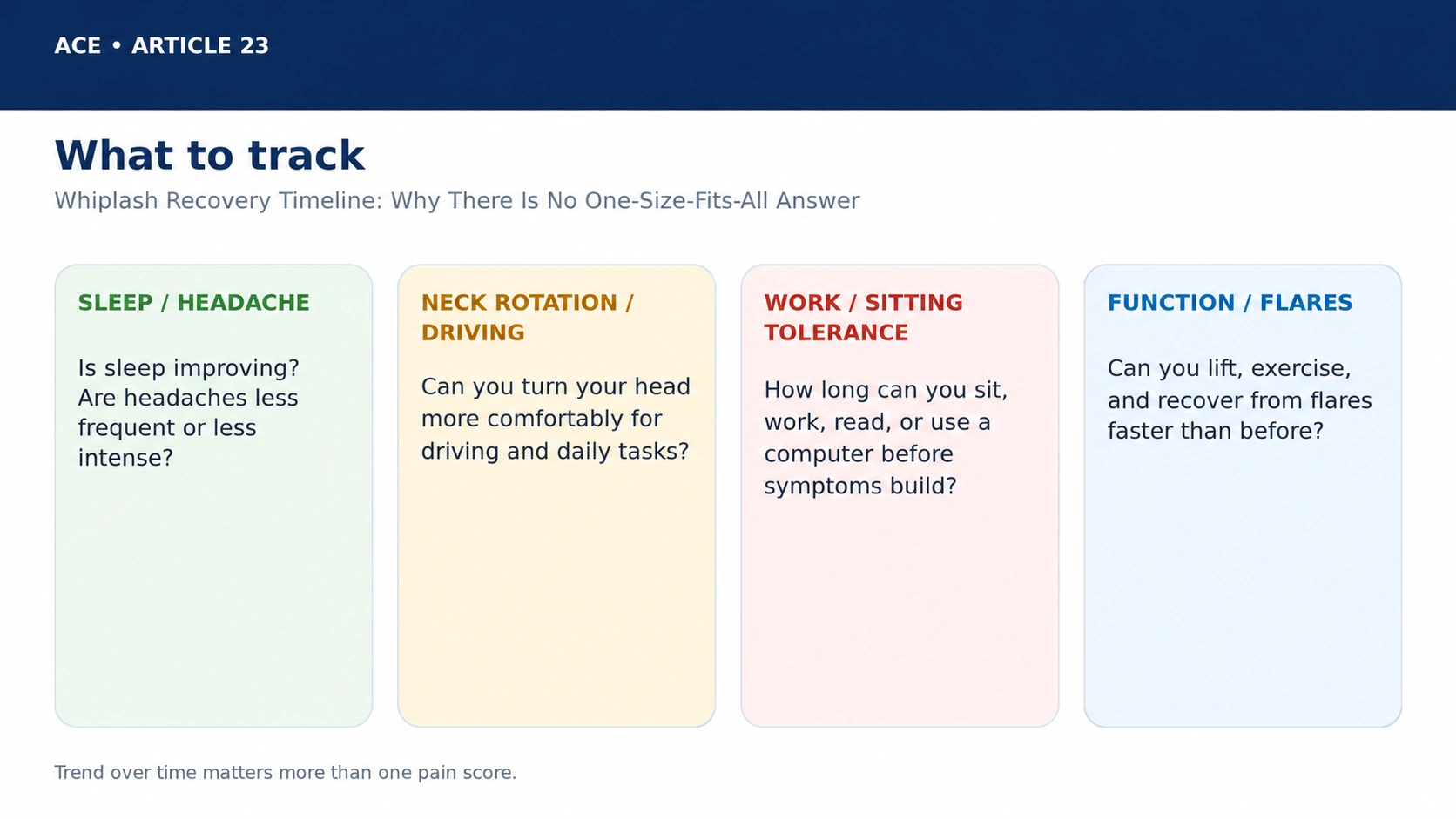
- sleep interruption and morning stiffness
- comfortable neck rotation for driving
- sitting, computer and commuting tolerance
- headache frequency and intensity
- arm pain, numbness, tingling or weakness
- lifting and household activity tolerance
- work capacity and need for modified duties
- exercise or recreation tolerance
- how long symptoms take to settle after activity
Choose a few markers that matter to your life and repeat them at sensible intervals. The goal is to see a trend, not to test yourself constantly.
When a slower course should trigger reassessment
Reassessment is reasonable when function is not improving as expected, symptoms are progressively worsening, new neurologic symptoms appear, or the plan no longer has clear goals. The point is not to label someone a “slow healer.” It is to ask whether there is a modifiable reason the trajectory is not moving in the expected direction.
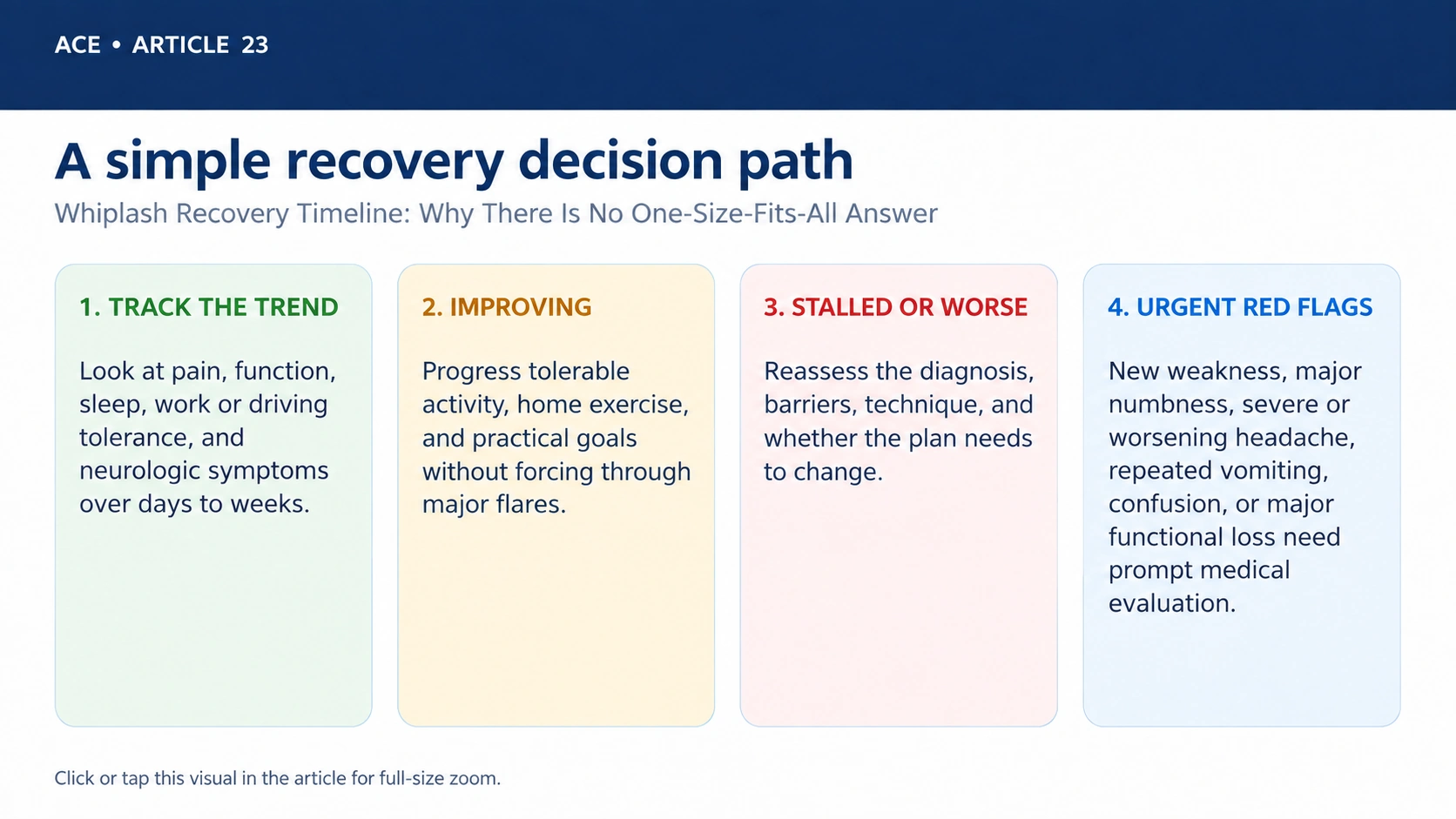
If the trend is improving
Continue to monitor function, progress activity at a tolerable pace, and keep the plan tied to meaningful goals.
If the trend is stalled or worse
Reassess the diagnosis, safety issues, neurologic findings, workload, sleep, psychosocial barriers and whether the current plan is actually advancing function.
When to seek prompt medical care
Do not use a recovery timeline to self-clear a serious problem.
Seek urgent or emergency medical attention when appropriate, especially for:
- severe or worsening headache, repeated vomiting, seizure, marked confusion, unusual drowsiness, slurred speech, unequal pupils, or new weakness/numbness after the crash
- new loss of coordination, fainting, significant chest or abdominal pain, shortness of breath, or rapidly worsening symptoms
- new arm or leg weakness, major balance difficulty, or loss of bladder/bowel control
CDC notes that mild traumatic brain injury symptoms may appear immediately or later and lists neurologic danger signs that require emergency evaluation.[5] The presence of red flags changes the priority from “How long will recovery take?” to “Does this need urgent medical assessment?”
Questions to ask about your recovery plan in Santa Clara
Ask about progress
- Which functional markers should we expect to change first?
- What would count as meaningful improvement over the next few weeks?
- When will we formally reassess the plan?
- What findings would change the diagnosis or require referral?
Ask about uncertainty
- Which factors in my case may be associated with a slower recovery?
- What can and cannot be predicted from imaging?
- Which activities should I modify versus gradually resume?
- What symptoms should make me seek care sooner?
ACE California Health Clinic provides chiropractic, acupuncture and rehabilitation services in Santa Clara. Care after a collision should remain individualized and should not substitute a generic visit count for ongoing clinical reassessment.
Need your recovery trend evaluated?
Bring your symptom timeline, relevant records and a short list of activities that are still limited. The goal is to understand the current trajectory and identify an appropriate next step.
Frequently asked questions
How long does whiplash usually take to recover?
There is no dependable single number for an individual. Research cohorts show substantial improvement often occurs during the first few months, but recovery varies widely and some people have persistent symptoms. Your own trend in pain, disability, sleep, movement, work and daily function matters more than a generic deadline.
Does slower recovery after three months mean I will not improve?
No. Group studies show that average recovery rates tend to slow after the first few months, but that is not an individual cutoff. Continued improvement can occur, and a slower course is a reason to reassess barriers, function, diagnosis and the plan rather than assume recovery has stopped.
What factors are linked with slower whiplash recovery?
Higher initial pain, greater initial disability and a larger symptom burden are among the more consistent prognostic signals. Psychological and social factors can also be associated with outcome. These are risk factors, not destiny.
Do crash direction or an MRI predict how long recovery will take?
Not reliably on their own. Reviews have found many collision-related factors and post-injury imaging findings are not consistent stand-alone predictors of persistent pain and disability. Imaging may still be important for diagnosis or safety when clinically indicated.
What should I track during recovery?
Track function as well as symptoms: sleep, neck movement, driving or sitting tolerance, work duties, lifting, exercise, headaches, neurologic symptoms and how long flares take to settle. A trend across days and weeks is more informative than one unusually good or bad day.
References
- Kamper et al. — Course and prognostic factors of whiplash: a systematic review and meta-analysis. Pain. 2008;138(3):617-629.
- Carroll et al. — Course and prognostic factors for neck pain in whiplash-associated disorders. Spine. 2008;33(4 Suppl):S83-S92.
- Sarrami et al. — Factors predicting outcome in whiplash injury: a systematic meta-review. J Orthop Traumatol. 2017.
- Alalawi et al. — Physical-function measures and prognosis after whiplash: a systematic review. Systematic review, 2021.
- CDC — Symptoms of Mild TBI and Concussion. Current CDC patient guidance.
Medical disclaimer: This article is for general education and is not a diagnosis, prognosis for an individual, treatment prescription, emergency screening tool, or substitute for care from a qualified health professional who has examined you. Seek appropriate medical evaluation for severe, rapidly worsening, neurologic, or post-trauma danger signs.