
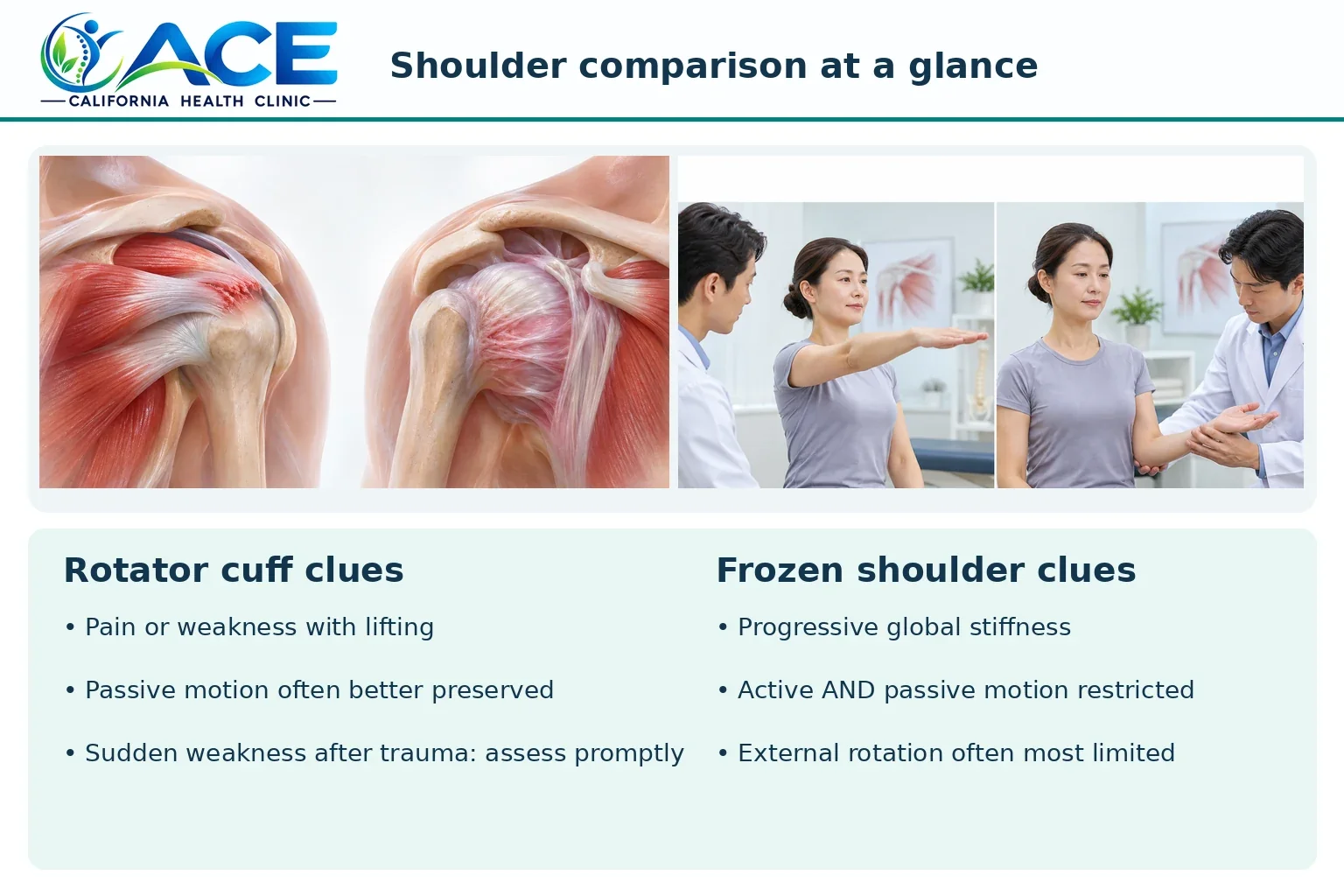
Many people say, “I have a frozen shoulder,” when they mean the shoulder hurts to move. Yet a rotator cuff injury and adhesive capsulitis (frozen shoulder) are not the same condition. A rotator cuff injury involves tendons and muscles that help stabilize and move the shoulder; frozen shoulder primarily involves a thickened, tightened joint capsule. Determining which tissue is most involved changes how a clinician chooses mobility exercises, strengthening, symptom relief, and referral decisions.[1], [2], [3]
1. Rotator cuff injury vs. frozen shoulder: the side-by-side comparison
| Feature | Rotator cuff injury / tendinopathy | Frozen shoulder (adhesive capsulitis) |
|---|---|---|
| Primary tissue | One or more rotator cuff tendons, sometimes with a partial or complete tear | Inflamed, thickened and stiff joint capsule |
| How it starts | Gradual overuse or a sudden fall, lift or injury | Frequently gradual; sometimes after immobilization or injury |
| Most noticeable symptom | Pain and/or weakness with specific movements, especially lifting away from the body | Increasing stiffness with pain and difficulty reaching in multiple directions |
| Active arm movement | Often painful, weak or difficult | Limited |
| Passive assisted movement | Often relatively better preserved, although pain may still restrict it | Restricted as well, particularly external rotation |
| Strength testing | May expose weakness of particular rotator cuff muscles | Can appear weak because stiffness and pain limit effort |
| Night pain | Common | Common; not useful alone to distinguish them |
| Typical rehabilitation focus | Progressive loading, shoulder/scapular control and return to activity | Comfortable stage-adjusted motion, gradual stretching and later strengthening |
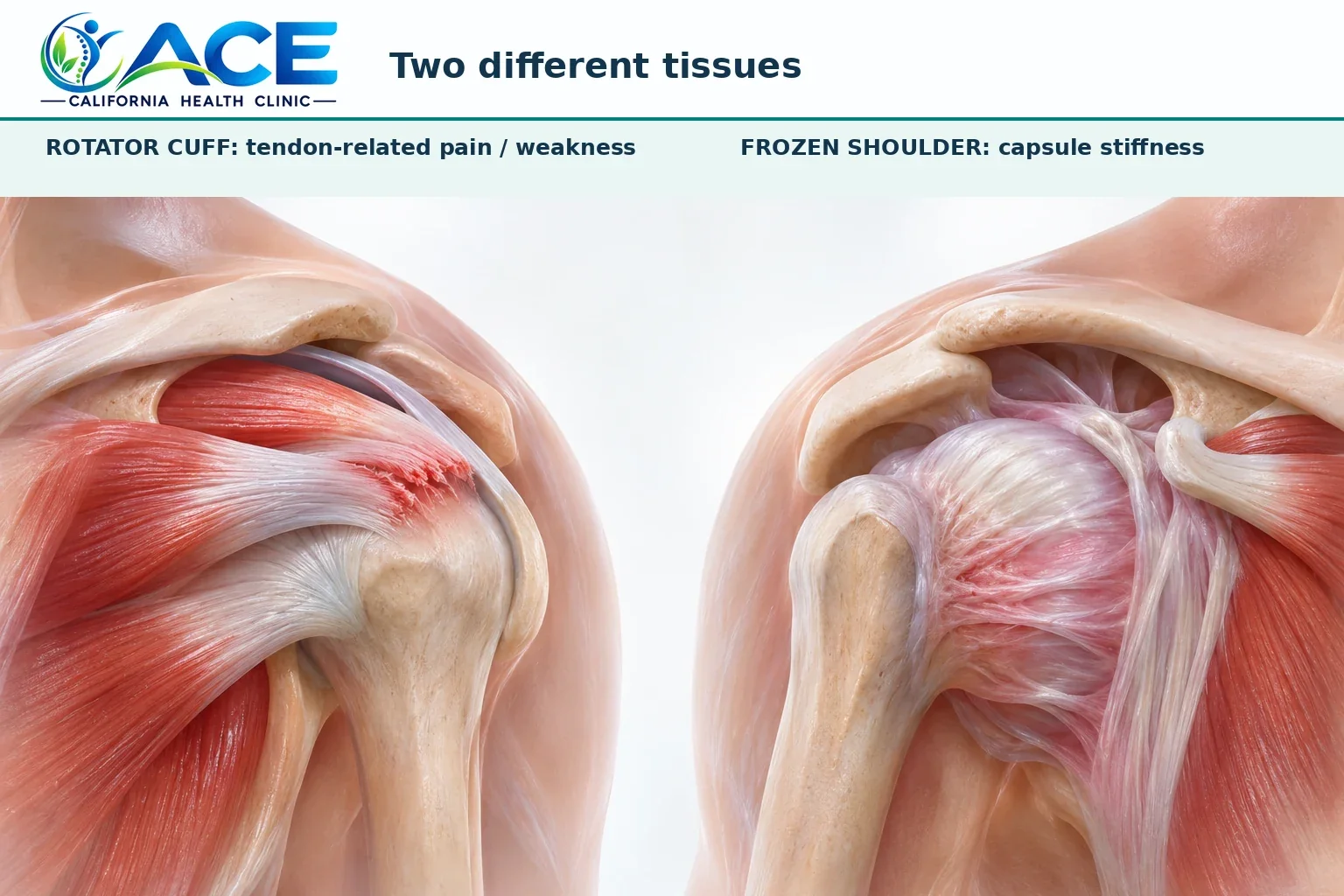
A torn or irritated tendon is a different problem from a stiff capsule. Having shoulder pain when you lie on that side, or pain that reaches the upper arm, does not prove which condition is present.[1], [2]
2. How clinicians make the distinction
A thorough assessment starts with the timeline: sudden injury versus progressive stiffness; whether pain or weakness came first; tasks that provoke symptoms; neck and nerve-related symptoms; and any history of diabetes, thyroid disease or immobilization. A hands-on exam then assesses both shoulders, strength, and range of motion.[1], [2]
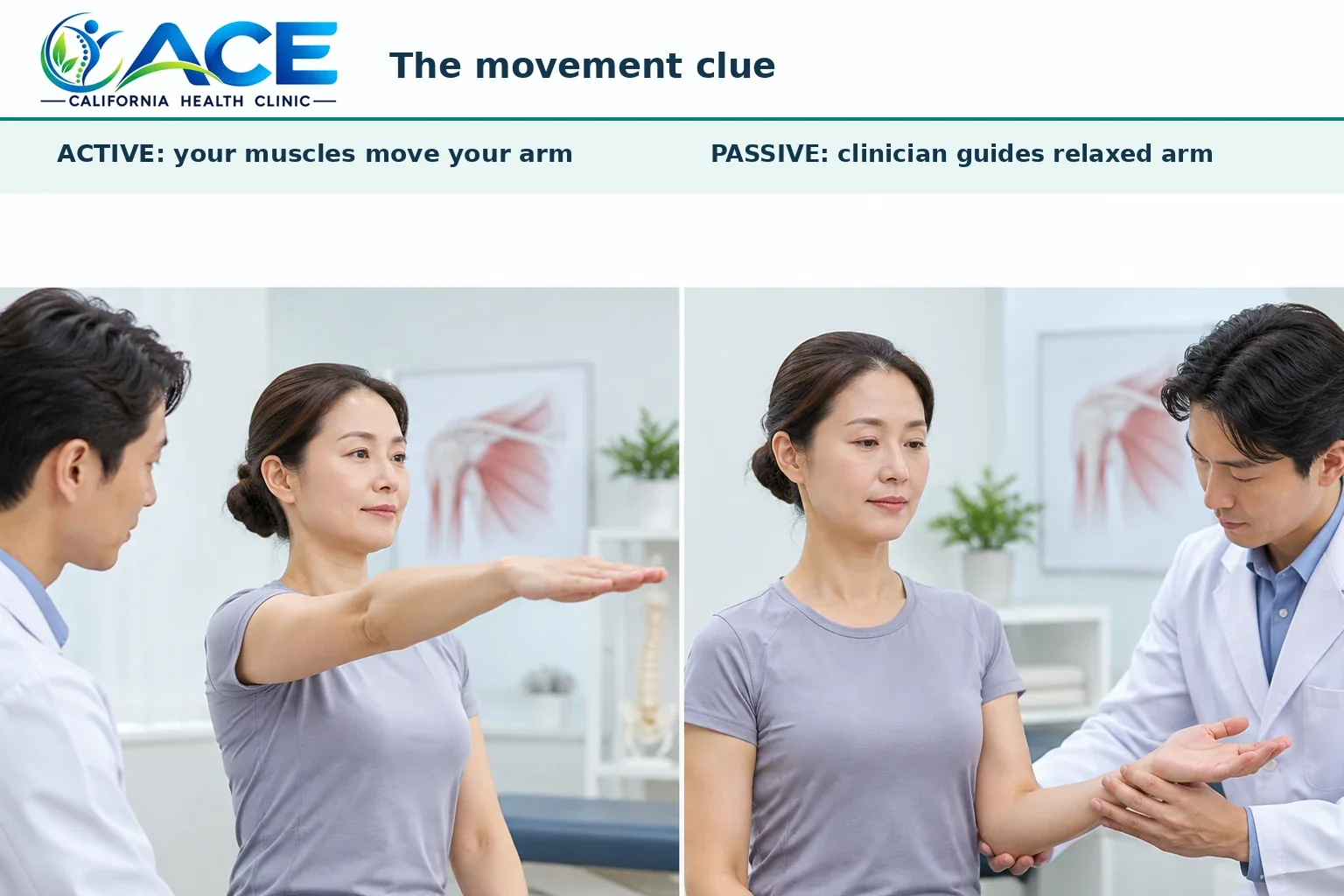
- Active range of motion: You lift, turn and reach with your own muscles.
- Passive range of motion: While you relax, the clinician gently guides the shoulder, often checking outward rotation with the elbow at the side.
- Resisted testing: Selected rotator cuff muscles are challenged gently to look for pain or true weakness. Individual orthopedic tests are not a diagnosis by themselves.
- Neck and neurologic screening: Cervical sources of pain, numbness or weakness are considered when symptoms suggest them.
- Imaging when it changes decisions: X-rays help assess arthritis or bony problems. Ultrasound or MRI may help evaluate a suspected tear or overlapping conditions; they are not routinely required to establish a typical frozen-shoulder diagnosis.[1], [2], [3], [11]
3. Can you have a rotator cuff injury and frozen shoulder at the same time?
Yes. A tendon injury can coexist with capsular stiffness, especially after pain has reduced movement for an extended period. Published research has described patients with concurrent rotator cuff tears and adhesive capsulitis. A 2025 retrospective study included 29 patients treated for both conditions, confirming that a “rotator cuff or frozen shoulder” choice can sometimes be too simple.[10]
For someone with substantial loss of passive motion and reproducible focal weakness, an individualized evaluation—and imaging if clinically indicated—can be more informative than assuming there is only one diagnosis. Treatments should address the actual findings, not a label alone.[1], [10], [11]
4. Chiropractic, acupuncture and rehabilitation: a personalized care pathway
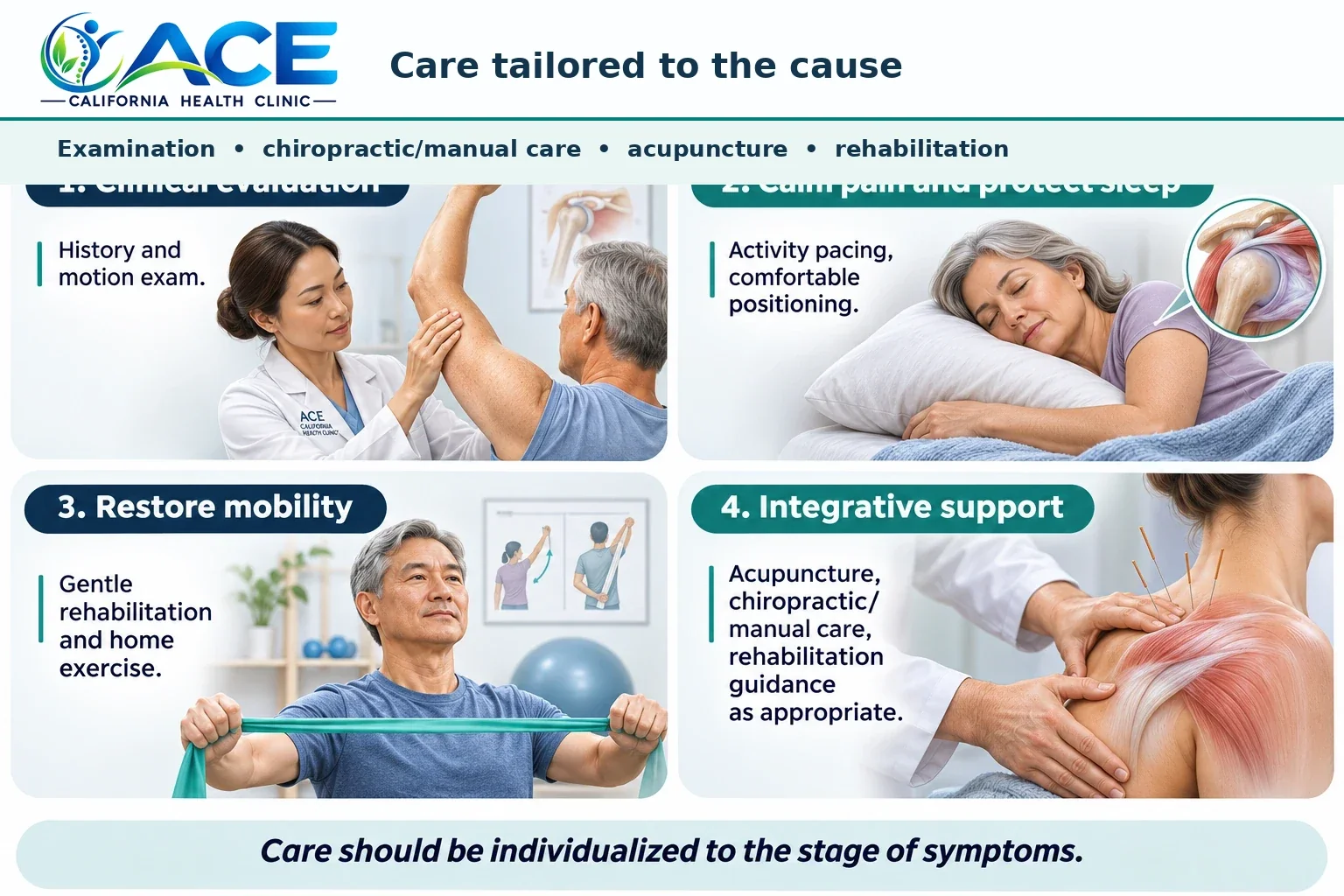
At ACE California Health Clinic, chiropractic and acupuncture are part of an integrative approach to musculoskeletal care. After assessment, the plan may combine conservative hands-on techniques, appropriately selected acupuncture, soft-tissue work and guided rehabilitation to support comfort, usable movement and a safe return to everyday activities.
For rotator cuff-related pain
Chiropractic-focused movement care: assess shoulder and shoulder-blade mechanics, modify painful activity, address comfortable mobility and progress strengthening when appropriate.
Acupuncture: may be offered alongside exercise and education for pain management and functional support. A 2024 meta-analysis of 13 randomized trials involving 1,371 people with rotator cuff disorders reported short- and medium-term pain and function improvements with acupuncture alone or combined with physical therapy.[5]
For frozen shoulder
Chiropractic/manual care: careful, symptom-guided mobilization, movement coaching and later strengthening may help improve functional range of motion. The 2025 frozen-shoulder guideline supports considering manual therapy with range-of-motion exercise.[4], [12]
Acupuncture: may be incorporated for symptom relief and participation in rehabilitation. Individualized treatment should respect the level of irritability and the person’s tolerance for movement.[1], [8]
The best program usually changes as recovery progresses. A painful early stiff shoulder may need small comfortable movements; a recovering tendon may need progressive resistance. A clinician may coordinate with a medical or orthopedic provider when the findings indicate another treatment pathway. Manual therapy and acupuncture are supportive treatments; neither should be described as mechanically reattaching a full-thickness torn tendon.[3], [4]
5. What published clinical cases and research show
Published cases can help explain treatment approaches, although an individual's improvement cannot establish that the same result will occur for everyone. Here are studies and patient cases from the medical literature; none are presented as patients treated at ACE.
Chiropractic case series · Frozen shoulder · 50 patients
Murphy and colleagues reviewed records from 50 consecutive patients treated with a chiropractic approach. The reported median reduction on an 11-point pain scale was 7 points; most records showed substantial reported improvement in pain and shoulder abduction. Because this was a retrospective series without a control group, it describes observed outcomes rather than proving cause and effect.[7]
Evidence type: retrospective case series, 2012.
Acupuncture case report · Frozen shoulder · 45-year-old patient
A 2021 report described a patient with marked restrictions in both active and passive shoulder motion. After 24 acupuncture sessions over six weeks, the report documented pain-free, full active and passive range of motion. The examination pattern—restriction even when the shoulder was guided—helps illustrate what distinguishes adhesive capsulitis from many tendon-dominant problems.[8]
Evidence type: single-patient case report, 2021.
Electroacupuncture case report · Rotator cuff tendinopathy · 58-year-old patient
A 2023 report described ultrasound-documented supraspinatus and infraspinatus tendinopathy with small partial tendon tears. After four weekly ultrasound-guided electroacupuncture treatments, the patient reported 85% symptom improvement at two months. This is an encouraging report about symptoms and function, not proof of tendon regeneration or a guarantee of similar outcomes.[9]
Evidence type: single-patient case report, 2023.
Why the overlap matters · 29 patients with both conditions
A 2025 retrospective study evaluated 29 patients with both adhesive capsulitis and rotator cuff tears. It reinforces a diagnostic point: stiffness and tendon injury can coexist, so a thorough examination is needed before selecting a recovery plan.[10]
Evidence type: retrospective clinical outcomes series, 2025; treatment context was orthopedic surgery, not an ACE treatment claim.
Beyond individual cases, randomized-trial reviews indicate potential benefits for acupuncture in selected rotator cuff-related shoulder pain and for manual therapy plus range-of-motion exercises in frozen shoulder. A clinician should still tailor recommendations to the particular diagnosis, the individual's goals and the quality of the evidence.[4], [5], [6], [12]
6. Helpful home steps before and during treatment
- Keep motion comfortable. For gradually developing symptoms without a major injury, gentle pendulum-type motion and supported movement may help maintain confidence without forcing range.
- Avoid repeated provocation. Temporarily modify painful overhead reaching or heavy lifting; resume gradually as tolerated.
- Use function as a progress measure. Consider changes in sleep, dressing, fastening a seat belt and reaching to a shelf.
- Ask for stage-appropriate exercises. Progressive rotator cuff strengthening is different from early pain-limited frozen-shoulder mobility work.
- Do not have someone force a stiff shoulder. Excessive force or painful manipulation can be inappropriate, particularly when an injury or tear is possible.
7. When to seek prompt or urgent evaluation
8. What to expect at ACE California Health Clinic
Dr. John J. Lee, D.C., L.Ac., brings experience in both chiropractic and acupuncture to a comprehensive musculoskeletal assessment. The visit focuses on your history, how your shoulder moves actively and passively, associated neck or neurologic findings, and the activities you want to regain. When appropriate, a care plan may blend chiropractic/manual methods, acupuncture, rehabilitation and home guidance, with referral or imaging coordination when needed.
Find a plan that fits your shoulder
ACE California Health Clinic · 345 Saratoga Ave., Santa Clara, CA 95050
Contact ACE or call (408) 984-6000 to discuss an evaluation.
9. Frequently asked questions
Can frozen shoulder and a rotator cuff tear feel the same?
Yes. Both can cause aching and night discomfort. A clinician checks active versus passive movement, strength, symptom history and sometimes imaging to help distinguish them.
Does weakness always mean a rotator cuff tear?
No. Pain, stiffness and nerve-related conditions can all make the arm feel weak. Sudden marked weakness after trauma deserves timely evaluation.
Can chiropractic care and acupuncture help?
They may be helpful parts of a conservative, individualized plan for pain, mobility and rehabilitation. The appropriate techniques depend on whether the shoulder has tendon-related pain, capsular stiffness or both, and on the clinician’s assessment.[4], [5], [7], [8], [9]
Do I need an MRI to know which condition I have?
Not always. Frozen shoulder is often diagnosed from the history and examination. Ultrasound or MRI can help when a significant tear or overlapping condition is suspected, or when the result would change care.[1], [2], [3], [11]
10. References and visual credits
- American Academy of Family Physicians. Adhesive Capsulitis: Diagnosis and Management. 2019.
- AAOS OrthoInfo. Frozen Shoulder (Adhesive Capsulitis).
- AAOS. Management of Rotator Cuff Injuries: Evidence-Based Clinical Practice Guideline. 2025.
- Lee BC et al. Clinical Practice Guidelines for Diagnosis and Non-Surgical Treatment of Primary Frozen Shoulder. Ann Rehabil Med. 2025.
- Zhang HN et al. Acupuncture for rotator cuff diseases: meta-analysis of randomized trials. Am J Transl Res. 2024.
- Effects of acupuncture on shoulder impingement syndrome: systematic review and meta-analysis. 2024.
- Murphy FX et al. Chiropractic management of frozen shoulder: retrospective case series of 50 patients. J Chiropr Med. 2012.
- Kim YJ. Acupuncture management for the acute frozen shoulder: a case report. Clin Case Rep. 2021.
- Stewman CG. Ultrasound-guided electroacupuncture for rotator cuff tendinopathy: case report. 2023.
- Sıvacıoğlu S et al. Simultaneous treatment of adhesive capsulitis and rotator cuff tear: 29-patient retrospective series. 2025.
- Sonography in diagnosis of adhesive capsulitis: case-control study. 2017.
- The effects of end-range interventions in primary adhesive capsulitis: systematic review and meta-analysis. 2023.
- AAOS. Rotator Cuff Injuries: Clinical Practice Guideline summary and resources. 2025.
Visual provenance: Anatomical image and clinical examination scenes are AI-generated educational images created on November 1, 2026; they are not scans or images of actual ACE patients. Summary and thumbnail are original composites derived from those AI images. The conservative-care image is an adapted derivative of an existing approved shoulder-series illustration, identified in the asset manifest. All visible ACE logos were overlaid from the clinic’s actual approved logo file, never redrawn or generated. The content and illustrations were reviewed and approved by the clinic owner on November 1, 2026.
Health information is educational, not a personal diagnosis or a substitute for clinical evaluation. Outcomes in case reports are not promises of results.