
When Numbness or Tingling With Leg Pain Needs Prompt Evaluation
Numbness and tingling point toward altered nerve sensation, but the cause can range from temporary irritation to a problem that needs prompt evaluation.
Numbness and tingling point toward altered nerve sensation, but the cause can range from temporary irritation to a problem that needs prompt evaluation. For Santa Clara patients, the same principles apply: start with a clear history and examination, then match treatment to the findings and your goals.
1-page visual summary
Start here for the major points, then continue into the article for evidence, limitations, safety guidance, and details.
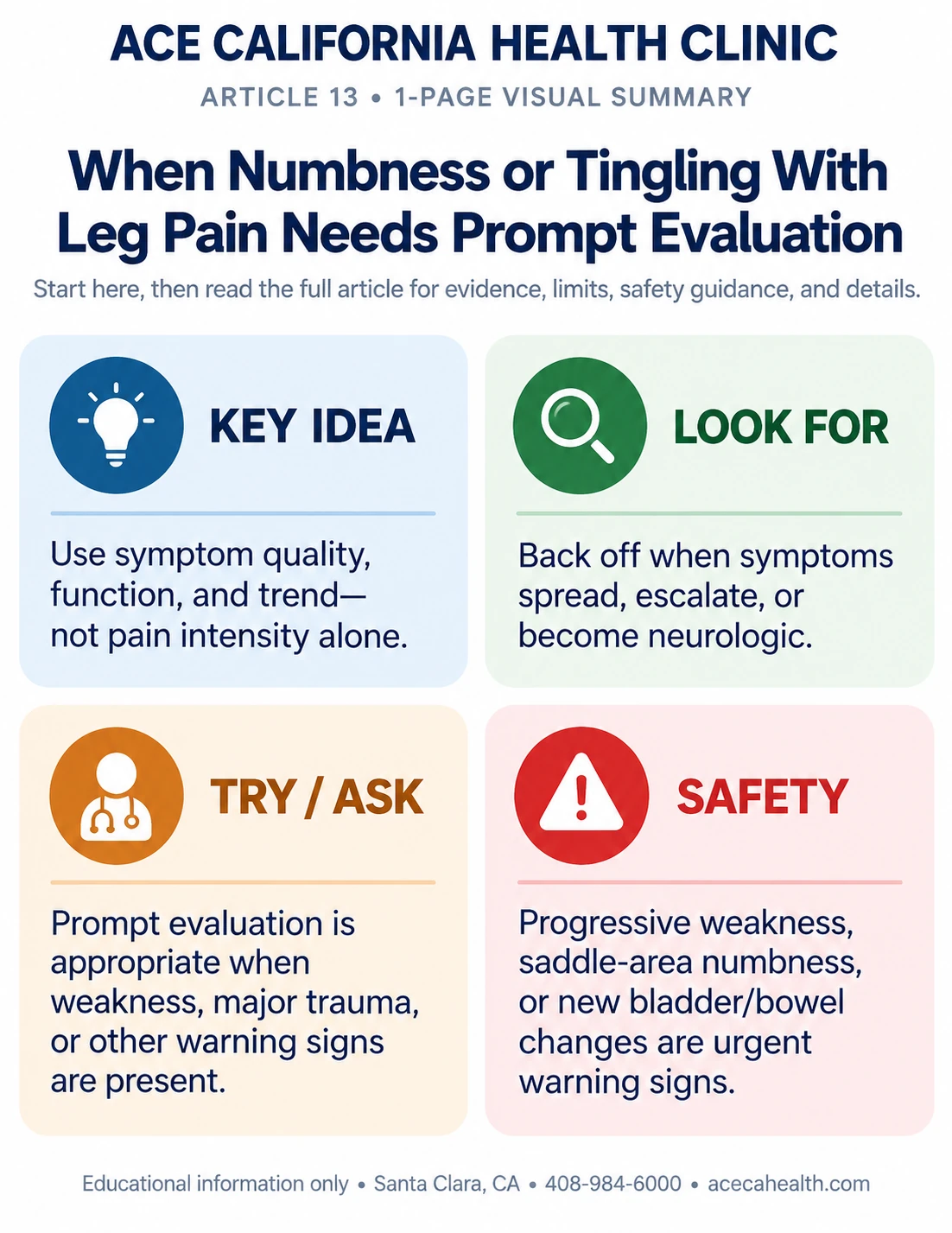
The short answer
Numbness and tingling point toward altered nerve sensation, but the cause can range from temporary irritation to a problem that needs prompt evaluation.
Progressive weakness, saddle-area numbness, or new bladder/bowel changes are urgent warning signs. The goal of this article is to give you a practical framework without pretending that an online checklist can diagnose you.
Guidelines for low back pain and sciatica emphasize self-management, continued activity when appropriate, and selective imaging rather than routine scans in non-specialist settings.[1] ACR criteria likewise rate routine initial imaging as usually not appropriate for uncomplicated acute or chronic low back pain without red flags.[2]
Start with the pattern, not the label
Pain is information, but it is not a direct damage meter. The same intensity can come from different mechanisms, and the same structural finding can feel very different from one person to another. That is why good care connects symptoms to function and examination findings.
Useful clues
Location, symptom quality, triggers, easing factors, function, and trend over time.
Less useful alone
A single tender spot, one posture photo, one scan finding, or one good/bad day without context.
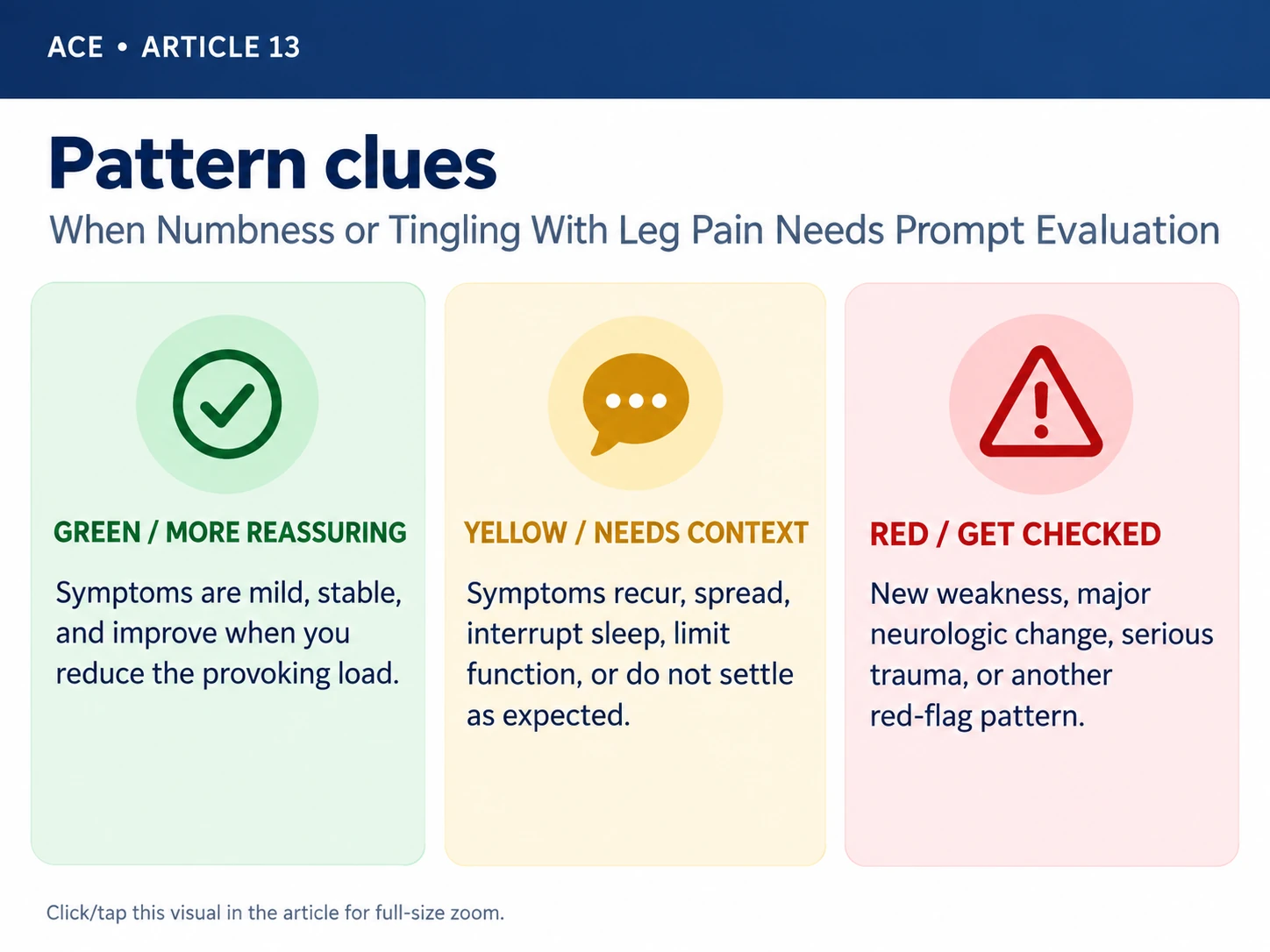
The most useful home experiment is usually small and reversible. Change one variable, observe the response during the activity, then look again later that day and the next morning. If the pattern is clearly worse, the dose or strategy was probably not a good fit.
What may be going on?
With leg symptoms, pay special attention to neurologic features: numbness, tingling, altered sensation, weakness, foot slapping, or changes in reflexes. These do not automatically identify the cause, but they make a neurologic examination more important.
Back-related leg pain can behave differently with sitting, standing, walking, bending, coughing, or repeated movement. A pattern that changes with spinal position can be clinically useful, but it still needs to be interpreted with the rest of the exam.
For many people without urgent warning signs, conservative care emphasizes education, staying active within tolerance, and a graded exercise plan. The exact exercise should fit the symptom response rather than being selected from a generic list. [1] [3]
That does not mean every item above applies to you. It means the same symptom can arise in more than one way, and the treatment plan should follow the pattern that is actually present rather than a generic protocol.
What to track before you change anything
One reason people get stuck is that they try to name the tissue before they have described the pattern. A better first step is to notice where the symptom starts, where it travels, what it feels like, what brings it on, what eases it, and what it prevents you from doing.
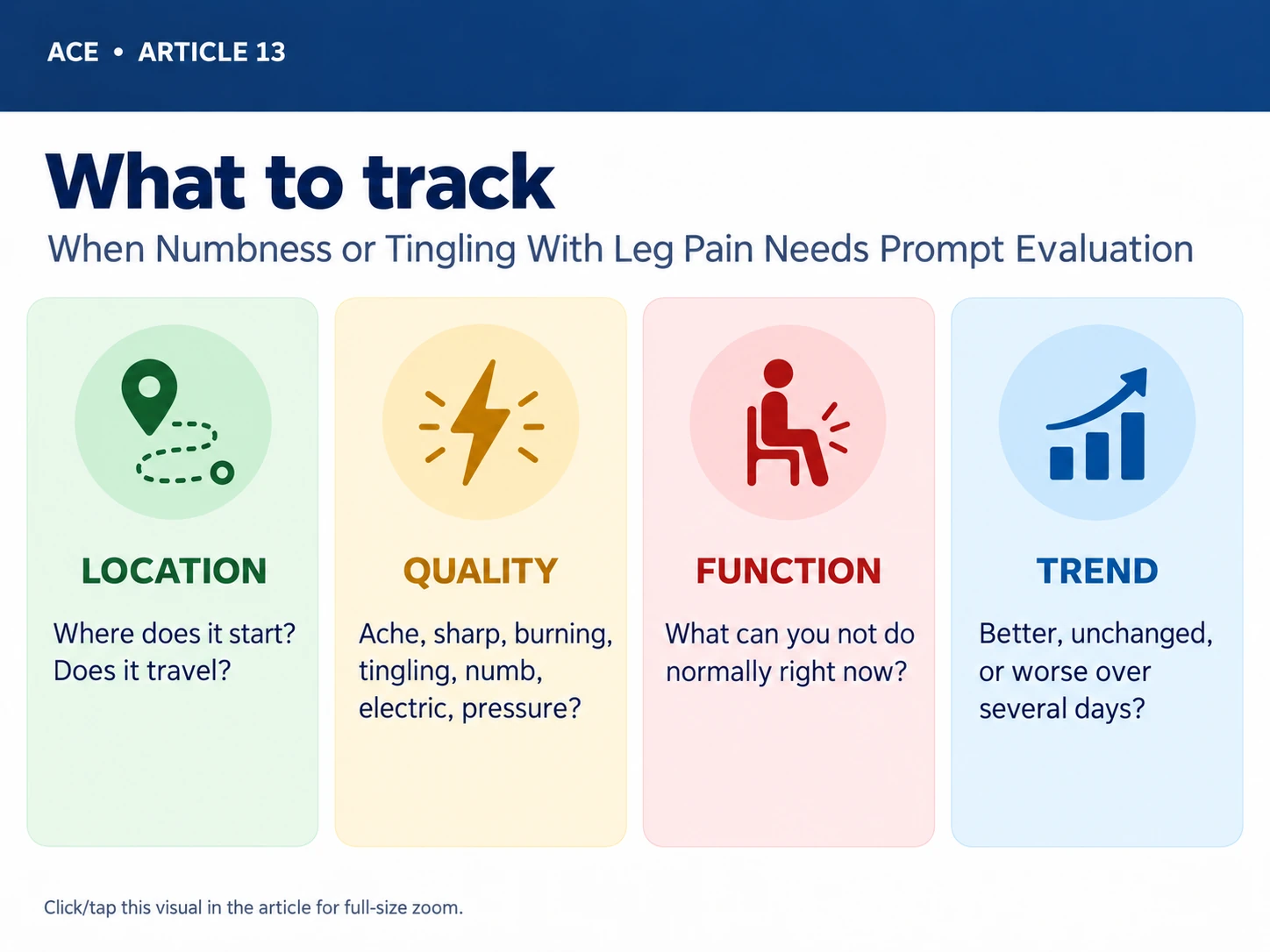
Also note the dose of the provoking activity: how long you sat, how far you walked, how much you lifted, how hard you stretched, or how many repetitions you performed. Without dose information it is easy to conclude that an activity is “bad” when the real issue may be that the current amount exceeds tolerance.
A safer way to experiment
A clinical evaluation is not just a hunt for one tender spot. Depending on the problem, it may include neurologic screening, strength, range of motion, repeated movement, balance, task simulation, palpation, and questions about sleep, training, work, medications, and prior injuries.
- Reduce the range or duration of any movement that sends symptoms farther down the leg.
- Keep comfortable walking or other activity if it does not progressively worsen neurologic symptoms.
- Avoid repeatedly testing a provocative stretch just to see whether it still hurts.
- Arrange evaluation when symptoms are persistent, function-limiting, or include numbness/weakness.
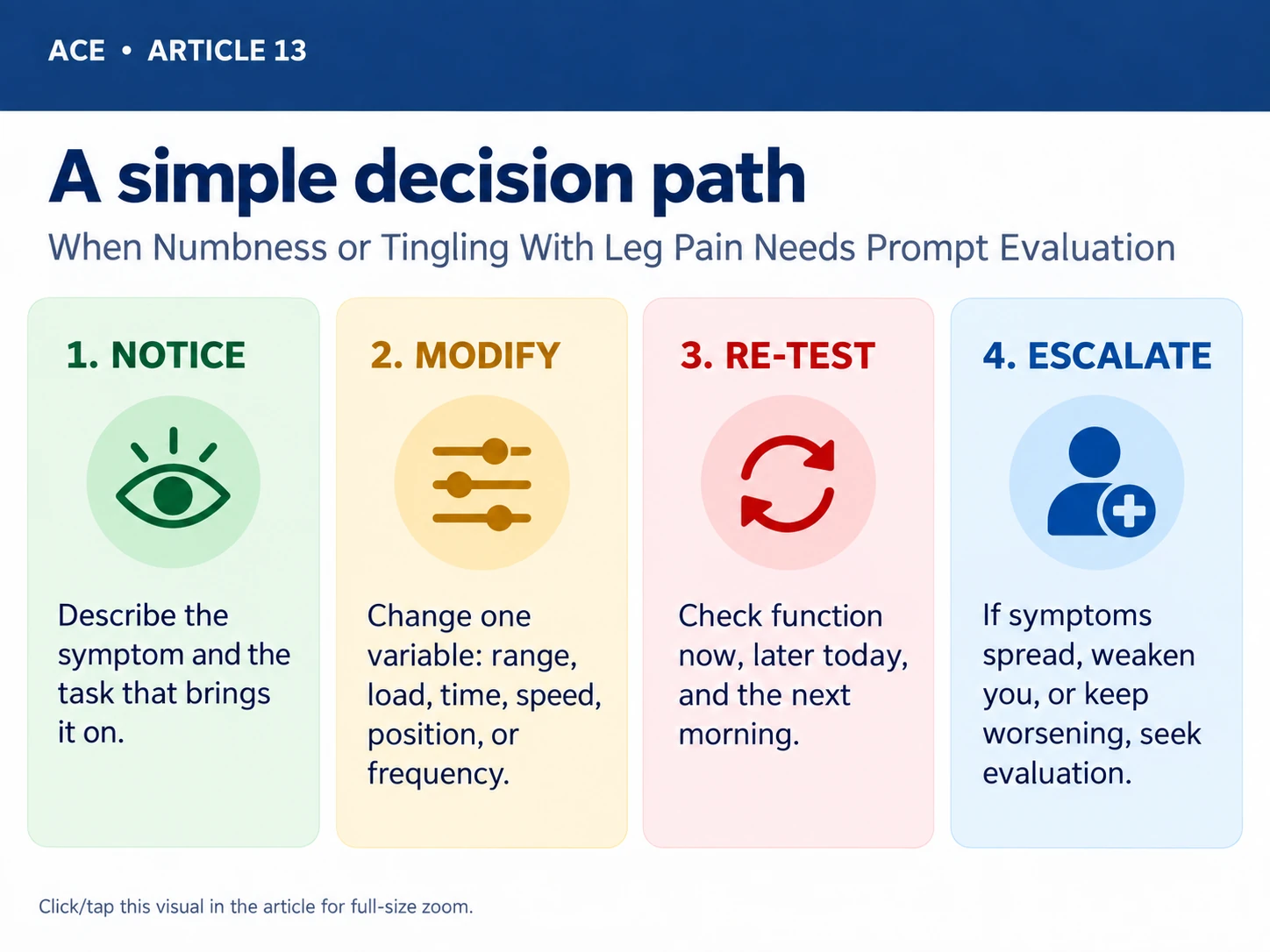
If a change helps, that is useful information—but it still does not prove a diagnosis. If a change consistently worsens symptoms, especially if symptoms spread or become neurologic, stop forcing the experiment and get the pattern assessed.
What an evaluation may include
Imaging can be valuable when the result is likely to change management, but routine imaging is not automatically helpful for every new episode of musculoskeletal pain. Guidelines emphasize matching imaging to the clinical scenario and red-flag profile rather than ordering a scan simply because pain exists.
The exact exam should match the complaint. A leg-pain visit may emphasize neurologic testing; a post-crash visit may include trauma and concussion screening; a sports complaint may require task-specific loading; and a desk complaint may include workstation and movement review.
A useful clinician should be able to explain what the exam suggests, what it does not prove, and why the proposed next step is reasonable.
Do you need imaging or other tests?
Recovery is better judged by trend than by a single good or bad day. Useful markers include walking or sitting tolerance, sleep interruption, range of motion, strength, work capacity, confidence with movement, and how long symptoms take to settle after activity.
For uncomplicated low back pain without red flags, major imaging guidance does not recommend routine initial imaging. [2] After significant trauma or when neurologic or systemic warning signs are present, the threshold can be very different. This is one reason the history and exam come before a blanket “MRI for everyone” or “no imaging ever” rule.
Imaging can show anatomy; it cannot by itself tell you which finding is generating symptoms. The result has to be interpreted in the context of the clinical picture.
Treatment is a plan, not a single technique
Conservative care can include education, activity modification, graded exercise, and—in selected cases—manual or other symptom-modulating approaches. Recommendations differ on acupuncture for low-back pain and sciatica: NICE advises against acupuncture for that indication, while NCCIH summarizes evidence suggesting possible benefit in some low-back-pain studies. Which options make sense depends on the diagnosis, risk profile, goals, preferences, and response. [1] [4]
For many musculoskeletal problems, active recovery is important. Passive treatments may be useful for symptom relief, but lasting progress usually needs a bridge back to normal movement, work, exercise, or sport rather than endless avoidance.
Why When Numbness or Tingling With Leg Pain Needs Prompt Evaluation can be confusing
Numbness and tingling point toward altered nerve sensation, but the cause can range from temporary irritation to a problem that needs prompt evaluation. The confusing part is that symptoms overlap across conditions. Two people can use the same word—'tight,' 'pinched,' 'inflamed,' or 'out of place'—while describing very different experiences. A careful history translates those words into observable features.
A better way to think about the problem
Instead of asking only, “What structure is causing this?”, ask three linked questions: Is anything urgent? What pattern best fits the symptoms? What action is most likely to improve function with acceptable risk? That sequence keeps safety first and prevents treatment from being driven by a label alone.
What to track for 48–72 hours
Track the location, quality, trigger, functional effect, and settling time of symptoms. If you try a new activity, note whether symptoms stay local or spread, whether strength or coordination changes, and how you feel later that day and the next morning. A simple log is often more useful than repeatedly rating pain every few minutes.
The role of expectations
People recover at different rates. Sleep, stress, prior episodes, overall health, workload, confidence, and access to activity can all influence the course. A realistic plan uses milestones—such as sitting longer, walking farther, lifting more comfortably, or sleeping with fewer interruptions—rather than promising a fixed number of visits or a guaranteed date.
Why aggressive treatment is not automatically better
A stronger stretch, harder manipulation, deeper massage, higher exercise load, or longer session is not inherently more effective. The useful dose is the smallest dose that moves function in the right direction without creating an unacceptable flare. When a treatment repeatedly worsens symptoms, the plan should be reconsidered rather than defended.
Shared decision-making
You should know what the clinician thinks is most likely, what remains uncertain, what options are reasonable, and what the tradeoffs are. If there is more than one defensible approach, your goals and preferences matter. A plan should also include a reassessment point so that 'continue the same thing' is not the automatic default.
When to seek prompt medical care
Do not use this article to self-clear a serious problem.
Seek urgent or emergency medical attention when appropriate, especially for:
- new bladder or bowel dysfunction, numbness in the saddle/groin area, or rapidly progressive leg weakness
- major trauma, fever with severe back/neck pain, a history that raises concern for infection or cancer, or unexplained systemic illness
- new severe neurologic symptoms, loss of coordination, or pain that is rapidly worsening and unlike your usual pattern
When in doubt after major trauma or with a rapidly changing neurologic pattern, err on the side of prompt medical assessment.
Questions to ask before you book in Santa Clara
Ask about the clinical plan
- What does the first visit include?
- What are the most likely explanations, and what remains uncertain?
- What are the benefits, risks, and alternatives?
- How will we measure progress in function?
Ask about logistics
- What does the visit cost and what is included?
- When will the plan be reassessed?
- Will you coordinate referrals or imaging if the exam indicates it?
- What should make me call sooner or seek urgent care?
ACE California Health Clinic provides chiropractic and acupuncture services in Santa Clara. The clinic can also coordinate appropriate referral or imaging decisions when the clinical picture warrants it. This article does not promise that any particular treatment is right for you.
Want this pattern evaluated?
Contact ACE California Health Clinic in Santa Clara to discuss an appointment. Bring your symptom timeline, medications, relevant records, and the activities that matter most to you.
Frequently asked questions
Can I tell what is causing numbness or tingling with leg pain from symptoms alone?
Usually not with confidence. Symptom location and quality help narrow possibilities, but examination findings, history, neurologic features, and response to movement or load often matter. A severe or unusual pattern deserves clinical evaluation.
Should I stop all activity until I am pain-free?
Not automatically. For many musculoskeletal problems, complete rest can reduce capacity. A better approach is to modify the provoking activity, keep tolerable movement, and progress gradually. Major trauma, neurologic change, or other red flags change that advice.
Do I need an X-ray or MRI?
Sometimes, but not for every episode. Imaging is most useful when a clinician has a specific question and the result is likely to change management. Trauma, progressive neurologic deficits, suspected serious disease, or persistent symptoms in an appropriate clinical context may change the threshold.
How quickly should I expect improvement?
There is no reliable one-size-fits-all timeline. Track function and trend: sleep, walking or sitting tolerance, strength, range of motion, work or sport capacity, and how quickly symptoms settle after activity.
What should I bring to an appointment?
Bring a medication list, relevant prior imaging or records, a short timeline of symptoms, the activities that reproduce or ease the problem, and your main functional goal. For an accident, also bring the date/mechanism and any emergency or specialist records.
References
- NICE — Low back pain and sciatica in over 16s: assessment and management. Accessed for this patient-education draft on Aug. 18, 2026.
- American College of Radiology — Appropriateness Criteria: Low Back Pain. Accessed for this patient-education draft on Aug. 18, 2026.
- World Health Organization — Guideline for non-surgical management of chronic primary low back pain. Accessed for this patient-education draft on Aug. 18, 2026.
- NCCIH — Low-Back Pain and Complementary Health Approaches. Accessed for this patient-education draft on Aug. 18, 2026.
Medical disclaimer: This article is for general education and is not a diagnosis, treatment prescription, emergency screening tool, or substitute for care from a qualified health professional who has examined you. If symptoms are severe, rapidly worsening, neurologic, or follow significant trauma, seek appropriate medical evaluation.