
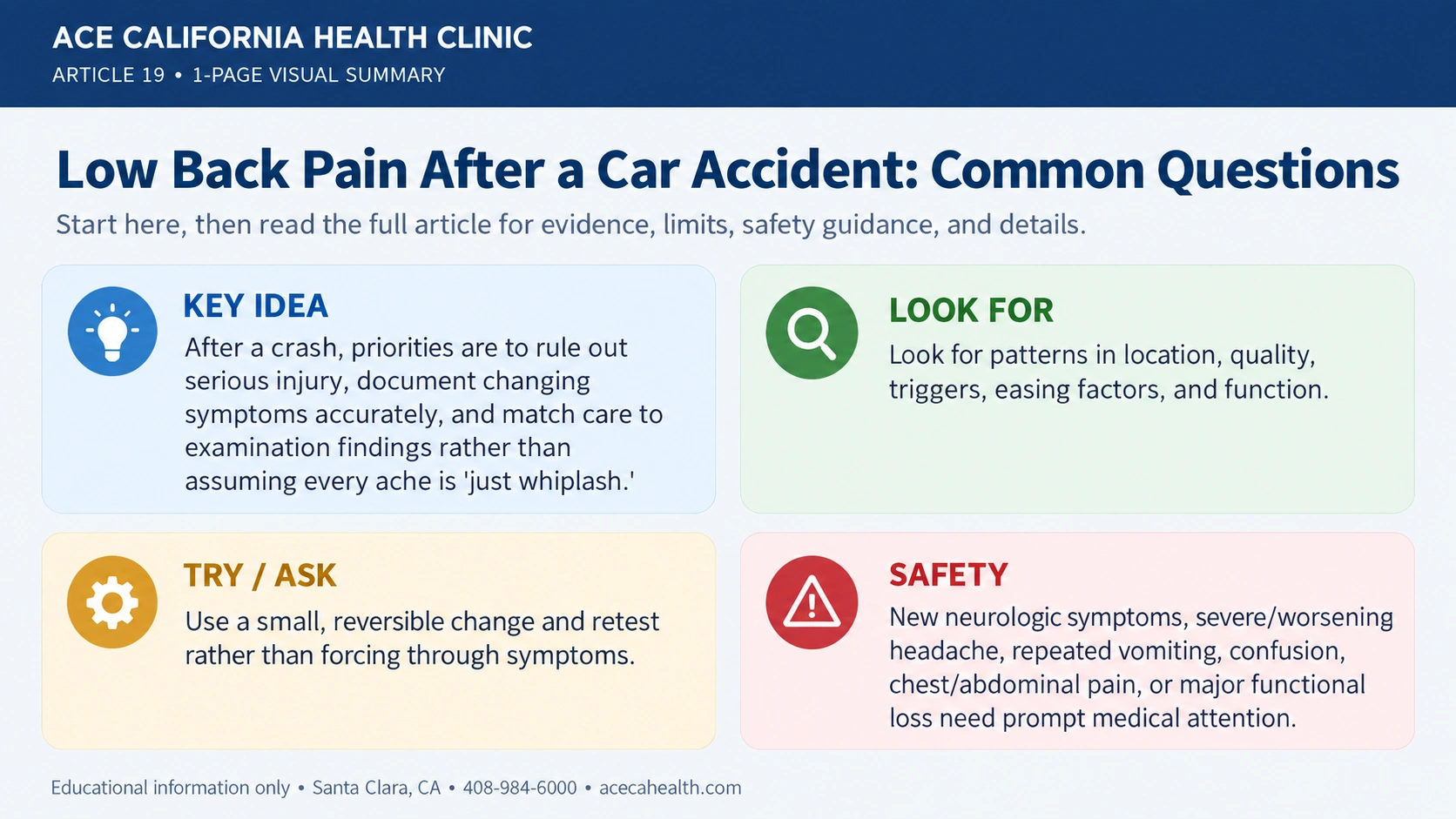
Low back pain after a car accident deserves context, not a one-size-fits-all label. The most useful first questions are whether there are signs of a serious injury, whether symptoms are staying local or becoming neurologic, what everyday functions changed after the collision, and whether the pattern is improving, stable, or worsening.
Short answer: Some post-crash low-back pain behaves like a musculoskeletal injury and can improve with appropriate conservative care. But a collision is a trauma event, so the threshold for medical evaluation and imaging can be different from ordinary low-back pain that starts without trauma. New weakness, bowel or bladder changes, numbness in the saddle/groin area, major difficulty walking, or rapidly worsening symptoms need prompt medical assessment.
1-page visual summary
Start here for the main pattern and safety points, then continue for context and limits.
What should I do first if my low back hurts after a crash?
Start with safety and an appropriate medical evaluation when the crash or symptoms warrant it. This article is deliberately not another accident checklist because ACE already has a step-by-step guide covering immediate safety, symptom tracking, practical records, and follow-up care.
For the low back specifically, note when the pain started, where it is located, whether it travels into the buttock or leg, whether you have numbness or weakness, and which tasks changed after the collision. Useful functional examples include getting in and out of the car, sitting, standing, walking, bending, lifting, sleeping, and working.
Why can the low back hurt after a car accident?
A collision can expose the trunk and spine to rapid forces while the body is braced, rotated, flexed, extended, or restrained by the seat and belt. Low-back symptoms may involve muscles and other soft tissues, joints, discs, nerve roots, or—less commonly but importantly—fracture or another serious injury. The pain location by itself cannot reliably tell you which structure is responsible.
That is why the goal is not to guess the tissue from one painful spot. The history, crash mechanism, examination, neurologic findings, and functional changes need to fit together.
Can low-back pain show up later rather than immediately?
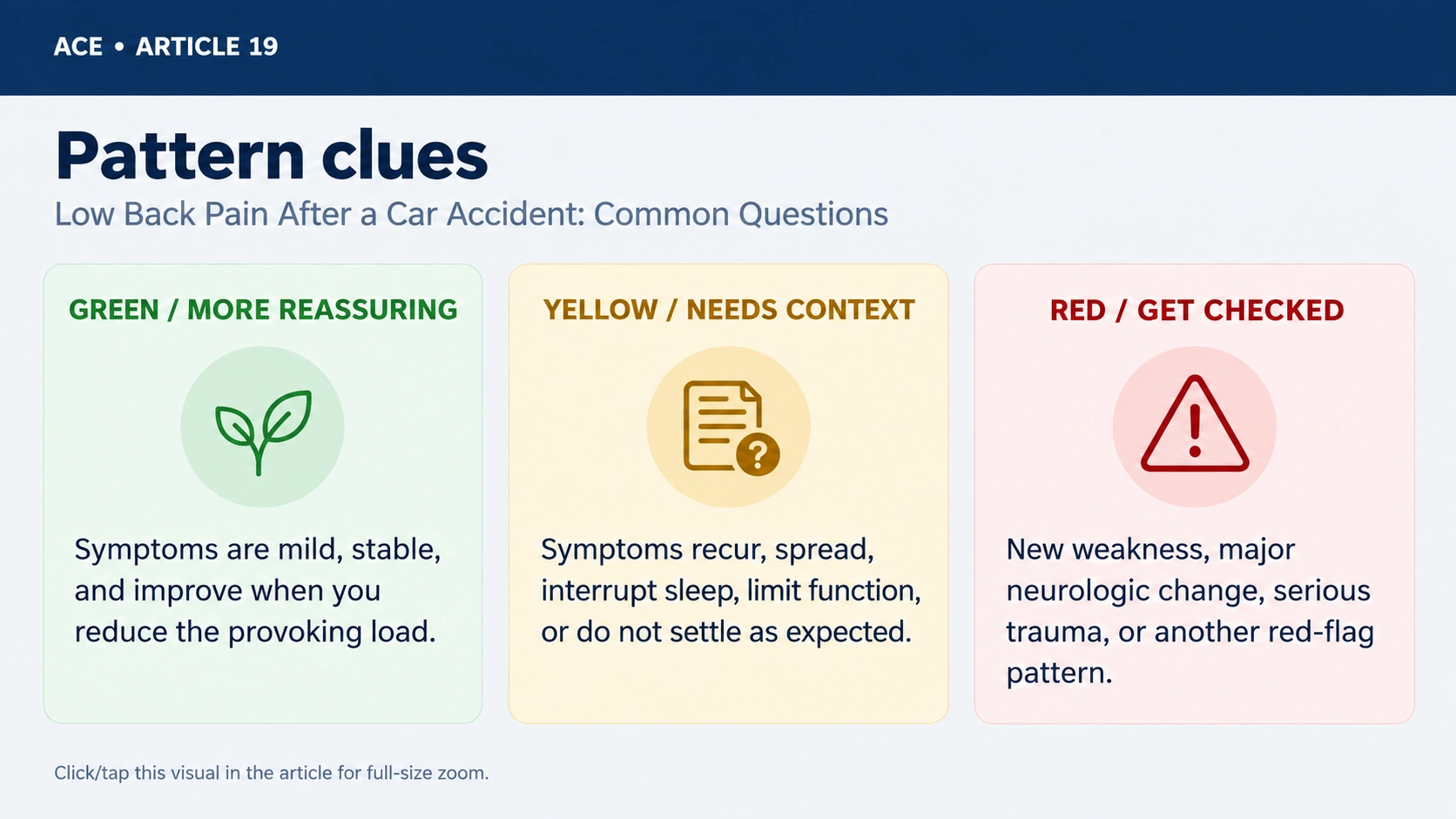
Yes, symptoms can evolve over the hours or days after a collision. Timing alone does not prove a specific injury, and delayed symptoms should not be used to dismiss a new problem or to claim a diagnosis.
ACE already has a separate article explaining why post-collision symptoms may be noticed later, so this article keeps the discussion brief rather than duplicating it.
How do I know whether it is a strain, a disc problem, a nerve problem, or something else?
You usually cannot determine that reliably from symptoms alone. Local aching and stiffness may occur with several musculoskeletal problems. Burning, electric pain, tingling, numbness, or weakness can raise concern for nerve involvement, but even those symptoms still need to be interpreted in context.
If symptoms travel into the leg, ACE already has dedicated guides that explain radiating pain and when numbness or tingling deserves prompt evaluation.
Which low-back symptoms after a collision need prompt medical attention?
Do not use an online article to self-clear a significant injury.
- new bowel or bladder dysfunction
- numbness in the saddle, groin, or inner-thigh region
- new or progressively worsening leg weakness
- major difficulty standing or walking after the crash
- severe or rapidly worsening back pain after significant trauma
- other major post-crash symptoms such as fainting, severe chest or abdominal pain, or rapidly changing neurologic symptoms
ACR guidance treats acute spinal trauma differently from uncomplicated low-back pain. For example, CT is generally appropriate in high-risk or unexaminable patients with acute thoracic or lumbar blunt trauma, and MRI can be appropriate when ligamentous, spinal cord, or nerve-root injury is suspected after trauma.
If neck pain is the main problem, ACE has a separate article focused on post-crash neck-pain warning signs so this low-back article does not repeat the same section.
What should I track before an evaluation?
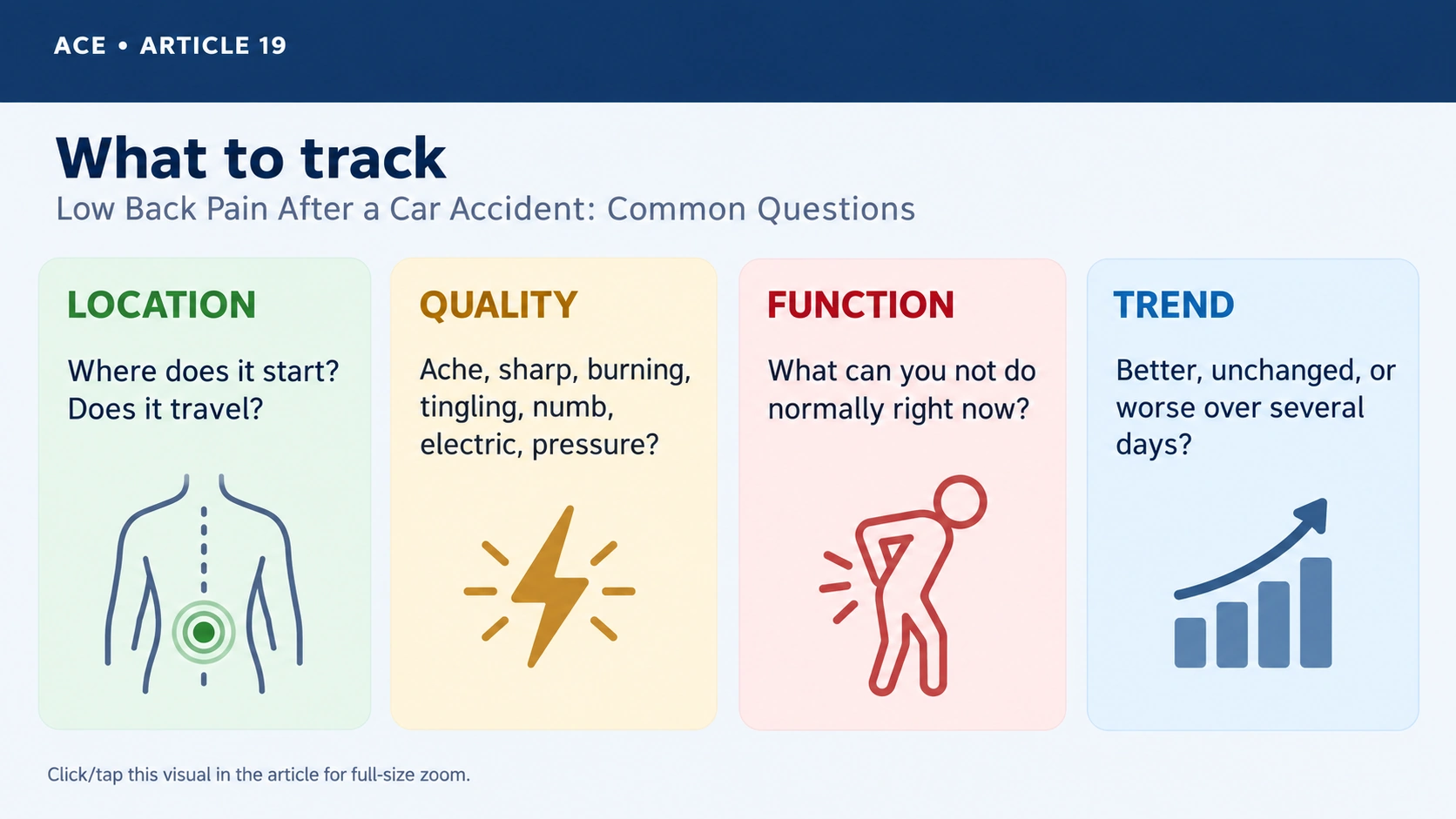
A short symptom-and-function log is more useful than repeatedly rating pain without context. Track:
- Location: center of the low back, one side, buttock, thigh, calf, or foot.
- Quality: ache, sharp, burning, electric, pressure, tingling, or numbness.
- Function: sitting tolerance, walking tolerance, getting in/out of the car, bending, lifting, sleep, work, and exercise.
- Trend: better, unchanged, or worse over several days.
- Neurologic change: new numbness, weakness, foot slapping, balance problems, or loss of coordination.
Do I need an X-ray, CT, or MRI?
Not every person with post-crash low-back pain needs the same test. The key point is that trauma changes the context.
For ordinary acute low-back pain without red flags, ACR rates routine initial lumbar imaging as usually not appropriate. But ACR’s acute-spinal-trauma criteria use a different pathway when the history or examination raises concern for fracture, spinal cord injury, ligament injury, or nerve-root injury.
The scan should answer a clinical question. Imaging should not be ordered automatically just because pain exists, but it also should not be dismissed when the trauma history or neurologic findings make it relevant.
Kept brief on purpose: ACE has a dedicated imaging article later in the editorial queue, so OPP-0019 only answers the common question without turning into a second imaging guide.
Should I rest until the pain is completely gone?
After a serious injury has been excluded and activity is medically appropriate, prolonged complete rest is usually not the goal for uncomplicated low-back pain. Major guidelines emphasize self-management and continued activity within the person’s capabilities.
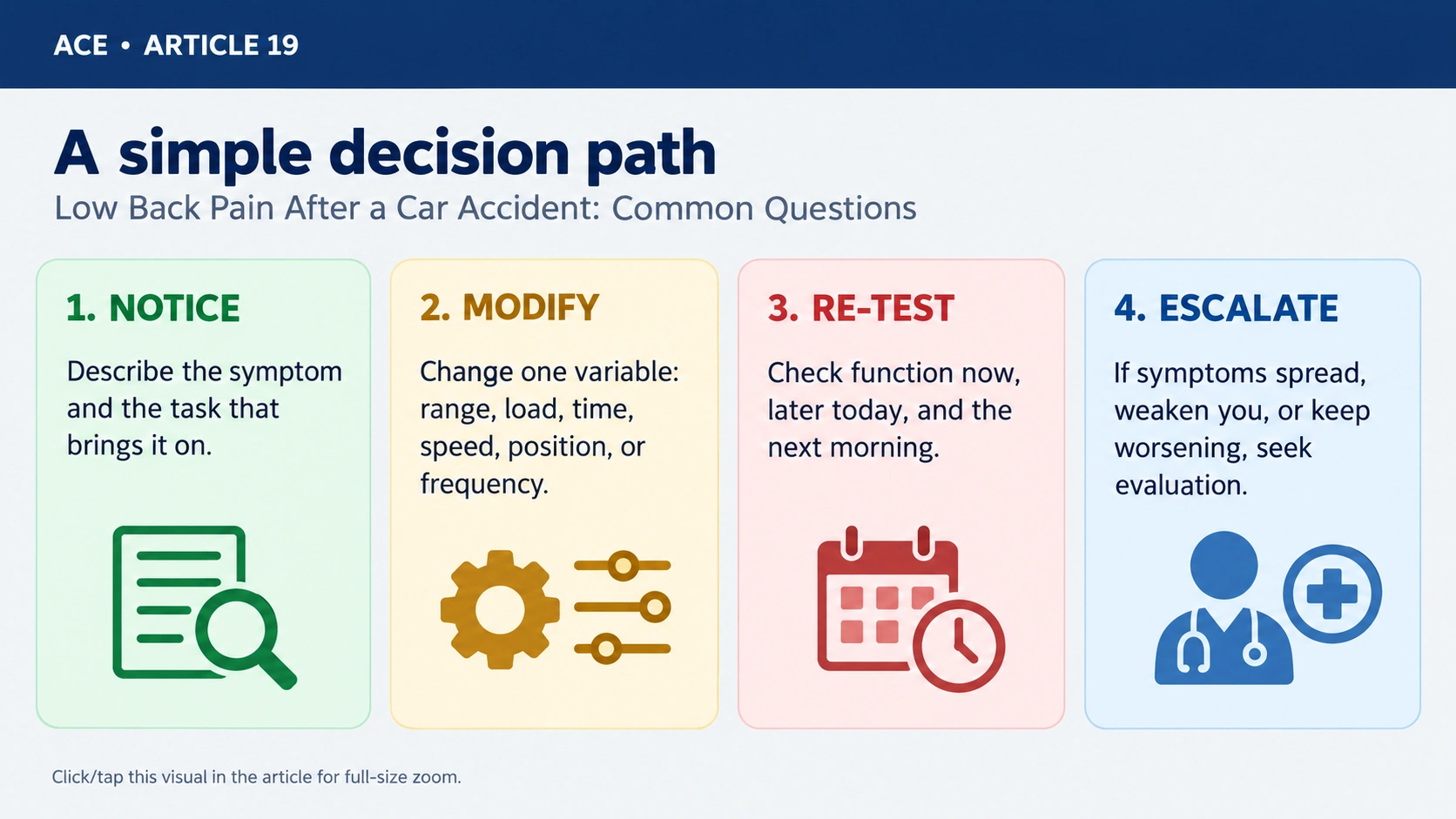
That does not mean forcing painful movement after an unassessed collision. Avoid aggressive self-manipulation, heavy loading, or repeatedly “testing” the injury when symptoms are clearly worsening. A safer approach is to use small, reversible changes and then reassess function.
What might a low-back evaluation after a car accident include?
The examination should match the complaint and the trauma history. Depending on the presentation, it may include:
- review of the collision mechanism and immediate versus delayed symptoms
- walking, transfers, range of motion, and task-specific function
- strength, reflexes, sensation, and other neurologic screening
- assessment of leg symptoms if pain travels below the low back
- palpation and musculoskeletal examination
- review of emergency-department records, imaging, medications, and prior back history
- a decision about whether additional medical referral or imaging is appropriate
A useful evaluation should explain what the findings suggest, what remains uncertain, and what would make the plan change.
What kinds of treatment may be considered?
This article does not repeat ACE’s full treatment article. Once urgent injury has been excluded, conservative care may include education, activity modification, progressive exercise or rehabilitation, manual care, acupuncture, physiotherapy, and coordination with other medical professionals when appropriate to the individual findings.
The important point is that treatment should follow the examination and the patient’s response—not a fixed “car accident protocol.”
What should I document after a crash?
For health care, document facts: when symptoms started, how they changed, which activities became difficult, visits and referrals, examination findings, imaging, treatment response, and meaningful functional changes. Medical records should describe care rather than try to predict a legal outcome.
ACE already has a separate article devoted to personal-injury medical documentation, so this article links to it instead of duplicating the checklist.
How long should low-back pain take to improve?
There is no reliable fixed recovery date that applies to everyone after a collision. The more useful question is whether function and symptom behavior are moving in the right direction.
Track meaningful markers such as sitting longer, walking farther, getting in and out of the car more easily, sleeping with fewer interruptions, tolerating work tasks, or needing less time for symptoms to settle after activity. If function is declining, neurologic symptoms are appearing, or the course is not matching expectations, reassessment is more useful than simply waiting for a calendar date.
Related ACE Learning Center articles
Need your low-back pattern evaluated after a collision?
ACE California Health Clinic provides chiropractic, acupuncture, physiotherapy, and rehabilitation care in Santa Clara and can coordinate referral or imaging when the clinical picture warrants it.
Frequently asked questions
Can low-back pain start the day after a car accident?
It can. Symptom timing alone does not identify the injury. Track the pattern and seek prompt evaluation if symptoms are severe, worsening, or neurologic.
Does leg pain mean I have a herniated disc?
Not necessarily. Leg symptoms can have several causes. The distribution, neurologic examination, functional changes, and sometimes imaging help clarify the pattern.
Do I automatically need an MRI after a crash?
No. Imaging depends on the trauma history, examination, neurologic findings, risk factors, and the clinical question the test would answer.
Should I stretch the low back right away?
Not aggressively after an unassessed significant trauma. Once serious injury has been excluded, movement can often be progressed according to tolerance and the clinical plan.
Should I keep a symptom diary?
A short function-focused log can help. Track where symptoms occur, what tasks provoke them, whether they travel, neurologic changes, and whether your tolerance for normal activities is improving.
References
- American College of Radiology — Appropriateness Criteria: Acute Spinal Trauma (revised 2024).
- American College of Radiology — Appropriateness Criteria: Low Back Pain.
- NICE — Low back pain and sciatica in over 16s: assessment and management.
- VA/DoD Clinical Practice Guideline — Diagnosis and Treatment of Low Back Pain (2022).
Medical disclaimer: This article is for general education. It is not a diagnosis, treatment prescription, emergency screening tool, or substitute for an examination by a qualified health professional. Significant trauma, rapidly worsening symptoms, or new neurologic findings require appropriate medical evaluation.