

Does your wrist ache when you lift a grocery bag, use a mouse, turn a doorknob or play pickleball? If the discomfort becomes more noticeable with repeated movement and settles when you rest, a wrist tendon may be involved. The location of the pain and the movement that reproduces it can help identify the source.
What is wrist tendinitis?
Tendons connect muscles to bones and transmit the force needed to move your wrist and fingers. When a tendon is irritated by a sudden or repeated load, it may become painful. Tendinitis describes inflammation; persistent tendon pain is often called tendinopathy, which can involve changes in tendon structure and load tolerance. Tenosynovitis refers to irritation of the surrounding tendon sheath. [1][2]
Where does wrist tendinitis hurt?
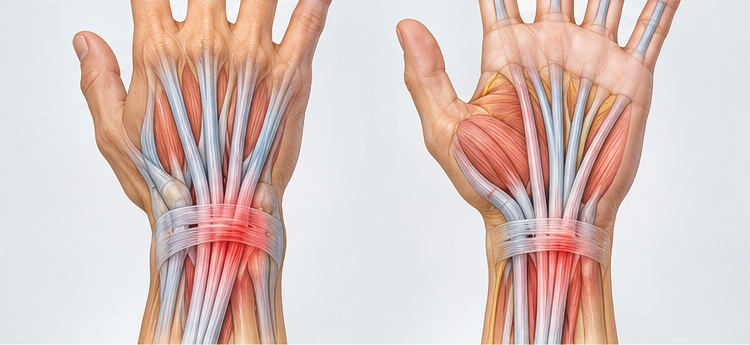
Extensor tendons: Pain on the back of the wrist may occur with lifting the hand upward, gripping or racquet sports. The extensor carpi ulnaris (ECU) tendon may cause pain on the little-finger side, especially with rotation.
Flexor tendons: Pain on the palm side may become noticeable when bending the wrist forward, lifting or gripping. Flexor carpi radialis and flexor carpi ulnaris are examples.
Pain on the thumb side may instead reflect De Quervain’s tenosynovitis (covered in Part 2) or another condition. Pain location alone does not establish the diagnosis. [1][2][3]
Common causes
Repeated gripping, lifting, tool use, typing or mouse work; a sudden increase in gym or sports activity; prolonged awkward wrist positions; or returning to strenuous activity before the wrist has recovered. The total amount of force, repetition and recovery time matters more than any single activity.
Common symptoms
Localized aching or tenderness along a tendon; discomfort with resisted wrist movement, gripping or lifting; stiffness after rest; occasional mild swelling; and reduced grip tolerance because of pain. Persistent tingling or numbness is less typical of isolated tendon irritation and deserves assessment.
How clinicians diagnose it
A clinician asks about the onset, recent workload, trauma, pain location and activities that reproduce symptoms. Examination may include palpation, active and passive motion, resisted wrist flexion and extension, grip testing, forearm rotation, and screening for nerve or ligament problems.
Imaging is not always needed. X-rays may help assess fracture or arthritis; ultrasound or MRI may be considered when tendon injury, instability or another soft-tissue problem is suspected, or when recovery is not progressing as expected.
Conditions that can mimic wrist tendinitis
| Condition | Common distinguishing clue |
|---|---|
| Carpal tunnel syndrome | Tingling or numbness, often at night, in thumb, index and middle fingers. |
| De Quervain’s tenosynovitis | Thumb-side pain with thumb movement or lifting. |
| TFCC injury / ECU instability | Little-finger-side pain, sometimes clicking with rotation. |
| Wrist arthritis | Joint-centered stiffness, swelling or restricted motion. |
| Ganglion cyst | A lump or focal pressure-related discomfort. |
| Sprain or fracture | Pain after trauma; focal bony tenderness or swelling. |
How chiropractic care may help
At ACE, care begins with identifying the painful structure and the movements that aggravate it. Gentle joint mobilization, soft-tissue techniques and movement assessment may help address associated stiffness and improve comfort. Treatment is selected according to the examination, not simply the location of pain.
Rehabilitation includes modifying aggravating loads, restoring comfortable wrist and forearm motion, and gradually rebuilding strength. Manual care can complement this process. A review of ECU tendinopathy in athletes describes conservative management incorporating activity modification, support, therapeutic exercise and manual therapy. [3]
How acupuncture may help
Acupuncture may be considered as an adjunct to help manage pain and associated muscle tension while you work toward comfortable movement and progressive exercise. A large analysis of randomized trials found benefits for several chronic pain conditions, including musculoskeletal pain. These findings are broader than wrist tendinitis specifically and do not establish that acupuncture repairs wrist tendons. [4]
Other non-surgical options
Relative rest from painful tasks, temporary wrist support when appropriate, cold or heat for comfort, and progressive therapeutic exercise are commonly considered. A clinician may recommend medication discussion with your primary care provider, or referral for hand therapy or further evaluation when needed.
What does a recovery plan look like?
A published review includes a clinical case involving an athlete with ECU tendinopathy, illustrating the role of individualized conservative rehabilitation. Case reports show how care may be organized, rather than predicting any individual patient’s outcome. [3]
The goal is not simply to reduce pain for a day. It is to help the wrist tolerate ordinary tasks again without repeated flare-ups.
Home care: start with a calmer wrist
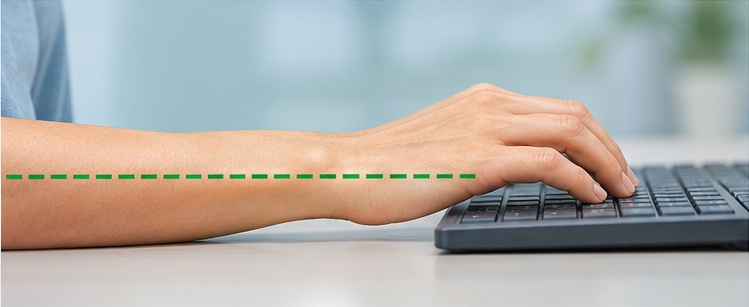
Keep the mouse and keyboard close, relax your grip, use short movement breaks, and avoid leaning heavily on the wrist. Reduce the intensity or duration of activities that repeatedly reproduce pain rather than stopping all movement indefinitely.
Gentle home rehabilitation
These examples are for mild, non-traumatic symptoms after serious injury has been excluded. Start slowly. Avoid sharp pain, numbness or increasing swelling; reduce the dose if symptoms are worse later that day or the next morning. [5][6]
1. Comfortable wrist range of motion
Rest your forearm on a table. Slowly bend the wrist up and down through a comfortable range without forcing the end positions. Start with 5–10 repetitions, once or twice daily.
2. Forearm rotation
Keep your elbow near your side, bent about 90 degrees. Slowly turn your palm upward and then downward. Start with 5–10 comfortable repetitions. Avoid painful clicking or catching.
Home rehabilitation: stretch and strengthen
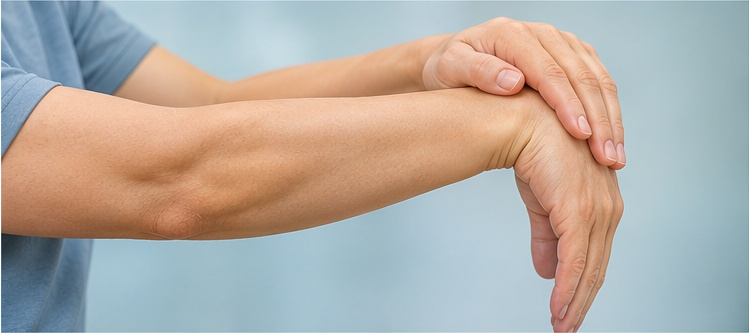
3. Gentle wrist extensor stretch
With your arm extended comfortably and palm facing down, use the opposite hand to gently bend the wrist downward until a mild stretch is felt along the back of the forearm. Hold 10–15 seconds; repeat twice if comfortable. Skip if it reproduces focal tendon pain.
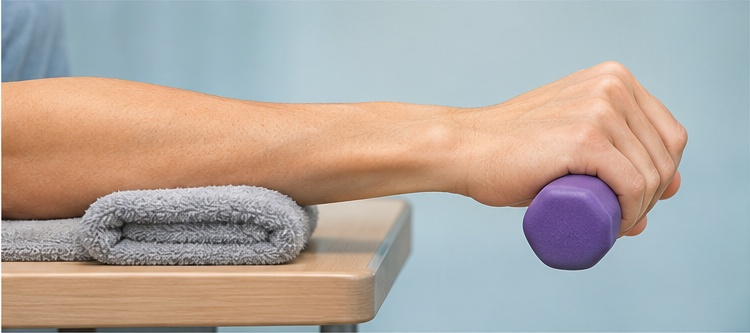
4. Gradual wrist extensor strengthening
Support your forearm on a table, palm down, with the hand beyond the edge. Begin without a weight; later use a very light weight if tolerated. Slowly lift the hand slightly and return to the starting position. Start with 5–8 repetitions every other day. A clinician can tailor loading to the affected tendon. [5][6]
When should you seek medical attention?
Seek urgent assessment after significant trauma, obvious deformity, severe swelling, inability to move the wrist, a sudden snap with loss of function, or a hot red wrist with fever. A cold, pale or blue hand or sudden major loss of sensation needs emergency assessment.
Arrange an evaluation for persistent or recurrent pain, numbness, tingling, progressive weakness, clicking with instability, or symptoms that interfere with work or sleep.
Key takeaway
Wrist pain from irritated tendons can interfere with everyday life, but a careful examination helps distinguish it from nerve, joint and ligament conditions. Combining appropriate activity changes with individualized rehabilitation, chiropractic care and acupuncture when indicated may support comfort and a gradual return to function.
The ACE Wrist Pain Series
- Part 1: Carpal Tunnel Syndrome
- Part 2: De Quervain’s Tenosynovitis
- Part 3: Wrist Tendinitis — this article
Need help with wrist pain in Santa Clara?
ACE California Health Clinic | John J. Lee, D.C., L.Ac.
345 Saratoga Ave, Santa Clara, CA 95050
(408) 984-6000 · ACECaHealth.com
Educational information only; not a substitute for individual diagnosis or treatment.
Clinical references
- American Physical Therapy Association. Physical Therapy Guide to Wrist Tendinitis. Reviewed June 26, 2024; revised July 19, 2024.
- Prasad N, LaPorte DM. Tendinitis Around the Wrist and Hand. Instr Course Lect. 2025;74:143–154. PMID: 39745557.
- McGrath E, et al. Extensor Carpi Ulnaris Tendinopathy in Athletes: A Review of the Conservative and Rehabilitative Options. J Hand Surg Glob Online. 2023. PMID: 36250572.
- Vickers AJ, Vertosick EA, Lewith G, et al. Acupuncture for Chronic Pain: Update of an Individual Patient Data Meta-Analysis. J Pain. 2018;19(5):455–474. doi:10.1016/j.jpain.2017.11.005.
- MyHealth Alberta. Wrist Tendinitis: Exercises. Current as of July 31, 2024.
- NHS inform. Exercises for wrist, hand and finger problems.